
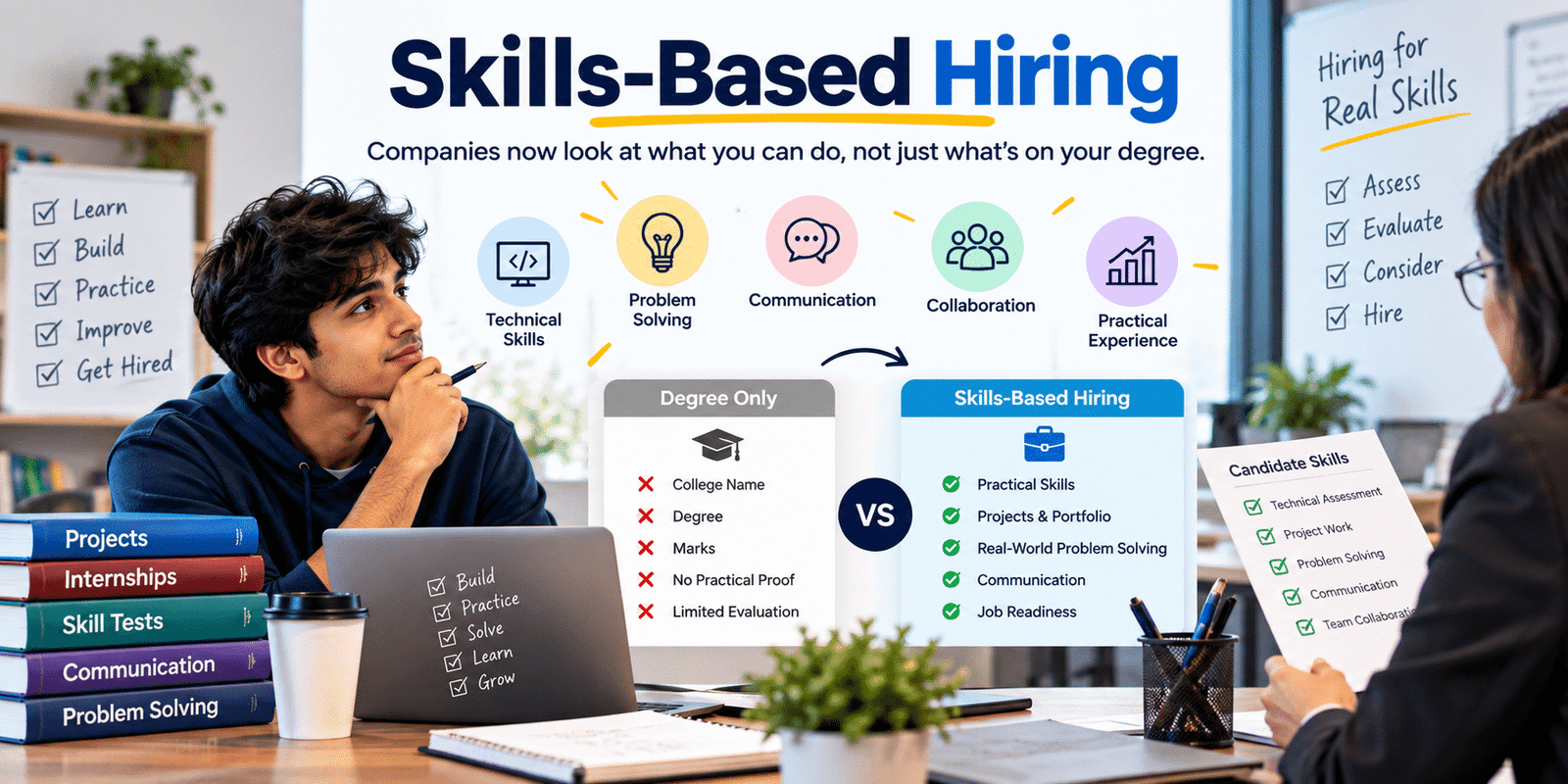
Skills-Based Hiring: Why Companies Are Looking Beyond Degrees
Focus Keyphrase: skills based hiring
SEO Title: Skills-Based Hiring: Why Companies Are Looking Beyond Degrees
Slug: skills-based-hiring
Meta Description: What is skills-based hiring? Learn why companies are focusing on practical skills, assessments, projects, and capabilities alongside traditional degrees.
What Is Skills-Based Hiring?
Skills-based hiring is an approach where employers focus more on what a candidate can actually do rather than relying only on their degree, college, or previous job title.
A degree can demonstrate that someone completed a particular course of study. However, it may not fully show whether that person can solve a business problem, use a technical tool, communicate with a team, or complete a real-world task.
Skills-based hiring looks at those capabilities more directly.
For students and freshers, this shift is important because it changes how they should prepare for the job market. Instead of focusing only on qualifications, students increasingly need to demonstrate practical skills through projects, internships, portfolios, assessments, and other forms of proof of work.
Why Are Companies Looking Beyond Degrees?
Traditional hiring often begins with qualifications.
A job description might ask for a particular degree, followed by technical skills and experience. But companies also need employees who can perform specific tasks after joining.
This has increased interest in skills-first approaches to recruitment.
The OECD’s research on skills-first hiring explains how employers can use information about candidates’ skills and practical assessments alongside traditional qualifications.
This does not mean degrees have become irrelevant. Instead, employers can use multiple signals to understand whether someone is suitable for a particular role.
How Is AI Changing the Hiring Process?
Artificial intelligence is changing how companies recruit, screen, and evaluate candidates.
Recruiters can now use AI-powered systems to process large numbers of applications, identify relevant skills, and assist with candidate screening.
At the same time, AI is changing the skills companies need.
For example, a technology graduate may no longer be evaluated only on whether they know a programming language. Employers may also want to understand whether the candidate can use AI tools responsibly, verify AI-generated output, solve unfamiliar problems, and work effectively with modern development tools.
This makes demonstrable ability increasingly important.
What Skills Are Employers Looking For in Freshers?
The exact requirements vary by role and industry, but students can expect a combination of technical and human skills.
Technical Skills
Depending on the career path, these might include:
- Programming
- Data analysis
- Cloud computing
- Cybersecurity
- Artificial intelligence
- Machine learning
- Database management
- Web development
- Software testing
- Digital tools
Human Skills
Technical knowledge is only one part of professional performance.
Employers may also look for:
- Communication
- Problem-solving
- Analytical thinking
- Teamwork
- Adaptability
- Time management
- Learning ability
- Decision-making
- Collaboration
Students can explore practical problem-solving skills for students and communication skills for students as part of their career preparation.
Why Are Practical Assessments Becoming Important?
A resume tells an employer what a candidate says they know.
A practical assessment gives the employer an opportunity to see how the candidate applies that knowledge.
For example, instead of simply asking a developer whether they know Python, a company could give them a programming problem.
Instead of asking a cybersecurity candidate whether they understand security concepts, an employer might provide a scenario and ask the candidate to identify potential risks.
Instead of asking a marketing candidate whether they understand analytics, a company might provide data and ask them to identify useful insights.
This approach can provide more direct evidence of practical capability.
Do Projects Matter in Skills-Based Hiring?
Projects can help students demonstrate skills before they have significant professional experience.
Consider two resumes.
The first says:
Python, SQL, Machine Learning
The second says:
Built a machine-learning model to classify customer complaints, cleaned a dataset using Python, evaluated model performance, and documented the results.
The second provides more context.
It gives an interviewer something specific to discuss and gives the student an opportunity to demonstrate what they actually learned.
Students can also build a professional portfolio to organize projects and other evidence of their abilities.
Why Proof of Work Matters
Skills are easier to evaluate when there is evidence behind them.
A certificate can show that a student completed a course.
A project can show how the student applied the knowledge.
An internship can show exposure to a professional environment.
A portfolio can bring different examples together.
This is why students should think beyond simply collecting qualifications.
A useful career-building process is:
Learn → Practice → Build → Document → Demonstrate
Students can learn more about this approach through Proof of Work for Students.
Are Degrees Becoming Less Important?
Skills-based hiring does not necessarily mean that degrees no longer matter.
Degrees can still provide evidence of structured education, subject knowledge, and persistence. Some professions also require specific educational qualifications or licenses.
The change is that a degree may increasingly be one part of the hiring decision rather than the entire decision.
For example, two candidates may have similar academic qualifications. Their practical projects, technical assessments, communication skills, internship experience, or problem-solving ability could provide additional information for an employer.
The relative importance of each factor depends on the role and organization.
What Does Skills-Based Hiring Mean for Students?
Students need to think about their education differently.
Instead of asking only:
“What certificate should I complete next?”
they can also ask:
“What can I build with what I have learned?”
That change can lead to more practical learning.
A student learning web development could build a website.
A cybersecurity student could create a security lab and document the findings.skills-based hiring
A data science student could analyze a public dataset.
An AI student could build an application using an AI model and explain its limitations.
The objective is to create evidence that connects learning with practical ability.
How Can Students Prepare for Skills-Based Hiring?
Students can start with a simple roadmap.
1. Choose Relevant Skills
Identify the skills required for the type of role you want.
2. Learn the Fundamentals
Do not rely entirely on short tutorials or certificates. Understand the concepts behind the tools you use.
3. Build Projects
Create projects that solve realistic problems rather than simply following tutorials.
4. Document Your Work
Explain what you built, why you built it, the challenges you encountered, and how you solved them.
5. Gain Practical Experience
Look for internships, freelance opportunities, hackathons, research projects, or open-source contributions.
6. Build Your Portfolio
Bring your strongest work together so employers can easily understand your capabilities.
7. Prepare for Practical Interviews
Be ready to explain your projects and solve problems without relying entirely on memorized answers.
Students preparing for technical roles can also use Technical Interview Preparation to strengthen their interview approach.
What Students Should Prepare for Skills-Based Hiring
A skills-focused resume should make it easy for recruiters to understand what a candidate can actually do.
Instead of creating a long list of technologies, students can connect skills with evidence.
For example:
Skill: Python
Evidence: Built a data-analysis project using Python and pandas.
Skill: SQL
Evidence: Designed queries to analyze customer transaction data.
Skill: Cybersecurity
Evidence: Created a home security lab and documented vulnerability-testing exercises.
This makes the resume more specific and easier to discuss during interviews.
Is Skills-Based Hiring Better for Students?
The impact can vary depending on the industry, employer, role, and candidate.
For students who have limited formal work experience, practical assessments and project evidence can provide additional ways to demonstrate their capabilities.
At the same time, academic qualifications remain relevant in many fields.
The important point is that students should not assume that one signal—whether a degree, certificate, or project—is enough to communicate everything an employer needs to know.
What Should Students Do Now?
Students do not need to wait until their final year to prepare for skills-based hiring.
They can start by choosing one career direction and identifying the skills associated with it.
Then they can gradually build evidence:
Skills → Projects → Experience → Portfolio → Proof of Work
This creates a stronger connection between what students learn and what they can demonstrate.
Final Takeaway
Skills-based hiring is changing the way employers can evaluate candidates.
Degrees and qualifications remain important, but employers can also look at practical skills, assessments, projects, experience, and other evidence of capability.
For students, the lesson is simple: do not just collect evidence that you have learned something. Build evidence that you can use it.
Learn the skill.
Practice it.
Build something.
Document it.
Then be prepared to explain it.
That approach can help students become more prepared for a job market where demonstrating practical capability is increasingly important.
Frequently Asked Questions
What is skills-based hiring?
Skills-based hiring is an approach where employers evaluate candidates based on the skills and capabilities relevant to a role, alongside or sometimes instead of relying solely on traditional qualifications.
Does skills-based hiring mean degrees are no longer useful?
No. Degrees remain important for many employers and professions. Skills-based hiring adds additional ways to evaluate whether candidates can perform the work.
How can students demonstrate their skills?
Students can demonstrate skills through projects, internships, portfolios, practical assessments, hackathons, research, open-source contributions, and other examples of completed work.
Are certificates useful for skills-based hiring?
Certificates can demonstrate learning, but they are stronger when supported by practical evidence showing how the student applied the knowledge.
How can freshers prepare for skills-based interviews?
Freshers should understand their projects deeply, practice role-specific problems, review fundamentals, and be prepared to explain their decisions and approach clearly.