Why Proof of Work for Students Matters
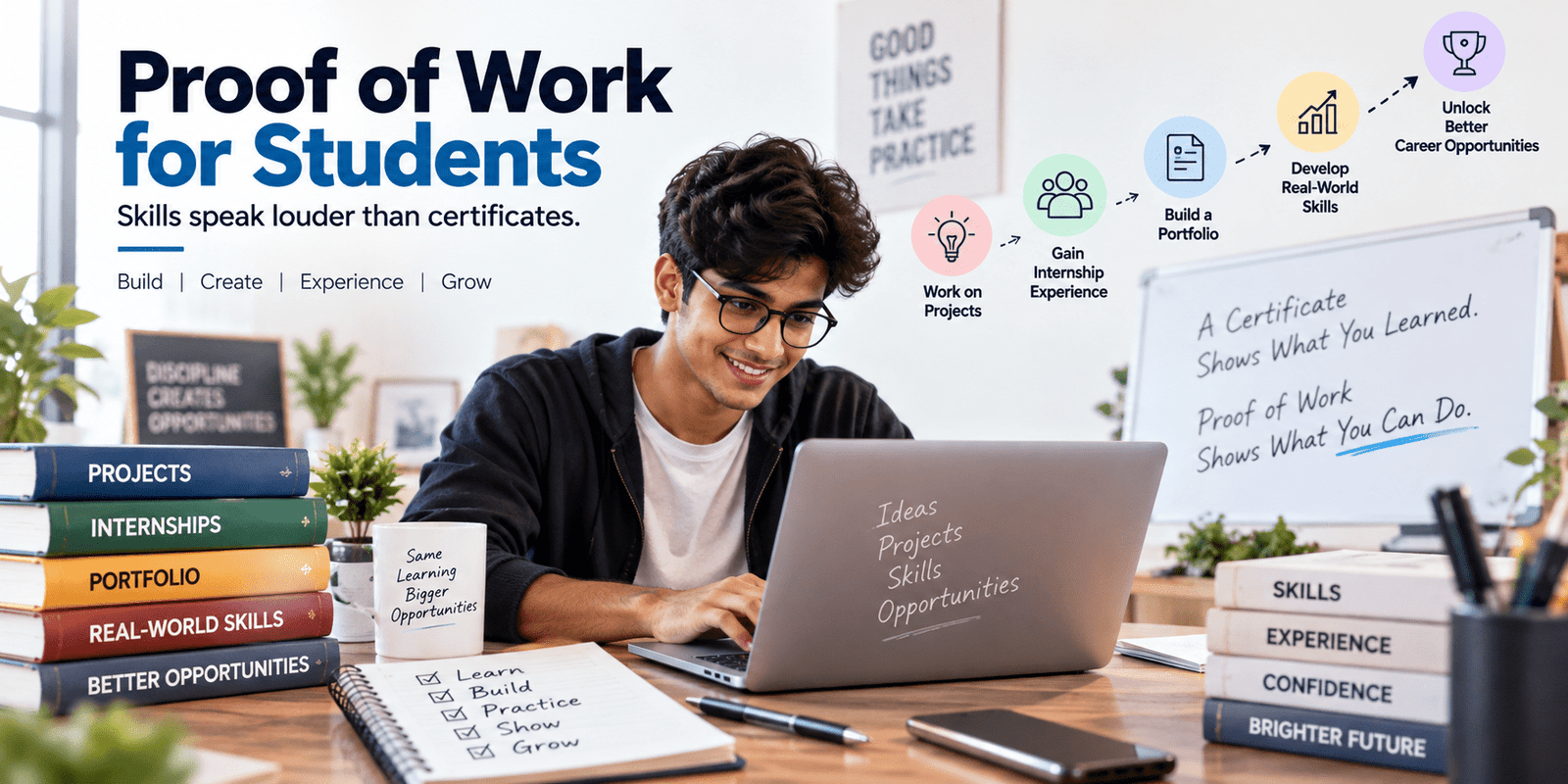
Proof of work for students can demonstrate practical skills in ways that certificates alone cannot. Projects, internships, research work, portfolios, and real-world assignments give students tangible evidence of what they have learned and what they can actually do..
Proof of work for students means having something practical that demonstrates their abilities. This could be a project, internship, research work, portfolio, GitHub repository, case study, prototype, presentation, or another meaningful work sample.
This idea is becoming increasingly relevant as education and employment systems place more attention on practical learning and demonstrable skills. A 2026 NITI Aayog working paper discusses the gap between educational credentials and job-relevant skills, while recent education policy updates emphasize project-based learning, internships, and industry interaction.
Certificates vs Proof of Practical Skills
A certificate can show that a student completed a course or training programme.
However, it may not answer questions such as:
- Can the student apply the knowledge?
- Can they solve a practical problem?
- Can they build something independently?
- Can they explain their decisions?
- Can they work with others?
- Can they handle unexpected challenges?
For example, a student may have a certificate in web development. That certificate shows that the student completed the course.
A working website, however, can demonstrate how the student actually used HTML, CSS, JavaScript, React, APIs, databases, or other technologies.
Students can also explore the Mercer India Graduate Skill Index to understand current employability and skill-readiness trends among Indian graduates.
Both can have value, but they communicate different things.
What Does Proof of Work Actually Mean?
Proof of work does not have to mean professional employment.
For a college student, it can include almost anything that provides credible evidence of practical learning.
Examples include:
- A software project
- A mobile application
- A data analysis project
- A research paper
- A design portfolio
- A business case study
- A hardware prototype
- An internship assignment
- A GitHub repository
- A technical presentation
- A community project
- A documented problem-solving case
The important part is not how impressive the project sounds.
It is whether the student understands the work and can explain what they did.
Why Projects Can Be Strong Evidence of Skills
Projects give students an opportunity to demonstrate the difference between knowing something and using it.
Suppose two students have completed the same programming course.
One student has only the course certificate.
The other student has built a small application, documented the process, fixed errors, and can explain the technical decisions involved.
The second student has more evidence that their learning has been applied.
Projects also give students opportunities to make mistakes. They may encounter bugs, change their approach, research unfamiliar concepts, or redesign part of their solution.
That process itself becomes valuable learning.
How Internships Help Students Demonstrate Experience
Internships can provide another form of proof of work because students get opportunities to apply their knowledge in a professional or workplace setting.
The AICTE National Internship Portal describes internships as a way to connect classroom theory with practical application and professional or community settings.
Students can explore the AICTE National Internship Portal to find internship opportunities that connect classroom learning with practical experience.
Students can potentially demonstrate:
- Tasks they completed
- Problems they worked on
- Tools they used
- Responsibilities they handled
- Team collaboration
- Communication
- Deliverables they contributed to
- Lessons they learned
Recent government initiatives have also expanded structured internship opportunities for eligible final-year students, with the stated aim of providing hands-on industry exposure before graduation.
However, students should focus on the actual learning and work performed, rather than simply collecting internship certificates.
Why Employers Want to See What Students Can Do
Employers need to understand whether candidates can apply their knowledge to real situations.
Deloitte India’s 2026 campus workforce study reports a growing shift toward skills-focused hiring and notes that employers are increasingly considering learning agility, adaptability, collaboration, and role-specific skills alongside technical capabilities.
Students can explore the World Economic Forum Future of Jobs Report to understand how employers’ skill requirements are changing.
This does not mean degrees or certificates have become useless.
Instead, students can think of them as different pieces of evidence.
A degree can demonstrate formal education.
A certificate can demonstrate additional learning.
A project can demonstrate application.
An internship can demonstrate workplace exposure.
A portfolio can bring that evidence together.
How Students Can Turn College Projects Into Proof of Work
Many students complete projects but do not present them effectively.
Instead of writing:
“Developed a web application.”
Building proof of work for students becomes easier when they consistently turn what they learn into practical projects and document their results.
Students can explain:
- What problem the application solves
- Who it was designed for
- Which technologies were used
- What their individual contribution was
- What challenges they encountered
- How they solved those challenges
- What they learned
- What could be improved
For example, instead of simply listing “Python project”, a student could document a Python-based data analysis project and explain the dataset, methodology, findings, limitations, and conclusions.
That creates much stronger evidence of learning.
Using GitHub, Portfolios, and Work Samples
Students in technical fields can use platforms such as GitHub to demonstrate their development work.
They can include:
- Well-organized repositories
- Project documentation
- README files
- Screenshots
- Setup instructions
- Technical explanations
- Commit history
- Demonstrations
Students from non-technical backgrounds can create different types of evidence.
A marketing student could showcase a campaign analysis.
A design student could present design projects.
A commerce student could demonstrate financial analysis.
A research student could document research work.
The goal is simple:
Technical students can use GitHub to showcase their projects, code, documentation, and development work as evidence of practical skills.
Show the work instead of only describing the skill.
What Students Can Show If They Have No Work Experience
Not having professional experience does not mean a student has nothing to demonstrate.
Students can start with academic and personal work.
For example:
Computer Science Student
Build a small web application or automation tool.
Mechanical Engineering Student
Create a CAD model, prototype, or engineering analysis.
Commerce Student
Prepare a financial analysis or business case study.
Design Student
Create a collection of design work with explanations.
Biotechnology Student
Document a research project or laboratory-based academic work.
Management Student
Analyse a business problem and present a structured solution.
The important thing is to choose work that genuinely represents the student’s abilities.
How Small Projects Can Create Career Opportunities
Students sometimes avoid projects because they think only large applications or complicated research projects are valuable.
That is not necessary.
A small project can still demonstrate:
- Initiative
- Curiosity
- Technical ability
- Research
- Problem-solving
- Communication
- Consistency
For example, a student could start with a simple application and gradually improve it.
The first version might solve one problem.
The next version could add authentication.
Later, the student could add an API, database, testing, deployment, and documentation.
The project becomes a record of learning and improvement.
Common Mistakes Students Make With Certificates
Certificates become less useful when students collect them without developing the underlying skill.
Some common mistakes include:
- Completing courses without practising
- Collecting certificates without projects
- Listing technologies they cannot explain
- Copying projects from tutorials
- Adding too many unrelated certifications to a resume
- Forgetting what they learned after completing a course
- Focusing on certificates instead of practical experience
The solution is not to stop earning certificates.
Instead, students can connect every important course with some form of practical application.
Learn something → practise it → build something → document it.
How to Build Proof of Work During College
Students can follow a simple cycle throughout college.
Step 1: Choose a Skill
Select one skill relevant to the student’s academic or career interests.
Step 2: Learn the Fundamentals
Use courses, books, documentation, classes, or other reliable resources.
Step 3: Build Something
Create a small project using the skill.
Step 4: Document the Process
Write down the problem, approach, tools, challenges, and results.
Step 5: Improve the Work
Ask for feedback and make improvements.
Step 6: Showcase It
Add the finished work to a portfolio, GitHub profile, resume, or relevant professional platform.
Step 7: Explain It
Practise explaining the project clearly in an interview.
This process turns passive learning into visible evidence.
A Simple Proof-of-Work Plan for Students
Students can start with one project rather than trying to build everything at once.
Month 1: Start by learning one relevant skill.
During Month 2, use that skill to build a small project
Next, in Month 3, improve the project and document what you have learned.
By Month 4, start another project or apply the skill through an internship.
In Month 5, create or improve your portfolio and add your best work.
Finally, during Month 6, practise explaining your work and use it when applying for opportunities.
By graduation, a student could have several meaningful examples of practical work instead of only a collection of certificates.
Why Documentation Makes Proof of Work Stronger
Building something is useful, but explaining it makes the evidence much clearer.
Students should document:
- The original problem
- Their approach
- Tools and technologies
- Challenges
- Solutions
- Results
- Mistakes
- Improvements
- Future possibilities
This also helps students prepare for interviews because recruiters may ask questions such as:
“Why did you choose this technology?”
“What problem did you face?”
“What would you change if you built it again?”
A student who has documented their work will usually have a clearer way to discuss these questions.
How Vyasa Nexus Can Help Students Build Practical Experience
Career preparation becomes more meaningful when students can connect learning with practical work.
Vyasa Nexus focuses on practical learning, projects, internships, career preparation, and skill development that can help students move beyond simply completing courses.
The goal is to help students understand what they learn, apply it through practical activities, and build evidence of their abilities before they graduate.
What Students Can Start Doing Today
Students do not need to wait until their final year.
They can start with one simple project.
Choose something related to your interests, build it, document it, improve it, and learn how to explain it.
Then repeat the process.
Over time, these small pieces of work can become a practical record of your development.
Final Thoughts: Show What You Can Do
Certificates can show that a student completed a learning programme.
But proof of work can show how that learning was applied.
Students should not think of certificates and practical experience as competing choices. Both can contribute to a strong career profile.
The bigger goal is to connect learning with action.
Learn the skill. Apply the skill. Build something. Document it. Show it.
That is how students can gradually turn their education into evidence of what they can actually do.
Internal Links
Students can understand how practical projects turn classroom knowledge into real skills through project-based learning.
Understanding the skills recruiters look for in freshers can help students choose projects and practical work that demonstrate relevant abilities.
Students can learn how to organize their projects, achievements, and practical experience through a professional portfolio for students.
Students can use their projects as examples when preparing for technical interviews, especially when explaining their skills and problem-solving approach