
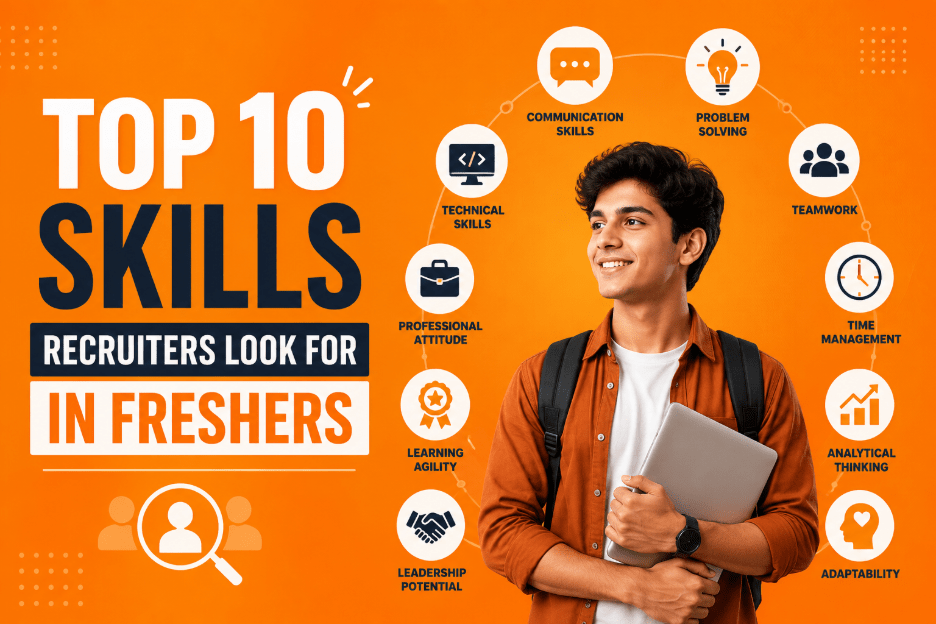
Every year, lakhs of students graduate. They walk out with a degree and a head full of theory.
Many are ready for the job market. But many are also surprised. A degree alone doesn’t open doors.
So, what skills do recruiters look for in freshers? In short: recruiters don’t hire marksheets. They hire people who can think, adapt, and get to work fast. This is true for campus placements. It’s true for off-campus drives too.
Here’s the simple truth: your CGPA gets you shortlisted. Your skills get you hired.
Below are the 10 skills recruiters look for in freshers, based on patterns that show up again and again in hiring panels. These are the skills that separate freshers who get the offer letter from those who don’t.
1. Communication Skills
This tops nearly every recruiter’s checklist. It’s not even close.
For example, a candidate who explains ideas clearly stands out. So does one who writes a proper email. Or holds a conversation without stumbling. As a result, this matters even if their technical knowledge is only average.
However, recruiters don’t want polished public speakers. Instead, they want freshers who can say what they mean, clearly. That could be in a group discussion. Or a one-on-one interview. Or a quick Slack message to a manager.
For instance, weak communication shows up fast in interviews:
- Rambling answers
- Unclear project explanations
- Trouble summarizing what you actually did
In contrast, strong communication looks different. Short answers. Clear structure. Straight to the point.
Tip: Practise talking about your projects out loud. Don’t just write them on your resume. Also, try recording yourself and listening back. It’s a fast way to catch filler words and fuzzy explanations.
2. Problem-Solving Ability
Employers don’t expect freshers to know everything on day one.
Instead, they expect something simpler: can you look at a problem, break it down, and work toward a fix? Can you do this instead of freezing up?
As a result, interviews are changing. Many companies now use case studies. Or puzzles. Or real business scenarios. So there are fewer bookish, textbook-style questions.
For example, think about times you’ve already done this:
- Debugged a piece of stubborn code
- Resolved a disagreement in a group project
- Found a workaround for a broken process during an internship
Each one is problem-solving in action.
Here’s the mistake most freshers make: they describe it vaguely. “I’m a good problem solver” tells a recruiter nothing. Instead, walk through it step by step. What was the problem? What did you try? What didn’t work? What finally did?
3. Adaptability and Willingness to Learn
Industries move fast. Therefore, what you studied in your final year may already be outdated by the time you join a company.
Because of this, recruiters weigh one thing heavily: are you willing to unlearn and relearn?
For instance, someone who stays curious tends to move up faster. So does someone who picks up new tools quickly. And someone who doesn’t resist change. This is true even if a more “technically strong” candidate is rigid.
That’s also why job postings now use phrases like:
- “Learning agility”
- “Growth mindset”
These sit right next to the usual technical requirements. So, recruiters read your resume for this trait, even when the job description doesn’t spell it out.
4. Basic Technical and Digital Literacy
Overall, you’re expected to know the digital tools your role needs.
| Field | Expected Tools |
|---|---|
| Commerce graduates | Excel, accounting software |
| Engineering graduates | Programming languages, design tools |
| Everyone else | AI tools, spreadsheets, Slack/Teams |
However, you don’t need to master everything. Just show you’re not scared of new software.
5. Teamwork and Collaboration
Very few jobs today involve working alone. This is true no matter how technical the job title sounds.
Specifically, recruiters want to know a few things:
- Can you work inside a team without creating friction?
- Do you share credit where it’s due?
- Do you pitch in when a teammate is struggling?
Therefore, group discussions and panel interviews are built to test exactly this. Often, how you answer matters more than what you answer.
For example, did you lead a college fest committee? Play a team sport? Work on a group assignment that got messy? Mention it. These stories show a recruiter how you actually behave in a team — far better than any single line on a resume.
6. Time Management and Organisation
Freshers who plan their day save managers a lot of trouble. Similarly, so do freshers who meet deadlines, or juggle more than one task at a time.
This skill gets overlooked a lot because it feels ordinary. But recruiters bring it up often. In fact, it’s frequently the line between an average hire and a strong one.
So, keep your examples simple and honest:
- Managing coursework alongside a part-time job
- Finishing an internship project ahead of schedule
Overall, small, real examples beat big, vague claims.
7. Analytical and Data-Oriented Thinking
Marketing. Finance. Operations. Across almost every sector, recruiters expect one thing: can you look at data and draw a sensible conclusion?
That said, you don’t need to be a data scientist. You just need to:
- Read a spreadsheet comfortably
- Spot a trend
- Ask the right questions about what the data means
Consequently, recruiters increasingly test this directly. A bit of hands-on practice with Excel or basic dashboards goes a long way.
8. AI and Automation Awareness
This is a newer skill. But it’s climbing the list fast.
Because freshers usually have less to unlearn than experienced professionals, companies now expect fresh graduates to already use AI tools for research, writing, or basic automation.
However, recruiters aren’t expecting AI expertise. Instead, they’re checking for something simpler: do you use these tools with judgment, not blind dependence?
For example, if you used an AI tool for a college project, be ready to explain two things: how it helped, and where you had to think for yourself.
9. Leadership Potential
Not every fresher needs to lead a team on day one. Still, recruiters do look for early signs of ownership:
- Did you take initiative in a group project instead of waiting to be told?
- Did you step up when something was going wrong?
As a result, these small signals matter more than a fancy title on a resume. They often come up in behavioural interview questions.
10. Emotional Intelligence and Self-Awareness
Recruiters watch how you react — to a tough question, to feedback, or to a story about a past failure.
For instance, someone who admits a mistake honestly leaves a strong impression. So does someone who explains what they learned and moves on without getting defensive. Generally, this lands better than someone trying to appear flawless.
Therefore, this trait is often tested with one simple question: “Tell me about a time you failed.”
In short, the story matters less than the delivery. Stay calm. Stay honest. That’s what recruiters remember.