
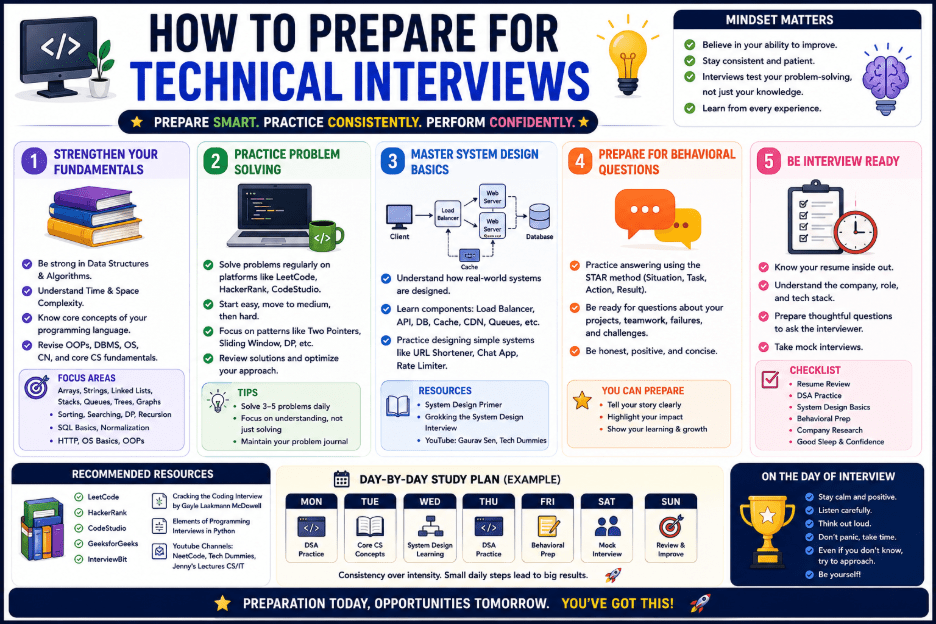
Here’s the readability-restructured version — new H2/H3s, a table, bolded key terms, and prose broken into scannable lists.
Technical Interviews Are a Learnable Skill, Not a Talent
Technical interviews make most engineers nervous, even the ones with years of experience behind them. The format is unusual — you solve problems out loud, in front of a stranger, on a whiteboard or shared code editor, while your mind races to remember syntax you use every day but suddenly can’t recall under pressure.
The good news: technical interview preparation is a learnable skill, not a talent you either have or don’t.
With the right plan, a candidate can walk into a coding interview, a system design interview, or a behavioral round and perform close to their actual ability, instead of freezing up.
This guide covers what to study, how to practice, and how to think about the weeks leading up to interview day — whether you’re preparing for a software engineer role at a large company or a startup.
Start With the Job Description, Not a Random List of Problems
A common mistake candidates make is opening a coding practice website and grinding through problems in no particular order. This wastes time.
Before touching a single problem, read the job description carefully and note the technologies, languages, and systems mentioned. A backend role heavy on distributed systems will test different things than a role focused on front-end or mobile engineering.
The Three Buckets of Preparation
| Bucket | What It Covers |
|---|---|
| Data structures & algorithms | Arrays, strings, hash maps, trees, graphs, recursion, sorting, searching |
| System design | Scalability, load balancing, caching, database sharding, API design |
| Behavioral & soft skills | Communication, conflict handling, describing past projects |
Most candidates over-invest in the first bucket and under-invest in the other two. All three show up at almost every company.
Build a Study Schedule You Can Actually Follow
Cramming the night before an interview rarely works for technical material — the brain needs repetition spread across days to move concepts into long-term memory.
A four to six week study schedule tends to work well for most people balancing a full-time job:
- Weeks 1–2: Review core data structures and algorithms. Rebuild arrays, linked lists, stacks, queues, trees, and hash tables from memory, without looking at notes first.
- Weeks 2–4: Move into practice problems on a coding platform, starting easy and working up to medium and hard. Time yourself the way a real interview would.
- Weeks 3–5: Add system design practice, even for entry-level roles — many companies now ask a lightweight design question regardless of seniority.
- Weeks 4–6: Run mock interviews with a friend, mentor, or peer, and record yourself explaining your thought process out loud.
Consistency matters more than intensity. Thirty focused minutes a day for six weeks beats a single eight-hour weekend session.
Practice Explaining Your Thinking Out Loud
Interviewers rarely care only about whether you reach the correct answer — they care about how you get there.
A candidate who talks through their approach, states assumptions, and asks clarifying questions is demonstrating exactly what they’ll do on the job when a problem is ambiguous.
Before writing any code:
- Restate the problem in your own words
- Ask about edge cases
- Mention your planned approach, including time and space complexity
Only after that should you start typing. This habit alone separates strong candidates from average ones — it shows structured thinking rather than guesswork.
Don’t Skip Behavioral Interview Preparation
Technical skill gets a candidate into the interview process, but poor communication or a lack of self-awareness can end it early. Behavioral questions usually follow a pattern:
- “Tell me about a time you disagreed with a teammate.”
- “Describe a project you’re proud of.”
- “Walk me through a mistake you made and what you learned.”
The STAR method — Situation, Task, Action, Result — remains a reliable way to structure these answers.
Write out five to seven stories from your work or school experience ahead of time, covering conflict, failure, leadership, and a technical challenge you solved. Practice telling them concisely.
A two-minute answer lands far better than a rambling five-minute one.
Review Company-Specific Interview Formats
Interview formats differ across companies, and a bit of research goes a long way. Some companies favor algorithm-heavy rounds, others lean on take-home assignments, and some run a single long loop covering coding, design, and culture fit in one sitting.
Before interview day, check:
- Recent interview experiences shared by other candidates
- The company’s engineering blog
- Their public tech stack
Mock Interviews Are Worth the Discomfort
Simulating the real thing is one of the highest-value things a candidate can do. Mock interviews expose gaps that silent, solo practice never will:
- Hesitation under time pressure
- Unclear explanations
- A habit of jumping into code too fast
Pair up with another engineer, trade practice interviews, or use a peer practice platform. Ask for direct, specific feedback rather than general encouragement.
Take Care of Yourself Before Interview Day
Sleep, food, and a calm mind affect performance as much as preparation does. Many candidates study late into the night before an interview and show up exhausted — undoing weeks of work.
- Aim for a full night of sleep
- Eat a normal meal
- Do a light review rather than a heavy cram session the day before
- Arrive a few minutes early — test your equipment ahead of time if it’s remote
Common Mistakes to Avoid
- Memorizing solutions instead of understanding the underlying pattern
- Staying silent while solving a problem, leaving the interviewer guessing
- Ignoring system design and soft skills while over-preparing for algorithms alone
- Not asking clarifying questions before diving into a solution
- Skipping practice under real time constraints
Final Thoughts
Preparing for a technical interview is less about being the smartest person in the room and more about being the most prepared one. A steady study schedule, regular mock interviews, comfort explaining your reasoning out loud, and attention to behavioral questions will put a candidate ahead of most others in the process.
Treat it as a skill to train, not a test to fear — and the entire experience becomes far more manageable.