
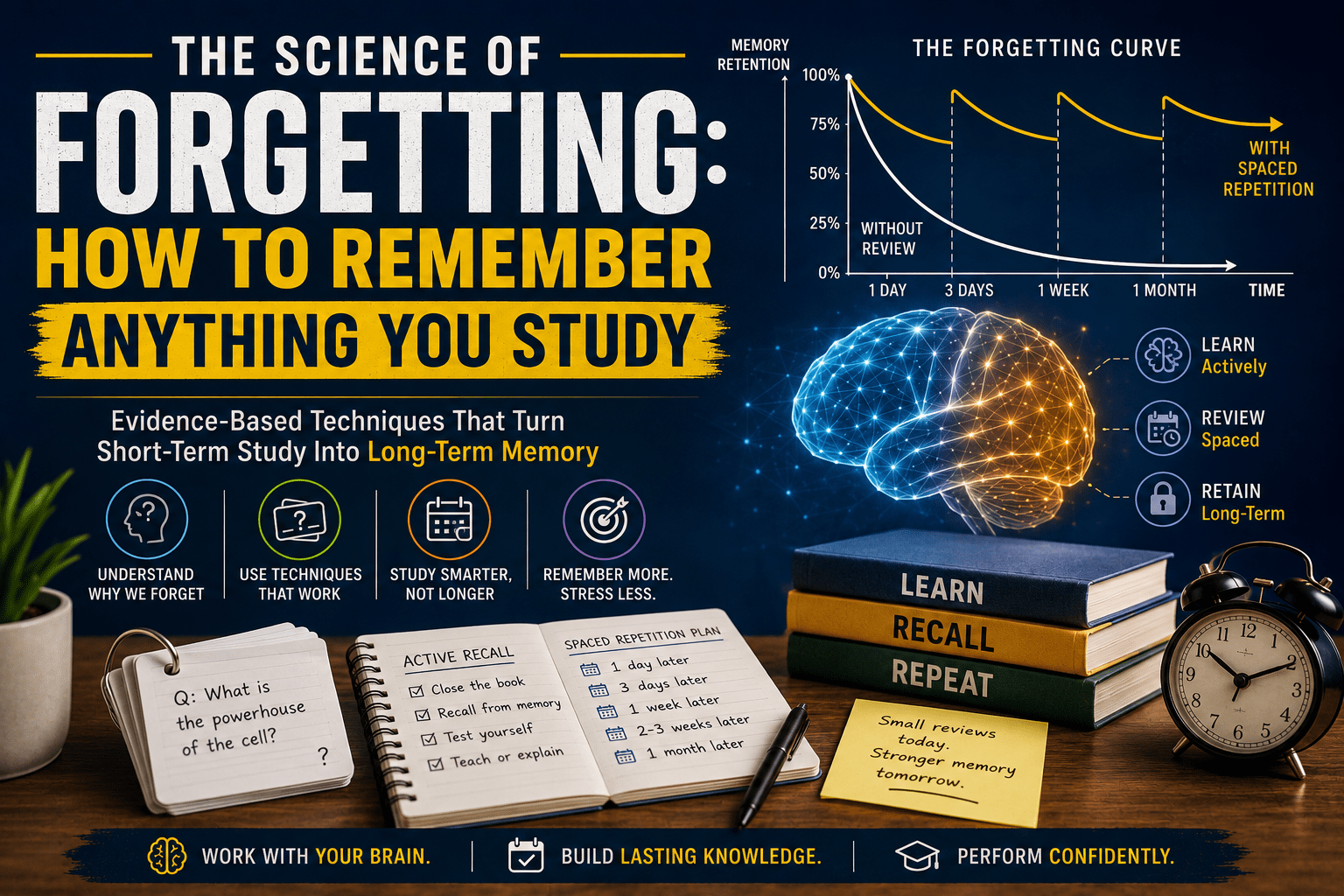
Most students think Science of Forgetting is a failure of memory. It isn’t. Science of Forgetting is memory working exactly as designed — the brain filters out information it decides isn’t worth keeping. The real problem isn’t that people forget. It’s that most study habits fight against the brain’s natural rules instead of working with active recall and spaced repetition, the two techniques cognitive Science of Forgetting shows actually work.
This guide covers the science behind why we forget, and the specific techniques that turn Science of Forgetting short-term cramming into long-term recall.
Why We Forget: The Forgetting Curve
In the 1880s, psychologist Hermann Ebbinghaus ran a series of memory experiments on himself and discovered something that still holds up today: without reinforcement, we forget the majority of new information within days.
This decline is known as the forgetting curve. It’s steepest right after learning something, then levels off over time. The good news is that the curve isn’t fixed — every time you review information at the right moment, the curve flattens, and the memory becomes more durable.
Key insight: The goal of studying isn’t to avoid forgetting. It’s to interrupt forgetting at the right moments.
The Two Techniques That Actually Work on Science of Forgetting
Decades of cognitive science research point to two techniques that outperform almost everything else students typically do: active recall and spaced repetition.
1. Active Recall: Science of Forgetting
Active recall means retrieving information from memory instead of passively reviewing it. Rereading a textbook chapter or highlighting notes feels productive, but it barely touches long-term memory. Pulling an answer out of your own head — through flashcards, practice questions, or simply closing the book and explaining a concept out loud — does.
How to practice active recall: Science of Forgetting
- Close your notes and write down everything you remember about a topic
- Use flashcards that ask questions rather than restate facts
- Teach the concept to someone else, or explain it to an empty room
- Take practice tests before you feel “ready”
2. Spaced Repetition
Spaced repetition means reviewing information at increasing intervals — a day later, then a few days later, then a week later, then a month later — instead of cramming it all at once. Each review resets the forgetting curve and pushes the memory further into long-term storage.
A simple spacing schedule:
| Review | Timing After First Study |
|---|---|
| 1st review | 1 day later |
| 2nd review | 3 days later |
| 3rd review | 1 week later |
| 4th review | 2–3 weeks later |
| 5th review | 1 month later |
Apps like Anki and Quizlet automate this schedule, but a simple calendar reminder works just as well.
Why Cramming Feels Effective — and Isn’t
Cramming produces a short-term illusion of mastery. Information sits in working memory long enough to survive a test the next morning, then disappears within days because it was never moved into long-term storage.
The difference:
- Cramming = short bursts of intense review right before a test
- Spaced study = shorter, spread-out sessions that force retrieval over time
Spaced study takes more discipline because it doesn’t produce the same immediate feeling of confidence. But it’s the version that survives past the exam.
Science of Forgetting: Other Techniques That Support Long-Term Memory
Interleaving
Instead of studying one topic for hours, switch between related topics or problem types within a single session. This forces your brain to actively identify which method or concept applies, which strengthens understanding.
Elaboration
Connect new information to something you already know. Asking “why is this true?” or “how does this relate to what I learned last week?” builds stronger memory pathways than memorizing a fact in isolation.
Sleep
Memory consolidation — the process of moving information from short-term to long-term storage — happens largely during sleep. A late-night cram session followed by four hours of sleep undermines the very process it’s trying to achieve.
Retrieval Under Mild Difficulty
Struggling slightly to recall something, rather than instantly re-reading the answer, strengthens the memory more than easy review does. This is sometimes called “desirable difficulty” — a bit of friction during practice strengthens memory.
A Sample Weekly Study Structure Using Active Recall and Spaced Repetition
- Monday: Learn new material; create flashcards or a self-quiz
- Tuesday: Quick active recall review of Monday’s material (10 minutes)
- Thursday: Second review of the same material, mixed with new content
- Following Monday: Third review, interleaved with other subjects
- End of month: Final cumulative review across everything studied that month
Common Mistakes That Undo Good Intentions
- Rereading and highlighting instead of testing yourself
- Studying one subject in one long block instead of spacing it out
- Reviewing material only right before a test, when it’s too late to reset the forgetting curve
- Treating sleep as optional during exam periods
- Avoiding practice questions because they feel harder than reviewing notes
Final Thoughts on Science of Forgetting
Forgetting isn’t a personal failing — it’s how the brain is built to work. The students who remember more aren’t smarter or more naturally gifted. They’ve simply learned to work with the forgetting curve instead of against it, using active recall and spaced repetition to turn short-term study into knowledge that lasts.
Internal Links
- Active Recall and Spaced Repetition: The Study Techniques That Actually Work
- Study Motivation: 12 Proven Tips for Long Study Sessions
- AI-Powered Learning: How Artificial Intelligence Is Transforming Education
- Best Note-Taking Methods for Students
- Effective Time Management Strategies for Students
- How to Build Better Study Habits
- The Future of Personalized Learning with AI