
There’s a particular kind of tired that has nothing to do with sleep. You wake up after eight hours in bed and still feel foggy, distracted, and strangely on edge before you’ve even checked your phone. Once you do check it, that feeling only gets worse.
This is the quiet cost of constant connectivity — and it’s exactly why a digital detox has moved from wellness trend to genuine necessity for millions of people.
A digital detox simply means stepping away from screens, notifications, and the endless scroll for a set period of time, so your brain gets a real chance to rest.
It’s not about rejecting technology altogether. It’s about giving your mind the breaks it was never designed to go without.
What Constant Screen Time Actually Does to Your Brain
Every notification, every red badge, every auto-playing video is competing for the same limited resource: your attention. Neuroscientists have long pointed out that the brain’s reward system releases small hits of dopamine every time we get a like, a message, or a new piece of information. That’s not an accident — apps are built this way on purpose.
The problem is that this steady drip of stimulation trains the brain to expect novelty at all times. Over time, ordinary moments — a quiet commute, a meal with no screen nearby, waiting in line — start to feel unbearably boring. This is sometimes called attention fragmentation, and it shows up as trouble focusing, shorter patience, and a nagging sense of restlessness even when nothing is actually wrong.
Chronic screen use has also been linked to:
- Poor sleep quality — blue light exposure at night interferes with melatonin production (research on light and sleep)
- Higher anxiety and stress — particularly tied to social media comparison and the pressure to always be reachable
None of this means screens are evil. It means the brain needs downtime it isn’t currently getting.
Signs You Might Need a Digital Detox
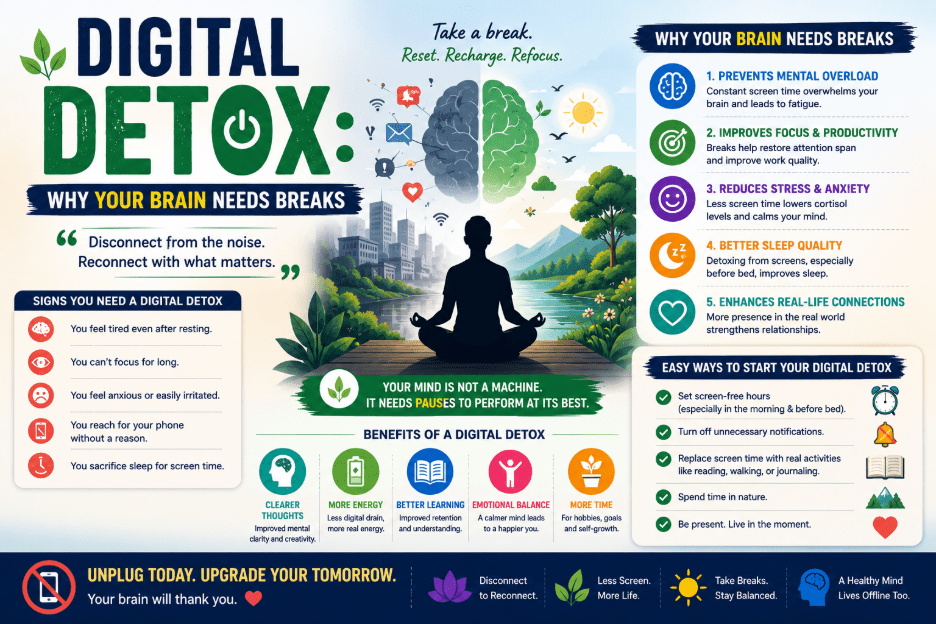
Not everyone needs to unplug for a month in the woods. But certain patterns are worth paying attention to:
- You reach for your phone the moment you feel bored, even for three seconds
- You check email or messages first thing in the morning, before you’ve gotten out of bed
- You feel a flash of anxiety when your phone battery is low or you can’t find it
- Screen time reports leave you feeling a little ashamed
- You struggle to sit through a meal, a film, or a conversation without glancing at a device
If two or three of these sound familiar, that’s a fairly ordinary signal your brain could use a break — not a personal failing.
Why the Brain Needs Rest Just Like the Body Does
We accept without question that muscles need recovery days after exercise. The brain works on a similar principle.
Periods of quiet, unstimulated time allow the default mode network — a set of brain regions active when we’re not focused on a specific task — to do its work. This network is tied to memory consolidation, self-reflection, and creative problem-solving.
In plain terms, some of your best ideas and clearest thinking happen when you’re doing nothing in particular: walking without headphones, staring out a train window, washing dishes. Constant digital input crowds out this kind of mental idle time almost completely, which is one reason people report feeling more creative and clear-headed after even a short digital detox.
How to Start a Digital Detox Without Overhauling Your Life
A digital detox doesn’t have to mean deleting every app or buying a flip phone. Small, consistent changes tend to stick better than dramatic ones.
| Strategy | What It Looks Like |
|---|---|
| Device-free mornings | No screen for the first 30 minutes after waking |
| Boundaries around meals | Phone in another room during breakfast, lunch, dinner |
| Built-in screen time tools | Use app limits and turn off non-essential notifications |
| Weekly offline block | 2–3 hours fully offline — read, cook, walk, sit with your thoughts |
| Digital detox retreat | A structured, guided reset for a more complete break |
| Reintroduce boredom | Let a few minutes of nothing go unfilled |
Benefits of a Regular Digital Detox
People who commit to regular digital detox habits, even modest ones, tend to report a handful of consistent benefits:
- Better sleep
- Longer attention spans
- Reduced anxiety
- Improved mood and mental clarity
Relationships often improve too, simply because presence is contagious. When one person puts the phone away, others tend to follow.
Final Thoughts
None of this requires technology to become the enemy. Phones, apps, and constant connection are woven into modern life for good reason, and there’s no realistic case for abandoning them.
That’s the real purpose of a digital detox — not punishment, but balance.
Your brain runs better with breaks, the same way your body runs better with rest, and building small pockets of quiet into each day is one of the simplest forms of self-care available to anyone with a few minutes to spare.