
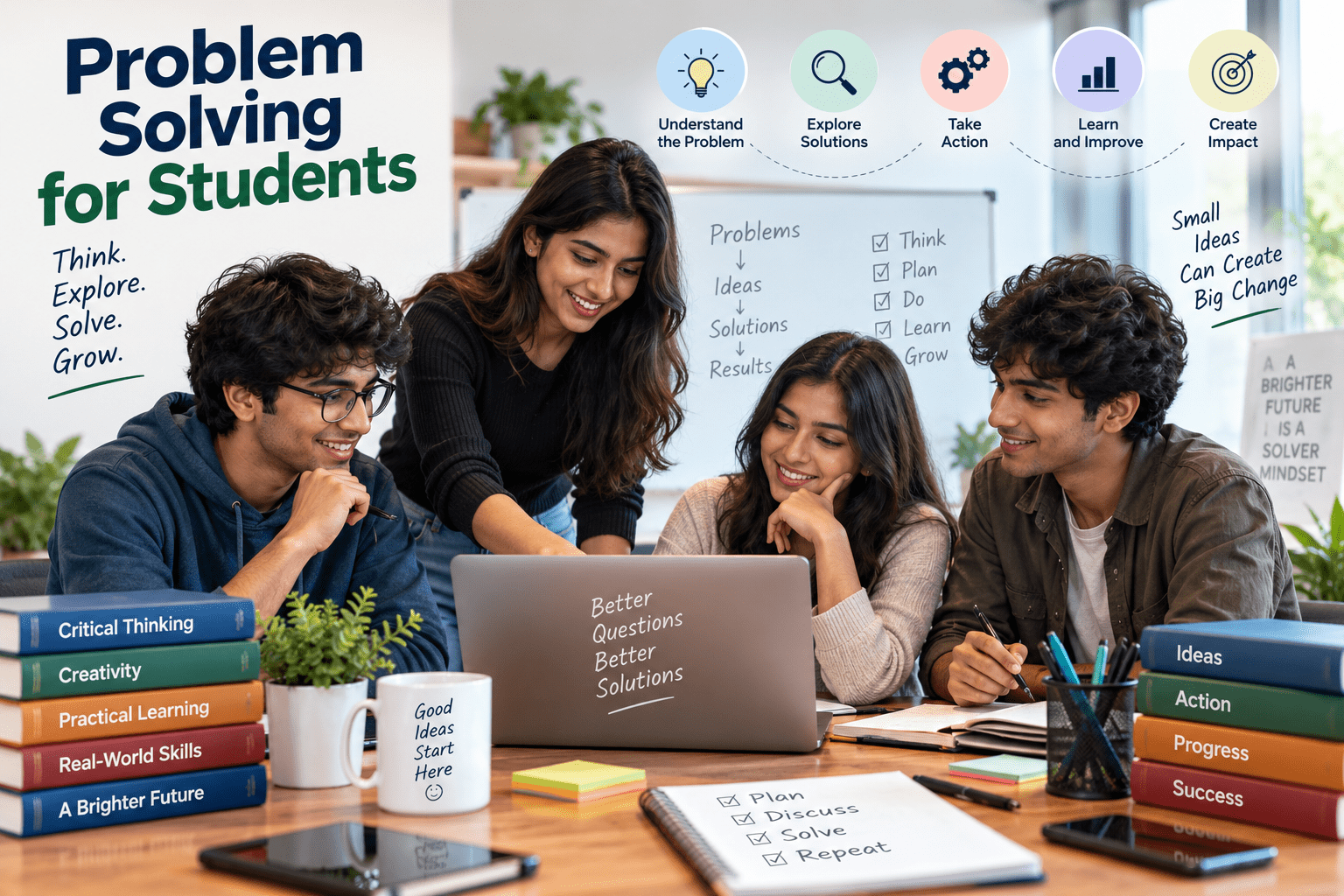
Problem solving for students is an important part of meaningful education. Students need more than the ability to remember information; they also need to understand challenges, think independently, explore solutions, and apply their knowledge to real situations.
Problem-solving skills for students can help them become more independent learners, confident decision-makers, and practical thinkers who are prepared to handle situations where there is no single ready-made answer.
How Problem Solving for Students Builds Independent Thinking
Problem-solving is not limited to technical subjects. Students use it when managing deadlines, working on group projects, understanding difficult concepts, making career decisions, and handling unexpected challenges.
A student who can break a difficult situation into smaller parts and approach it logically is better prepared to handle uncertainty.
The goal is not always to find an immediate answer. It is to develop the ability to understand the situation and determine the best possible way forward.
Memorization vs Understanding: What Is More Valuable?
Memorization can help students remember formulas, definitions, concepts, and important information. However, simply remembering something does not always mean that a student understands how to use it.
For example, a student may memorize a programming concept but struggle when asked to use it in a project. Understanding the concept allows the student to adapt it to a new situation.
Strong learning combines knowledge with understanding and application.
Why Real Problems Do Not Have Ready-Made Answers
Academic questions often have clearly defined answers. Real-world problems are usually different.
A project may have incomplete information. A customer may change their requirements. A technical issue may have several possible causes. A team may disagree about the best approach.
Students need to learn how to work through these situations rather than expect every problem to have an answer they can simply memorize.
How Problem-Solving Develops Independent Thinking
Problem-solving encourages students to think for themselves.
Instead of immediately asking someone else for the solution, students can first try to understand the problem, research possible approaches, compare alternatives, and test their ideas.
This process develops independence and helps students become more comfortable with challenging situations.
The Role of Practical Learning in Problem-Solving
Practical learning creates opportunities for students to apply their knowledge.
Projects, internships, workshops, experiments, and real-world assignments can require students to make decisions and adapt when their first approach does not work.
These experiences can teach students an important lesson: a problem is not always solved on the first attempt.
How Projects Help Students Become Better Problem-Solvers
A good project is more than something students add to their resumes. It can become an environment for learning how to solve problems.
Students may need to understand requirements, divide a large task into smaller parts, research unfamiliar topics, test their work, identify errors, and improve their solution.
For example, a student developing a web application may discover that the original design does not work well for users. Instead of simply completing the assignment, the student can collect feedback and improve the design.
That process develops practical problem-solving ability.
Learning From Failed Attempts
Failure is often treated negatively in academic environments, but unsuccessful attempts can provide useful information.
If a project does not work, students can ask:
- What went wrong?
- Which assumption was incorrect?
- What could I change?
- What did I learn?
- What should I try next?
This approach turns mistakes into feedback.
Students who learn from unsuccessful attempts can become more resilient and willing to experiment.
Problem-Solving Skills in Internships and Careers
Workplaces frequently present problems that students have never encountered before.
An intern may receive an unfamiliar task and need to research the technology before beginning. A new employee may discover an issue in an existing process. A team may need to find a better way to complete a task.
Employers therefore value people who can understand problems, ask useful questions, collaborate with others, and work toward solutions.
Technical knowledge remains important, but the ability to apply that knowledge can make a significant difference.
How Technology Can Support Better Problem-Solving
Technology provides students with many resources for researching and testing ideas.
Students can use documentation, online learning platforms, development tools, simulations, data analysis tools, and AI-assisted tools to explore possible solutions.
However, technology should support thinking rather than replace it.
Students should still understand the problem, verify information, evaluate possible solutions, and take responsibility for the decisions they make.
How Students Can Practice Problem-Solving Every Day
Students can develop problem-solving ability through simple activities.
They can:
- Work on practical projects.
- Solve coding or logical problems.
- Participate in competitions and hackathons.
- Analyse real-world situations.
- Take apart complex tasks and solve them step by step.
- Try different approaches when one method fails.
- Discuss problems with classmates and compare solutions.
- Reflect on what worked and what did not.
Regular practice can make problem-solving a natural part of learning.
Using Problem-Solving Skills to Create Social Impact
Problem-solving can also help students contribute to society.
A student might identify a difficulty faced by a local community, educational institution, small business, or student group and explore ways to address it.
The solution does not need to be large or complicated. A simple improvement that saves time, makes information easier to access, or helps people complete a task can create meaningful value.
When students learn to look at problems from the perspective of the people affected by them, their education can become more purposeful.
How Vyasa Nexus Encourages Practical Problem-Solving
At Vyasa Nexus, learning can go beyond simply understanding concepts. Students can connect their learning with practical projects, real-world challenges, internships, and career preparation.
This approach encourages students to ask questions, experiment with ideas, develop useful skills, and understand how knowledge can be applied outside the classroom.
The objective is not only to help students know more, but also to help them think better and apply what they know.
Final Thoughts: Learn to Think, Not Just Remember
Memorization can help students build a foundation of knowledge. However, knowledge becomes more valuable when students know how to apply it.
Problem-solving skills for students can help them approach unfamiliar situations with curiosity, logic, and confidence. These abilities can support them throughout education, careers, and everyday life.
Students should not be afraid of problems they cannot immediately solve. Instead, they can learn to ask better questions, explore different approaches, learn from mistakes, and keep improving.
Don’t just learn the answer. Learn how to find the solution.
Internal Links
Practical projects help students apply their knowledge while developing problem-solving abilities.
Understanding the skills employers value can help students prepare for professional challenges.
Students can improve their ability to approach technical problems through structured interview preparation.
Effective learning strategies can help students understand and retain concepts more effectively.
Outbound Links
The report provides insights into the skills and capabilities becoming important in the changing workplace.
Mercer’s research provides insights into graduate employability and skills valued by employers.