
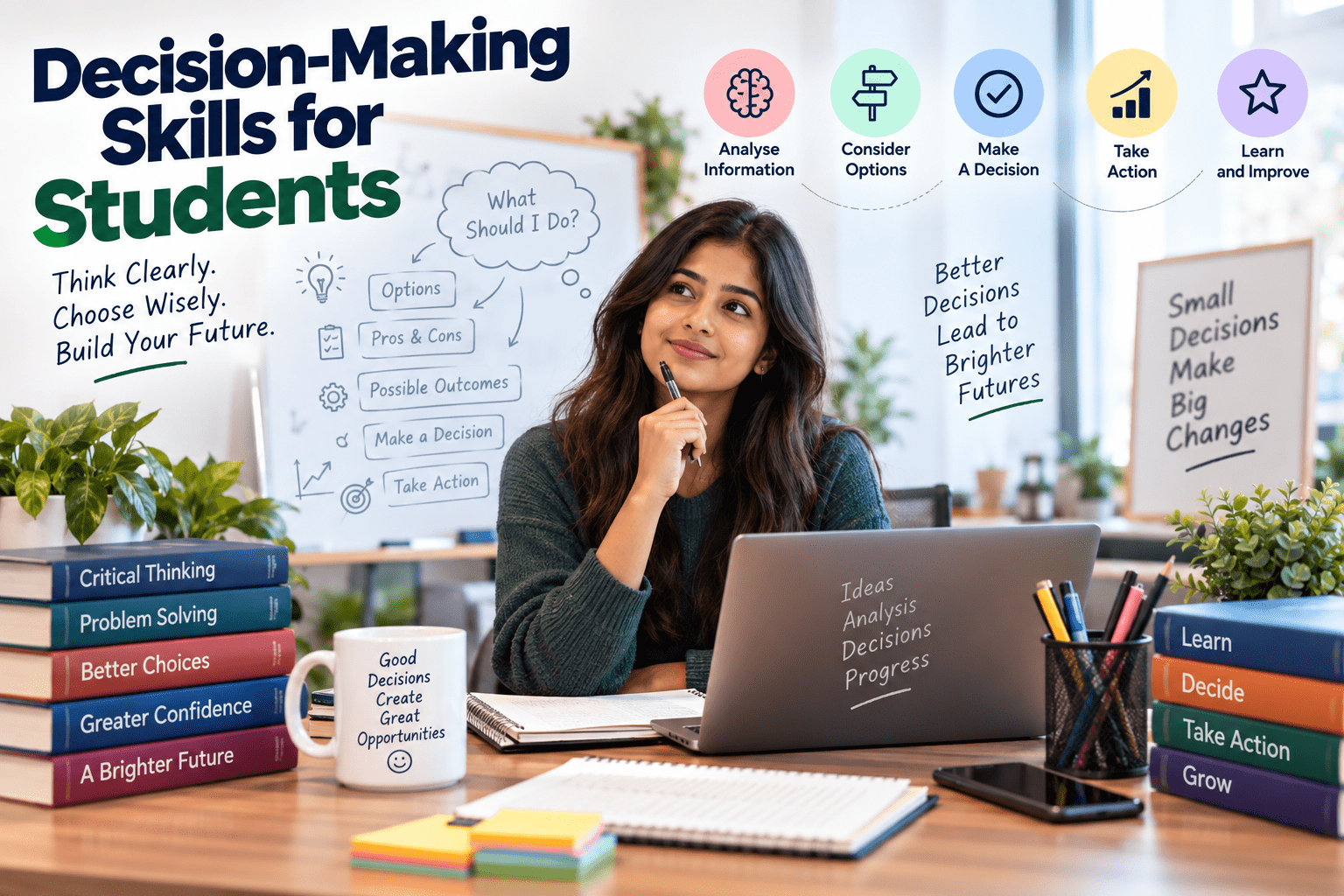
Students spend much of their academic life following instructions. They attend classes, complete assignments, prepare for exams, and follow project requirements. While following instructions is important, education should also help students develop the ability to think independently, evaluate choices, and make responsible decisions.
Decision-making skills for students can help them become more confident learners, responsible professionals, and capable individuals who can handle situations where there is no single correct answer.
Why Decision-Making Skills for Students Matter
Every student makes decisions every day. Which subject should I focus on? Which skill should I learn? Should I join this project? How should I approach a difficult assignment?
These choices may seem small, but learning how to make thoughtful decisions can prepare students for more complex situations in higher education, internships, careers, and personal life.
Good decision-making is not about always making the perfect choice. It is about understanding the situation, considering the available options, and taking responsibility for the choice.
Following Instructions vs Thinking Independently
Instructions provide direction, especially when students are learning something new. However, professional and real-world situations often do not come with step-by-step instructions.
A student may be given a project requirement but need to decide how to build the solution. An intern may receive a problem without knowing exactly which approach to take.
Students who learn to think beyond instructions can become more comfortable handling these situations.
Why Students Need to Make Their Own Choices
Students eventually have to make important choices about their education and careers.
They may need to decide which skills to develop, which projects to pursue, what opportunities to accept, or which career direction interests them.
Learning how to evaluate these choices can help students make decisions based on their interests, strengths, goals, and available information rather than simply following what everyone else is doing.
How Decision-Making Builds Responsibility
Every decision has consequences.
When students make choices and experience the results, they learn to take responsibility for their actions. A decision that produces a good result can show them what worked. A poor result can provide an opportunity to understand what could have been done differently.
This process can gradually develop maturity and accountability.
Learning to Make Decisions With Limited Information
Students may sometimes expect to have all the information before making a decision. In real situations, that is not always possible.
For example, a student choosing an internship may not know exactly what the experience will be like. They can research the organization, understand the role, ask questions, and then make the best decision based on the information available.
Learning to make reasonable decisions with incomplete information is an important part of becoming independent.
How Projects Develop Decision-Making Skills
Practical projects provide students with opportunities to make decisions.
Students may need to choose technologies, divide responsibilities, design a solution, manage time, prioritize features, or decide how to respond when something does not work.
These decisions make projects more than academic assignments. They become opportunities to practice thinking and responsibility.
Decision-Making in Internships and the Workplace
Workplaces often require employees to make decisions within their responsibilities.
An intern might need to determine how to investigate a technical issue before asking for help. A team member may need to prioritize tasks when several requirements have the same deadline.
Students who have already practiced making decisions through projects, teamwork, and practical experiences may find these situations easier to approach.
Learning From the Decisions That Do Not Work
Not every decision will produce the expected result.
Instead of treating an unsuccessful decision as a complete failure, students can analyse what happened.
They can ask:
- What information did I have?
- What assumptions did I make?
- What options did I consider?
- What could I have done differently?
- What did I learn from the result?
This reflection can turn an unsuccessful decision into a valuable learning experience.
How Students Can Improve Their Decision-Making
Students can develop better decision-making habits through regular practice.
Before making an important choice, they can:
- Clearly identify the problem.
- Gather relevant information.
- List the available options.
- Consider the advantages and disadvantages.
- Think about the possible consequences.
- Choose an appropriate option.
- Review the outcome afterward.
This simple process can help students avoid impulsive decisions and develop a more structured approach.
The Role of Critical Thinking in Better Decisions
Critical thinking and decision-making are closely connected.
Students need to question information, identify assumptions, compare different viewpoints, and distinguish useful evidence from unreliable claims.
This becomes especially important when students use online resources and AI tools. Having access to information does not automatically mean that every piece of information is accurate.
Students should learn to evaluate information before using it to make decisions.
Using Better Decisions to Create Meaningful Impact
Decision-making can also influence how students contribute to their communities.
A student who notices a problem can decide to investigate it rather than simply ignore it. A group of students can choose to build a project that addresses a genuine community need.
Responsible decisions can therefore create value beyond individual academic success.
How Education Can Encourage Independent Thinking
Education can encourage independent thinking by giving students opportunities to explore different approaches instead of always expecting one fixed answer.
Open-ended projects, discussions, practical assignments, research activities, and collaborative work can encourage students to explain why they chose a particular approach.
When students understand the reasoning behind their decisions, they become more active participants in their learning.
How Vyasa Nexus Helps Students Become Independent Learners
At Vyasa Nexus, learning can extend beyond simply following a curriculum. Practical projects, skill development, internships, and real-world learning experiences can give students opportunities to apply knowledge and make meaningful choices.
This approach can help students develop not only technical abilities but also the confidence to think, experiment, evaluate, and improve.
The goal is to help students become learners who can understand problems and decide how to approach them.
What Students Can Start Doing Today
Students can begin developing decision-making skills through small everyday choices.
Instead of immediately following the first available solution, ask:
“What are my options?”
Before choosing a course or skill, ask:
“How does this connect with my goals?”
When a project does not work, ask:
“What can I change?”
These simple questions can encourage more independent thinking.
Final Thoughts: Think, Decide and Take Responsibility
A student’s education should prepare them for more than situations where the correct answer is already provided.
Decision-making skills for students can help them approach uncertainty, evaluate choices, learn from outcomes, and take responsibility for their actions.
Students do not need to make perfect decisions every time. They need to develop the ability to think carefully, make informed choices, learn from the results, and keep improving.
Don’t just learn what to do. Learn how to decide what to do.
Outbound Links
Students can explore how critical thinking, problem-solving, and other skills are becoming important in the changing workplace.
The report provides insights into graduate employability and skills valued by employers.
Internal Links
Projects give students opportunities to make choices, test ideas, and solve practical problems.
Understanding employer expectations can help students make better decisions about the skills they develop.
Interview preparation can help students practice structured thinking and explain their decisions clearly.
Effective learning strategies can help students make better use of their study time and learning resources.