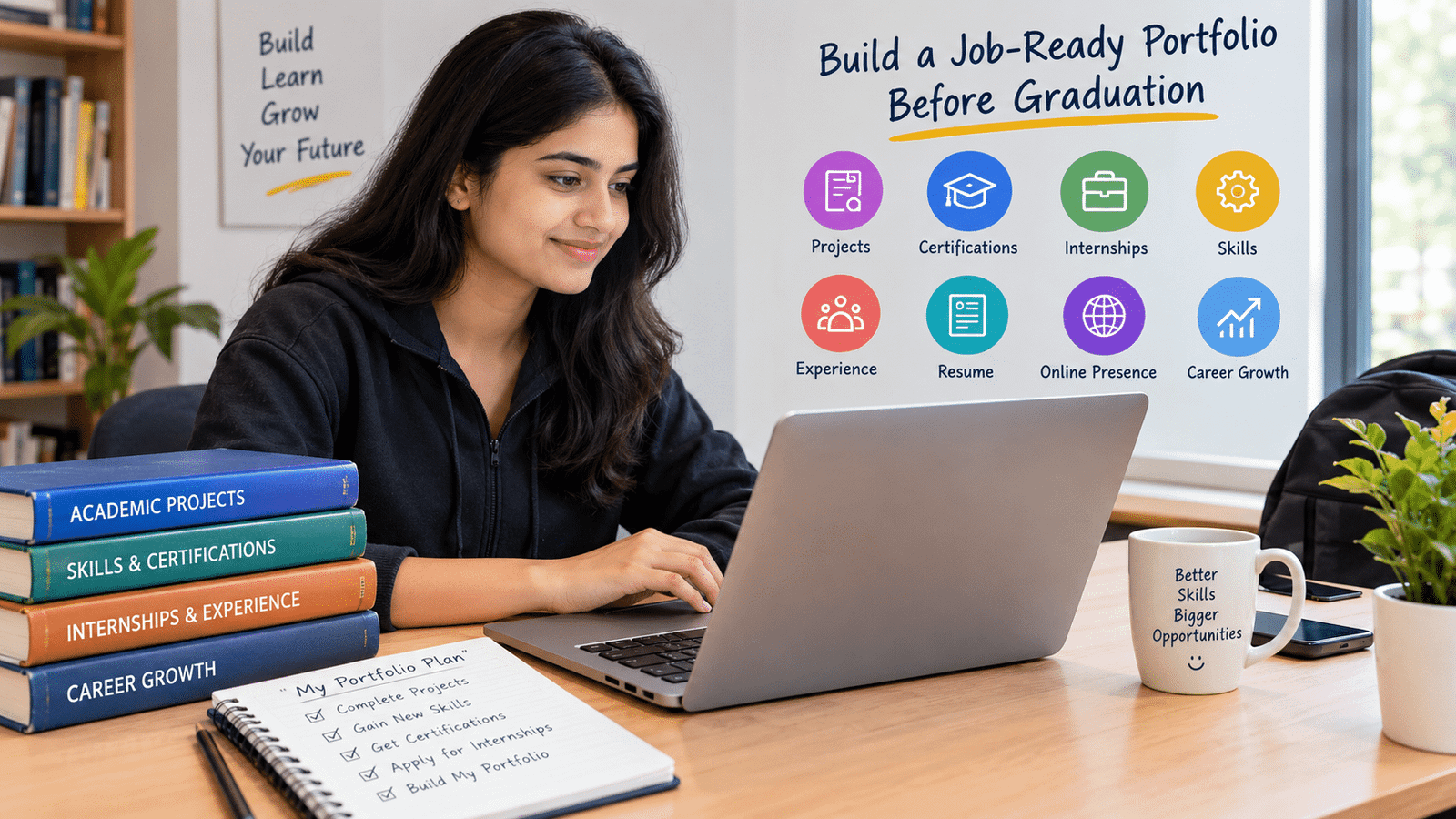
Preparing for a successful career involves more than earning a degree. Students also need to demonstrate their skills, practical knowledge, and ability to solve real-world problems. Learning how to build a job-ready portfolio before graduation can help students showcase their abilities and prepare for future employment opportunities.
A student portfolio is a collection of projects, achievements, certifications, and practical experiences that demonstrates what a student can do. It gives potential employers a clearer understanding of a candidate’s abilities beyond academic grades.
Whether you study engineering, computer science, business, commerce, design, or another discipline, a professional portfolio can help you connect classroom learning with real-world applications.
In this guide, you will learn how to build a job-ready portfolio, choose meaningful projects, develop relevant skills, and present your achievements professionally before completing your education.
1. Start Building Your Portfolio Early
Many students wait until their final semester to prepare for job applications. However, starting early gives you more time to develop skills, complete projects, and gain practical experience.
You do not need professional work experience to begin. Your academic assignments, presentations, research projects, and personal experiments can provide a useful starting point.
Create a dedicated digital folder to organize your work. As you learn new skills or complete projects, add your best examples to the collection.
Follow these simple steps:
- Identify your career interests and the roles you want to explore.
- Collect relevant academic assignments and completed projects.
- Maintain a record of your achievements and certifications.
- Update your portfolio whenever you complete meaningful work.
- Review your progress regularly and identify areas for improvement.
Practical tip: Set a goal to complete one meaningful project or portfolio improvement every month. Consistent progress can help you develop a stronger professional profile before graduation.
2. Showcase Projects That Demonstrate Practical Skills
Projects allow students to demonstrate how they apply their knowledge to practical situations. Employers can understand your abilities more clearly when they see examples of work you have completed.
Choose projects that relate to your field of study and career interests.
For example:
- Computer science students: Develop a website, mobile application, cybersecurity lab project, or data analysis solution.
- Business students: Create a market research report, business plan, or customer analysis.
- Commerce students: Prepare a financial analysis, accounting case study, or budgeting project.
- Design students: Showcase branding concepts, user interface designs, or creative work.
- Engineering students: Document prototypes, technical experiments, or engineering problem-solving projects.
- Arts and humanities students: Present research papers, writing samples, communication projects, or creative work.
For every project, explain its objective, your role, the tools or methods you used, and the outcome.
Include screenshots, diagrams, reports, demonstrations, or links where appropriate. If you worked with a team, clearly explain your individual contribution.
Remember that a well-explained project is more useful than a long list of unfinished projects.
3. Develop Job-Ready Skills Alongside Academic Learning
Academic knowledge provides a foundation, but many roles also require practical and transferable skills.
Students should identify the abilities commonly expected in their chosen career and gradually work toward developing them.
Important job-ready skills include:
- Communication and presentation
- Critical thinking and problem-solving
- Teamwork and collaboration
- Time management and organization
- Digital literacy and relevant technical tools
- Research, analysis, and decision-making
- Adaptability and continuous learning
For technical careers, students can explore programming languages, data analysis tools, cybersecurity fundamentals, design software, or other role-specific technologies.
For non-technical careers, useful areas may include business communication, market research, financial analysis, digital marketing, and professional documentation.
The goal is not to learn everything at once. Choose a few relevant skills, practise them consistently, and demonstrate them through real examples.
For more guidance, explore our article on problem-solving skills for students.
4. Include Relevant Certifications and Online Courses
Online courses and professional certifications can help students explore subjects beyond their regular curriculum. They can also demonstrate initiative and a willingness to learn.
When selecting a course, consider whether it supports your career goals and provides useful knowledge.
You can explore topics such as:
- Data analytics and visualization
- Programming and software development
- Artificial intelligence fundamentals
- Digital marketing
- Project management
- Communication and presentation
- Financial literacy
Choose courses from credible learning providers and prioritize quality over quantity.
After completing a course, include the certification in your portfolio if it is relevant. Mention the course name, issuing organization, completion date, and credential link where available.
However, certifications alone do not guarantee employment. Combining structured learning with practical projects provides a more complete picture of your abilities.
5. Gain Experience Through Internships and Practical Activities
Internships, volunteering, student clubs, competitions, and collaborative projects can help students understand how their knowledge applies outside the classroom.
These experiences may also help develop communication, teamwork, responsibility, and professional confidence.
If you cannot find an internship immediately, consider alternatives such as:
- Participating in a college project.
- Contributing to an open-source initiative.
- Helping a community organization with a relevant task.
- Taking part in a hackathon or case study competition.
- Completing an independent project related to your field.
- Collaborating with classmates to solve a practical problem.
Document what you contributed and what you learned from each experience.
For example, instead of simply stating that you participated in a college event, explain whether you managed registrations, coordinated a team, prepared promotional material, or analyzed feedback.
Be honest about your responsibilities and achievements. A professional portfolio should accurately represent your work rather than exaggerate your experience.
You can also explore our guide to internships for college students for more career preparation ideas.
6. Create a Professional Online Portfolio
A digital portfolio makes it easier to share your work with recruiters, mentors, and professional contacts.
Depending on your field, you can use a personal website, a professional networking profile, a code repository, or a design portfolio platform.
Your online portfolio should include:
- A short professional introduction
- Your education and career interests
- Your strongest and most relevant projects
- Skills and certifications
- Internship or volunteering experience, if applicable
- Achievements and competition results
- Contact information or a professional contact link
Keep the design simple, the information organized, and the language professional.
You do not need an expensive website to get started. A clean, easy-to-navigate portfolio with meaningful examples of your work can be sufficient.
For students in software development, a code repository can demonstrate programming projects. Design students may benefit from visual case studies, while business students can showcase reports, presentations, and research.
Review your public social media profiles as well. Ensure that your professional information is accurate and that your public content reflects the image you want to present to potential employers.
7. Write Clear Project Descriptions and Improve Your Resume
A portfolio becomes more effective when employers can quickly understand your contributions.
For each project, answer four important questions:
- What problem were you solving? Describe the purpose of the project.
- What was your responsibility? Explain your individual contribution.
- What tools or skills did you use? Mention relevant technologies, methods, or techniques.
- What was the result? Explain the outcome, what you learned, or how the project could be improved.
Use specific details wherever possible.
For example, instead of writing, “Completed a website development project,” explain which pages you developed, which technologies you used, and what the website was designed to achieve.
If you have measurable results, include them only when they are accurate and can be supported.
Your resume should complement your portfolio. Keep it concise, highlight relevant achievements, and include links to your strongest work.
Before applying for a position, review the job description and emphasize the skills and experience most relevant to that role.
You can strengthen your preparation further by reading our guide to building a portfolio without work experience.
8. Keep Improving Your Portfolio
Building a professional portfolio is an ongoing process rather than a one-time task.
As you gain experience, replace weaker examples with stronger projects, update your skills, and remove outdated information.
Ask teachers, mentors, classmates, or experienced professionals for feedback. Their suggestions may help you improve the clarity, presentation, and quality of your work.
You should also check that all links work correctly and that your portfolio displays properly on mobile devices.
Before sharing your portfolio with an employer, check the following:
- Are your strongest projects easy to find?
- Are your project descriptions clear?
- Are your skills supported by examples?
- Are your certifications and achievements accurate?
- Is your contact information current?
- Have you checked spelling, grammar, and formatting?
- Do all project links open correctly?
A simple portfolio that is regularly updated can be more useful than a complicated website containing outdated information.
A Simple 30-Day Portfolio-Building Plan
If you are unsure where to start, follow this practical four-week plan to begin building a job-ready portfolio.
Week 1: Choose Your Career Direction
Identify two or three roles that interest you. Research the skills and qualifications commonly expected for those roles.
Choose one area to focus on and decide which project would help demonstrate a relevant skill.
Week 2: Complete a Small Project
Choose a manageable project that demonstrates your knowledge.
Focus on completing useful work rather than making the project unnecessarily complicated.
Document your process, the tools you used, the challenges you faced, and the outcome.
Week 3: Organize Your Portfolio
Write a professional introduction, document your project, add relevant certifications, and prepare a simple resume.
Choose a suitable platform to present your work and make sure the layout is easy to navigate.
Week 4: Review and Improve
Ask a teacher, mentor, or classmate to review your work.
Correct mistakes, improve project descriptions, check links, and identify areas that need further development.
By the end of 30 days, you can have a starting portfolio that you can continue improving throughout your education.
Common Portfolio Mistakes Students Should Avoid
While preparing a portfolio, students should avoid mistakes that make their work difficult to evaluate.
Adding projects without explanations: Employers need to understand the purpose of each project and your contribution.
Listing skills without evidence: Support important skills with projects, examples, or practical experience.
Including irrelevant information: Focus on work that relates to your career interests and target roles.
Copying other people’s work: Credit external resources appropriately and clearly identify your own contribution.
Exaggerating achievements: Present your experience honestly and avoid unsupported claims.
Ignoring presentation: Spelling mistakes, broken links, and confusing layouts can make a poor impression.
Waiting until graduation: Starting early provides more time to learn, practise, and improve.
A strong portfolio should be relevant, organized, honest, and easy to understand.
Conclusion: Start Building Your Job-Ready Portfolio Today
Learning how to build a job-ready portfolio before graduation can help students connect academic learning with practical skills.
By completing meaningful projects, developing relevant abilities, gaining experience, and maintaining a professional online presence, students can prepare more effectively for future career opportunities.
You do not need an impressive portfolio on your first day. Start with what you have, identify areas for improvement, and make consistent progress.
Choose a project this week. Document what you learn. Add your best work to your portfolio and improve it as your skills develop.
Your career preparation begins before your first job application. Start building your portfolio today and take a practical step toward your professional future.
For more educational resources, career guidance, and skill-development articles, visit Vyasa Nexus.
Internal Links
Portfolio Without Work Experience
Professional Portfolio for Students
Internships for College Students