
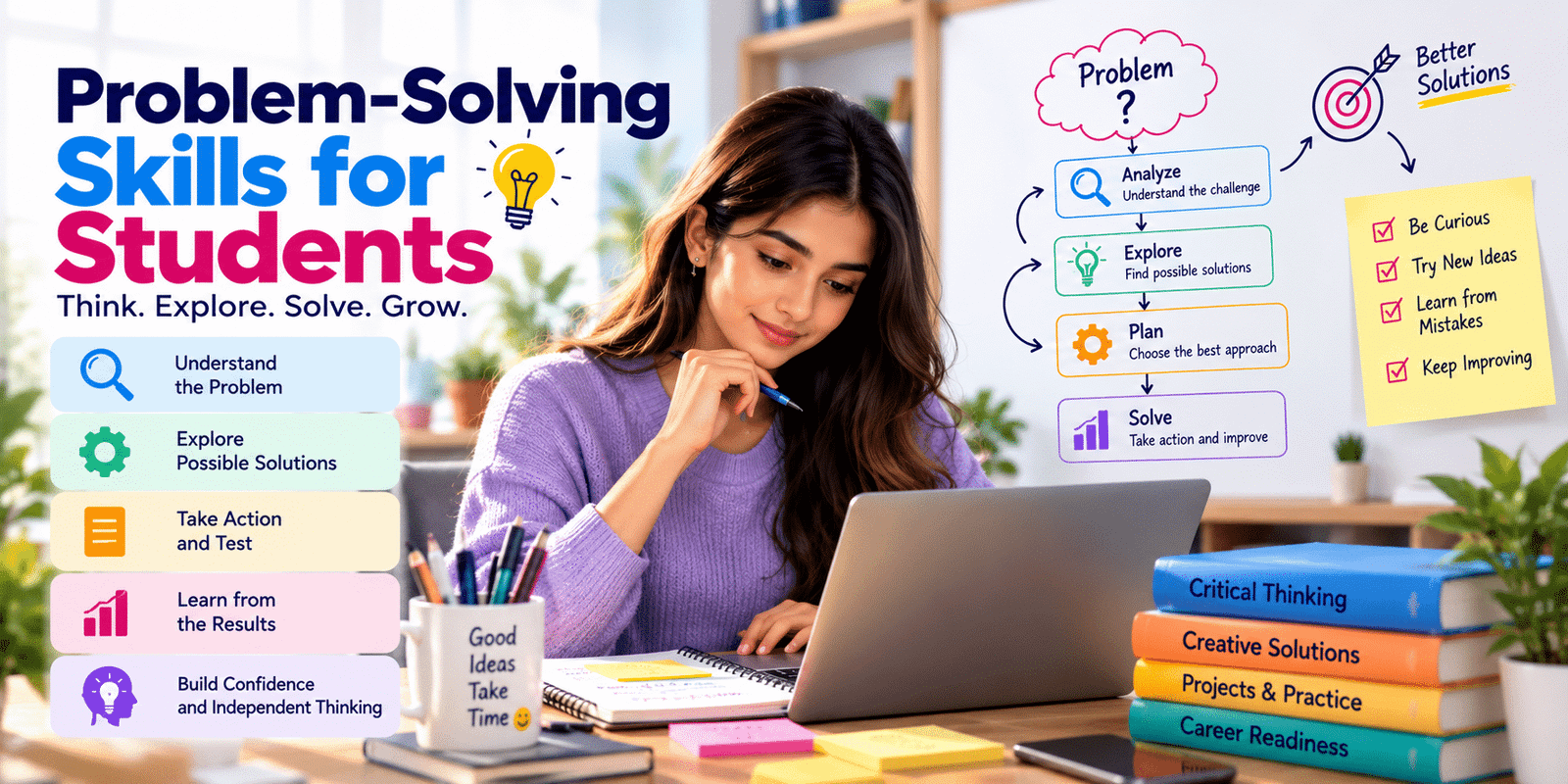
Problem-Solving Skills for Students: Why They Matter
Problem-solving skills for students help learners understand challenges, analyze information, explore possible solutions, and make informed decisions. From completing academic assignments to working on practical projects, students regularly face situations that require logical thinking and independent action. Developing these skills prepares them for learning opportunities and future workplace challenges.
Problem-solving skills for students help learners think independently, analyze situations, overcome challenges, and apply their knowledge in practical ways. These skills are valuable not only in education but also in professional life, where employees regularly encounter unfamiliar tasks and unexpected problems.
In this article, we will explore why problem-solving matters, how students can become more independent thinkers, and practical ways to develop these skills before starting a career.
1. Why Problem-Solving Skills for Students Matter
Problem-solving is an essential part of learning and personal development. Students who develop this ability can approach difficult tasks more confidently instead of giving up when they do not immediately know the answer.
For example, a student working on a programming assignment may encounter an error that prevents the application from running. Instead of immediately copying a solution, the student can examine the error message, review the code, test possible explanations, and identify the cause.
This process develops analytical thinking, patience, and confidence.
Problem-solving skills for students also encourage curiosity. Students begin asking why something is happening, what information they need, and which approach is most likely to work. These habits help them become more active learners and better prepared for real-world challenges.
2. What Is Independent Problem-Solving?
Independent problem-solving is the ability to understand a challenge, explore possible solutions, and take reasonable steps toward resolving it without depending entirely on others.
It does not mean that students should never ask for help. Instead, it means making a genuine effort to understand the problem before seeking assistance.
For example, when a student struggles with a mathematics problem, they can first review the relevant concept, identify what is confusing, and try different methods. If the difficulty continues, they can ask a teacher a specific question.
This approach helps students understand the reasoning behind a solution instead of simply memorizing the final answer.
Independent problem-solving also involves recognizing when collaboration or expert guidance is necessary. Knowing when to work independently and when to seek support is an important part of effective learning.
3. Why Students Depend Too Much on Ready-Made Answers
Digital resources make it easier than ever to find explanations, tutorials, and answers. These resources can be valuable learning tools, but depending on them without understanding the reasoning can limit skill development.
Some students look for complete solutions as soon as they encounter a difficult question. Others copy code or project examples without understanding how the different parts work.
Although this approach may help complete a task quickly, it can make similar problems more difficult to solve independently later.
Students can use online resources more effectively by attempting a problem first, identifying the specific difficulty, and then searching for an explanation. After reviewing the solution, they should try applying the concept to a different example without copying the original answer.
This process turns external resources into learning aids rather than replacements for independent thinking.
4. How Independent Thinking Improves Learning
Independent thinking helps students understand concepts more deeply. Instead of accepting information without examination, they learn to question assumptions, compare approaches, and evaluate evidence.
For example, when working on a science assignment, a student can consider why a particular result occurred, whether the evidence supports the conclusion, and what other explanations might exist.
This process improves understanding and helps students remember concepts more effectively because they actively engage with the material.
Independent thinking also supports creativity. Students may discover that a problem can be solved in more than one way, allowing them to compare different approaches and select the most suitable one.
Over time, these habits can improve academic performance and prepare students to handle unfamiliar situations with greater confidence.
5. Practical Steps to Solve Problems Independently
Students can develop problem-solving skills by following a structured approach whenever they encounter a challenge.
Step 1: Understand the Problem
Before searching for an answer, identify exactly what needs to be solved. Read the instructions carefully and separate the known information from the information that is missing.
If a project is not working, for example, describe what you expected to happen and what actually happened.
Step 2: Break the Problem Into Smaller Parts
Large problems can feel overwhelming when approached all at once. Divide them into smaller tasks that can be investigated separately.
For a software project, these tasks might include checking the user interface, testing the API request, reviewing the returned data, and examining error messages.
Step 3: Explore Possible Solutions
Consider different ways to approach the problem. Review relevant concepts, examine available evidence, and think about the advantages and limitations of each option.
Avoid choosing the first solution simply because it is familiar.
Step 4: Test One Approach at a Time
Choose a reasonable solution and test it. Changing several things simultaneously can make it difficult to identify which change affected the result.
Record what you tried and what happened. This makes the process easier to understand and repeat.
Step 5: Review the Result
After implementing a solution, check whether it actually addresses the original problem. If it does not, review the evidence and try another approach.
Step 6: Learn From the Experience
Think about what caused the problem, which approach worked, and what you would do differently next time.
Reflecting on the process helps students apply what they have learned to future challenges.
6. How Projects Help Students Develop Problem-Solving Skills
Practical projects give students opportunities to apply knowledge, make decisions, and handle unexpected difficulties.
For example, a student developing a website may need to resolve layout issues, fix broken links, connect an API, or improve page performance. Each challenge requires investigation, experimentation, and evaluation.
Projects also teach students that the first solution is not always the best one. They may need to test alternatives, revise their approach, and improve the result based on evidence.
Students can begin with small projects related to their interests and gradually work on more complex challenges.
Our guide on project-based learning explains how practical activities can help learners apply concepts and develop useful skills.
When documenting a project, students should include the problem they encountered, the steps they took, the solution they selected, and what they learned. This demonstrates not only the final result but also their reasoning process.
7. Common Problem-Solving Mistakes to Avoid
Students can become better problem-solvers by recognizing habits that make challenges harder to resolve.
Rushing to Find an Answer
Trying to solve a problem immediately without understanding it can lead to incorrect assumptions. Take time to identify the actual issue before choosing a solution.
Giving Up Too Quickly
Some problems require several attempts. When the first approach fails, review what happened and use that information to decide what to try next.
Copying Solutions Without Understanding Themindependent problem-solving for students
A copied answer may complete a task, but it does not necessarily develop the ability to solve similar problems independently. Understand the reasoning and practice applying the concept elsewhere.
Trying Too Many Changes at Onceindependent problem-solving for students
Making several changes simultaneously can hide the cause of a problem. Test one change at a time whenever practical.
Ignoring Feedback
Other people may notice an assumption or mistake that you missed. Consider their suggestions and evaluate whether they help improve your solution.
Refusing to Ask for Help
Independent thinking does not mean struggling indefinitely. If you have made a reasonable effort and remain stuck, ask a teacher, mentor, or teammate a specific question about the difficulty.independent problem-solving for studentsIndependent thinking does not mean struggling indefinitely. If you have made a reasonable effort and remain stuck, ask a teacher, mentor, or teammate a specific question about the difficulty.
8. Why Employers Value Independent Problem-Solvers
Workplaces regularly involve challenges that do not have immediate or obvious answers. Employees may need to investigate technical issues, respond to customer concerns, improve processes, or adapt to changing requirements.
Employers value people who can analyze situations, explore alternatives, communicate their reasoning, and take appropriate action.
For freshers, independent problem-solving can be especially useful because they may not have extensive professional experience. Demonstrating how they approached a project challenge can help them explain their abilities during interviews.
For example, a candidate could describe a project issue, the possible causes they investigated, the tests they performed, and how they evaluated the final solution.
Students can learn more about workplace expectations through our article on skills recruiters look for in freshers.
Developing these abilities before graduation can help students become more confident contributors when they enter internships or full-time roles.
9. How Students Can Practice Problem-Solving Every Day
Problem-solving does not need to be limited to major assignments or technical projects. Students can practice it through everyday activities.
- Attempt questions before checking answers: Give yourself time to understand the question and develop a possible solution.
- Solve practical challenges: Work on coding exercises, case studies, puzzles, or small personal projects.
- Ask better questions: Identify exactly what you do not understand instead of saying only that something is difficult.
- Compare different approaches: When you solve a problem, consider whether another method could be simpler or more effective.
- Keep a problem-solving journal: Record difficult problems, attempted solutions, results, and lessons learned.
- Learn from mistakes: Treat unsuccessful attempts as information that can guide your next decision.
- Discuss your reasoning: Explain your approach to classmates or mentors and listen to their perspectives.
- Regular practice in independent problem-solving for students can improve confidence and prepare learners to handle unfamiliar challenges.
Regular practice helps students build a repeatable approach to unfamiliar situations rather than relying only on intuition.
10. How Problem-Solving Builds Confidence and Adaptability
Confidence grows when students learn that difficult situations can be approached systematically. They may not know the answer immediately, but they can investigate the problem, learn what is necessary, and test possible solutions.
This mindset also supports adaptability. When familiar methods stop working, students can reconsider their assumptions and explore alternatives.
For example, if a student discovers that an original project design does not meet the requirements, they can review the feedback, identify the limitations, and revise the design.
Each experience provides an opportunity to improve judgment and become more comfortable with uncertainty.
Students should remember that becoming a good problem-solver takes practice. Mistakes are a normal part of the process, and improvement comes from learning how to respond to them.
11. The Role of Continuous Learning in Problem-Solving
Effective problem-solving often requires knowledge that students do not yet possess. When they encounter an unfamiliar challenge, they may need to learn a new concept, tool, or technique before proceeding.
Continuous learning helps students build the knowledge needed to approach a wider range of problems.
For example, a student working on a data analysis project may need to learn a new visualization technique or understand a statistical concept. Applying that knowledge to the project strengthens both understanding and practical ability.
Students can support continuous learning by setting aside time for practice, reviewing useful resources, working on projects, and reflecting on what they discover.
Our article on continuous learning and career growth explores why regularly developing knowledge and skills is valuable throughout a career.
12. Frequently Asked Questions
What are problem-solving skills for students?
Problem-solving skills for students are abilities that help learners identify challenges, analyze information, explore possible solutions, make decisions, and evaluate results.
Why is independent problem-solving important?
Independent problem-solving helps students develop confidence, understand concepts more deeply, and become better prepared to handle unfamiliar academic and professional challenges.Independent problem-solving for students encourages learners to understand challenges before looking for ready-made answers.
How can students improve their problem-solving skills?
Students can practice by breaking problems into smaller steps, testing different approaches, learning from mistakes, working on practical projects, and reflecting on the results.
Should students solve every problem without help?
No. Students should make a reasonable independent effort, but asking teachers, mentors, or classmates for guidance is appropriate when they need clarification or specialized knowledge.
How do problem-solving skills help students get jobs?
These skills help candidates explain how they analyze challenges, make decisions, test solutions, and learn from results. Such abilities are useful in many professional roles.Practical projects give students opportunities to develop independent problem-solving for students through testing, experimentation, and reflection.
Can problem-solving skills be learned?
Yes. Students can develop problem-solving skills through regular practice, practical projects, constructive feedback, and a willingness to learn from unsuccessful attempts.
Final Thoughts
Problem-solving is not simply about finding the correct answer. It is about understanding challenges, evaluating information, exploring possible solutions, and learning from the results.
By developing problem-solving skills for students, learners can become more independent, improve their understanding of academic concepts, and prepare for challenges they may encounter in their careers.
Start with one problem you find difficult. Understand what is causing it, try a reasonable solution, review the result, and learn from the experience. With consistent practice, these small efforts can build the confidence and reasoning skills needed for long-term growth.
Outbound links
National Careers Service text ki ee URL hyperlink ga add cheyyi: