
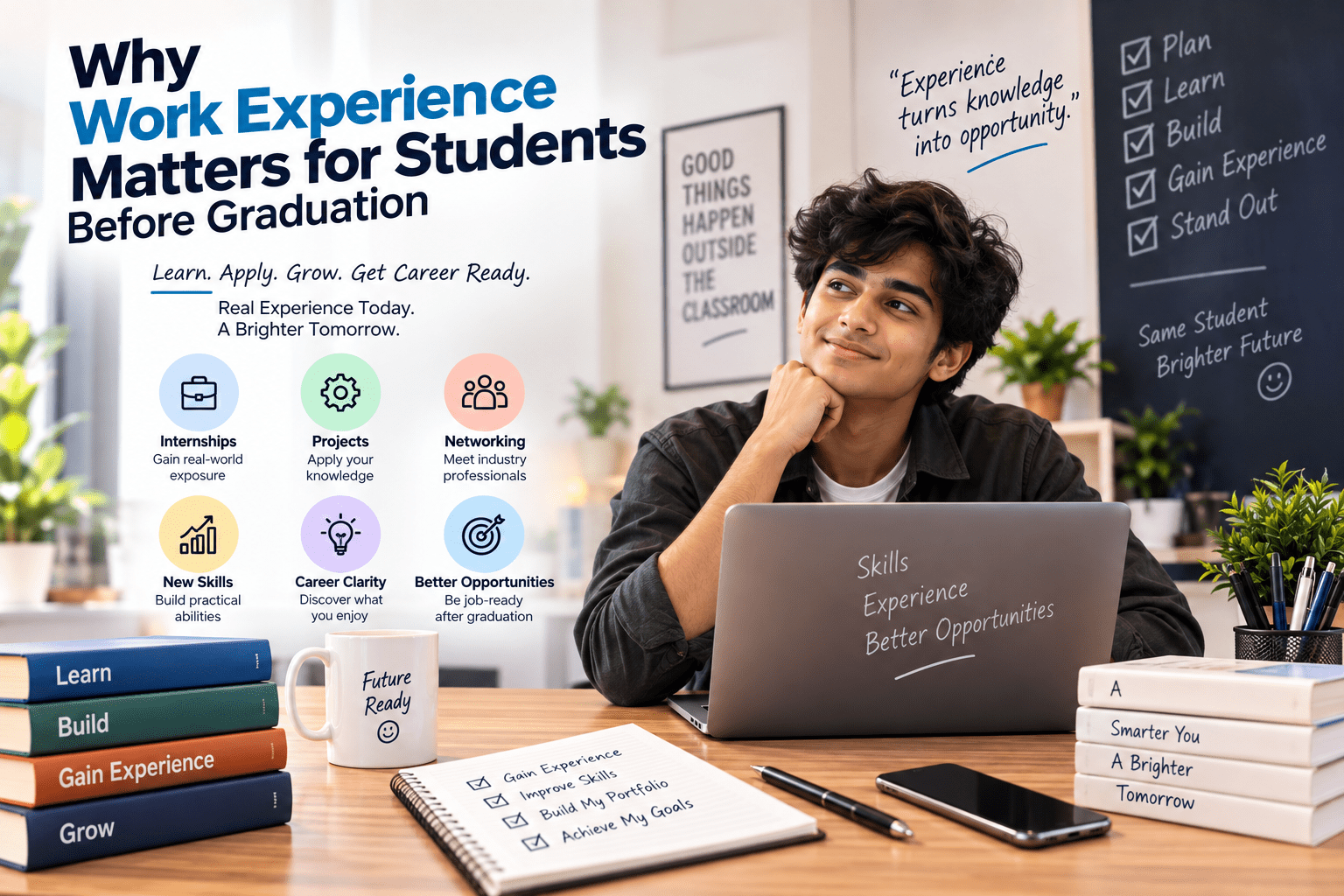
A college degree provides students with academic knowledge, but work experience for students can help them understand how that knowledge is applied in real professional environments. Internships, practical projects, volunteering, freelance work, and industry-focused activities can give students valuable exposure before they graduate.
For students preparing for internships and their first jobs, gaining practical experience early can help them understand workplace expectations, develop professional skills, and make more informed career decisions.
Why Work Experience for Students Matters Before Graduation
Students often spend years preparing for exams and completing academic assignments. However, professional environments can require a different set of skills.
Students may need to communicate with teammates, manage deadlines, understand requirements, solve unexpected problems, and take responsibility for their work.
Work experience for students provides an opportunity to experience these situations before entering full-time employment.
What Does Work Experience Mean for a College Student?
Work experience does not necessarily mean having a full-time job.
For a college student, it can include:
- Internships
- Industry projects
- Freelance assignments
- Research projects
- Part-time work
- Volunteering
- Open-source contributions
- Hackathons
- Practical training programs
- Community projects
The type of experience may vary depending on the student’s field and career goals.
What matters is that students get opportunities to apply their knowledge in practical situations.
Why Classroom Learning Alone May Not Be Enough
Classroom learning gives students an important foundation. It helps them understand concepts, theories, and principles related to their field.
However, applying those concepts can be very different.
For example, a student may understand database concepts in class but face unexpected challenges while working with a real application. Similarly, a student may learn communication principles but discover that working with a team requires active listening, coordination, and clear updates.
Practical exposure helps connect what students learn with how that knowledge is used.
How Internships Introduce Students to the Workplace
Internships can give students an opportunity to experience professional environments before graduation.
During an internship, students may work with teams, attend meetings, follow processes, use professional tools, and complete tasks within deadlines.
Even a small assignment can teach students how workplace responsibilities differ from college assignments.
More importantly, internships can help students understand what type of work they enjoy and which areas they may want to explore further.
How Projects Can Demonstrate Practical Skills
Projects can be another valuable form of experience.
A student who builds a meaningful project has an opportunity to demonstrate how they approached a problem, selected a solution, used specific tools, and handled challenges.
For example, a computer science student could build a web application. A data science student could analyse a real dataset. An electronics student could develop a prototype.
The project itself becomes evidence that the student has moved from learning concepts to applying them.
Why Students Should Gain Experience Before Their Final Year
Students often start thinking about careers only when graduation approaches. Starting earlier can provide more time to explore different areas and understand personal interests.
A first-year student might begin with small projects. During the second year, they could explore internships or competitions. Later, they can take on more advanced projects and industry experiences.
This gradual approach can make career preparation less overwhelming during the final year.
What Students Can Learn From Real Work Environments
Real work environments can teach lessons that are difficult to understand through textbooks alone.
Students can learn about:
- Professional communication
- Team collaboration
- Time management
- Workplace responsibility
- Task prioritisation
- Problem-solving
- Receiving feedback
- Meeting deadlines
- Professional behaviour
- Adapting to changing requirements
These experiences can help students understand what professional life actually involves.
How Practical Experience Builds Professional Confidence
Confidence often develops through experience.
A student who has completed a project, contributed to a team, or handled an internship assignment has real situations to discuss during interviews.
For example, instead of saying, “I know Java,” a student can explain how they used Java to solve a specific problem in a project.
That difference can make conversations about their skills more concrete.
Why Employers Value Practical Exposure
Employers hiring graduates need people who can eventually contribute to real work.
Practical exposure can provide evidence that a student has experience applying knowledge, working through challenges, and collaborating with others.
However, students should not assume that simply completing an internship guarantees employment. The value of the experience depends on what they actually learned, contributed, and can demonstrate.
How Students Can Gain Experience Without a Full-Time Job
Students do not need to wait for a full-time position to gain practical exposure.
They can start by participating in:
- College technical clubs
- Open-source projects
- Hackathons
- Research activities
- Student communities
- Freelance projects
- Volunteer initiatives
- Industry workshops
- Personal projects
For instance, a student interested in software development can contribute to an open-source project or build an application independently.
Small experiences can become building blocks for larger opportunities.
Common Mistakes Students Make When Seeking Experience
Students sometimes focus too much on collecting certificates instead of gaining meaningful experience.
Some common mistakes include:
- Joining an internship without checking what work is involved
- Choosing opportunities only for a certificate
- Copying projects without understanding them
- Adding experiences to a resume without learning from them
- Waiting until the final semester to start
- Ignoring opportunities outside traditional campus placements
Students should focus on what they can learn and contribute, not simply how many certificates they can collect.
How to Turn Experience Into a Strong Resume and Portfolio
Practical experience becomes more useful when students document it properly.
For every project or internship, students can record:
What was the problem?
What was my role?
What tools or skills did I use?
What challenges did I face?
How did I solve them?
What did I learn?
This information can later help students create stronger resumes and professional portfolios.
How Work Experience Can Help Students Choose a Career
Career decisions can be difficult when students have limited exposure to different types of work.
Practical experience can help them discover what they actually enjoy.
A student may believe they want to become a developer but discover through an internship that they enjoy data analysis more. Another student may discover an interest in research after working on an academic project.
Such experiences can help students make career choices based on exposure rather than assumptions.
How Vyasa Nexus Supports Practical Learning and Career Readiness
Vyasa Nexus focuses on connecting education with practical learning, skill development, projects, internships, and career preparation.
For students, these opportunities can provide a pathway to move beyond theoretical learning and gain experience applying their knowledge.
The goal is to help students gradually build the skills, experience, and confidence needed to approach future academic and professional opportunities.
What Students Can Start Doing Today
Students do not need to wait for the perfect opportunity.
Start with one practical activity related to your interests.
Build a small project. Join a student community. Participate in a competition. Explore an internship. Help with a real problem. Document what you learn.
Then use that experience to decide what you want to explore next.
Progress does not always happen through one major opportunity. Sometimes, it comes from consistently taking small opportunities to learn and contribute.
Final Thoughts: Start Building Experience Before Graduation
A degree can provide the foundation for a career, but practical experience can help students understand how that knowledge works in the real world.
Work experience for students can develop professional awareness, practical skills, communication, problem-solving, and confidence.
Students do not need to have everything figured out before they begin. They can start small, learn from each experience, and gradually build a stronger professional foundation.
Don’t wait until graduation to start preparing for the workplace. Start gaining experience while you are still learning.
Outbound Links
Students can explore internship opportunities and gain practical exposure through the AICTE National Internship Portal.
Students can also understand changing workplace skill requirements through current employment and skills research.
Internal Links
Internships can help students gain practical experience before graduation
Understanding recruiter expectations can help students prepare for their first professional opportunities
Practical experience can also give students real examples to discuss during technical interviews.