
Focus Keyphrase: why employers ask freshers for experience
SEO Title: Why Employers Ask Freshers for Experience: The Entry-Level Job Problem
Slug: why-employers-ask-freshers-for-experience
Meta Description: Why do employers ask freshers for experience? Learn what companies really mean by experience and how students can build practical skills before their first job.
Why Do Employers Ask Freshers for Experience?
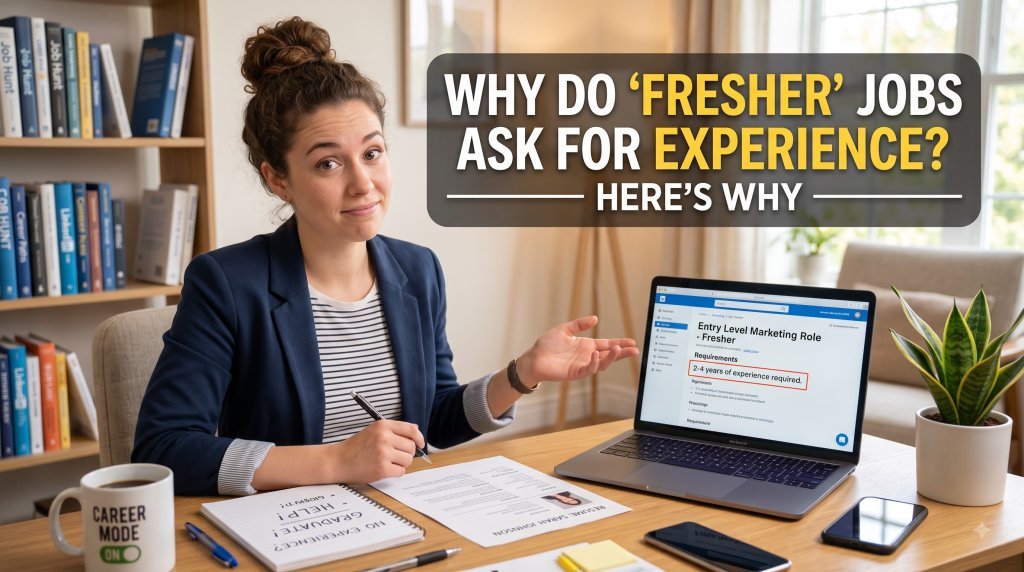
One of the most frustrating questions for students is simple: “How am I supposed to get experience when every job asks for experience?”
A fresher may have a degree, certificates, technical skills, and academic projects, yet many entry-level job descriptions still mention internships or previous experience.
This creates a difficult situation for students entering the job market for the first time. However, when employers ask freshers for experience, they are not always asking for several years of full-time employment. Often, they are looking for evidence that a candidate can apply their knowledge, solve problems, work on real tasks, and contribute to a team.
Understanding what employers mean by “experience” can help students prepare more effectively.
What Does “Experience” Actually Mean for Freshers?
Experience does not always mean having a previous full-time job.
For students and recent graduates, it can include:
- Internships
- College projects
- Personal projects
- Freelance work
- Open-source contributions
- Hackathons
- Research projects
- Volunteer work
- Part-time work
- Industry training
- Practical assignments
The important factor is not simply having something listed on a resume. Students need to be able to explain what they did, what problems they solved, and what they learned.
Why Do Employers Want Experience From Freshers?
Hiring a new employee involves uncertainty. A resume can show education and qualifications, but employers may also want evidence of how a candidate performs outside a classroom environment.
Experience can demonstrate that a student has already practiced skills such as:
- Problem-solving
- Communication
- Teamwork
- Time management
- Technical implementation
- Research
- Project management
- Handling feedback
- Meeting deadlines
This is one reason practical experience can make a fresher’s profile easier to evaluate.
Why a Degree Alone May Not Be Enough
A degree demonstrates academic achievement, but it does not necessarily show how a student applies knowledge to practical situations.
For example, a computer science student may know Python and list it on a resume.
But there is a significant difference between writing:
“Python — Intermediate”
and showing:
“Built a Python application that processes and analyzes customer data.”
The second example gives an employer something concrete to discuss and evaluate.
This is why students should focus not only on what they have learned, but also on what they have built with that knowledge.
Do College Projects Count as Experience?
They can be valuable evidence of practical ability.
A strong academic project can demonstrate that a student knows how to move from an idea to an actual result.
Instead of simply writing:
“Final-year project: AI-based application”
students should explain:
- What problem the project addressed
- Which technologies they used
- What their individual contribution was
- What challenges they encountered
- How they solved those challenges
- What the final result was
A project becomes much more useful when a student can confidently explain the decisions behind it.
Why Employers Ask Freshers for Experience in Entry-Level Jobs
Internships can provide exposure to professional environments that classrooms cannot completely replicate.
During an internship, students may experience:
- Team collaboration
- Real deadlines
- Professional communication
- Code reviews
- Client requirements
- Workplace tools
- Project documentation
- Feedback from experienced professionals
For this reason, internships can help students bridge the gap between academic learning and professional work.
What If a Student Has No Internship?
Not having an internship does not mean a student has no way to demonstrate experience.
Students can build their own practical evidence.
For example, a student interested in software development could:
- Choose a real problem.
- Build a working application.
- Publish the project on GitHub.
- Create documentation.
- Explain the technical decisions.
- Deploy the application if possible.
- Add the project to a portfolio.
- Prepare to explain it during interviews.
This creates evidence of practical ability even before the student gets their first full-time job.
Why Portfolios Can Help Freshers
A resume tells employers what a candidate claims to know.
A portfolio can show what the candidate has actually created.
A strong student portfolio might contain:
- Projects
- GitHub repositories
- Technical articles
- Case studies
- Research work
- Designs
- Certifications
- Internship experience
- Hackathon participation
- Open-source contributions
Students can also learn how to build a Professional Portfolio for Students that presents their work clearly.
Experience vs Proof of Work
These two ideas are related but not identical.
Experience describes where you gained practical exposure.
Proof of work demonstrates what you actually accomplished.
For example:
Internship → experience
Built and deployed an application during the internship → proof of work
Both can strengthen a student’s profile.
Students can learn more about this approach through Proof of Work for Students.
What Should Freshers Do Before Graduation?
Students do not have to wait until their final semester to start building experience.
A practical roadmap could look like this:
Learn → Practice → Build → Document → Share → Improve
Start with one useful skill.
Then build a small project around it.
After that, document the process and publish the result.
Over time, students can build a collection of work that demonstrates growth.
Internships can add workplace exposure, while projects and portfolios can provide additional evidence of practical ability.
Is Experience Becoming More Important in Hiring?
Hiring practices are changing as employers increasingly focus on the skills candidates can demonstrate rather than relying only on traditional qualifications.
The OECD’s research on skills-first hiring discusses how employers can use skills information and practical assessments alongside traditional qualifications.
For students, the message is straightforward: education still matters, but demonstrating how that education translates into useful skills can make a significant difference.
How Freshers Can Gain Experience Before Getting Hired
Students can start before receiving their first job offer.
Consider:
- Building personal projects
- Applying for internships
- Participating in hackathons
- Contributing to open source
- Freelancing
- Joining student organizations
- Working on research
- Solving real-world problems
- Creating a portfolio
- Documenting projects publicly
Students can also develop work experience while still in college through practical opportunities.
The Real Problem With “Experience Required”
The biggest problem is that students often interpret “experience required” as meaning they need a previous full-time job.
In reality, employers may be looking for evidence that a candidate understands professional expectations and can apply their skills.
That evidence can come from multiple sources.
The goal for students should therefore not be simply:
“How do I get a job without experience?”
A better question is:
“How can I demonstrate that I can do the work?”
That change in thinking can influence how students approach projects, internships, portfolios, and skill development.
Final Takeaway
The question “Why do employers ask freshers for experience?” does not have a single answer.
Companies want to reduce uncertainty when hiring. Experience can provide evidence that a candidate has already applied skills in practical situations.
For students, this does not mean waiting for someone to give them their first opportunity.
They can start building evidence today through projects, internships, open-source contributions, practical assignments, portfolios, and proof of work.
A certificate can show that you completed a course.
A project can show what you can build.
An internship can show how you work.
A portfolio can bring that evidence together.
And the combination can give employers a clearer picture of what a fresher can actually contribute.
Frequently Asked Questions
Why do employers ask freshers for experience?
Employers may ask for experience because they want evidence that candidates can apply their skills in practical situations and work in professional environments.
What counts as experience for a fresher?
Internships, college projects, personal projects, freelance work, hackathons, research, open-source contributions, and volunteer work can all provide practical experience.
Can projects replace work experience?
Projects cannot always replace formal work experience, but strong projects can demonstrate practical skills and give employers concrete evidence of what a candidate can do.
How can students get experience before graduation?
Students can pursue internships, build personal projects, contribute to open source, participate in hackathons, freelance, conduct research, and create portfolios.
Should freshers focus on certificates or projects?
Certificates can demonstrate learning, while projects can demonstrate application. Building both can give students a more complete profile.