
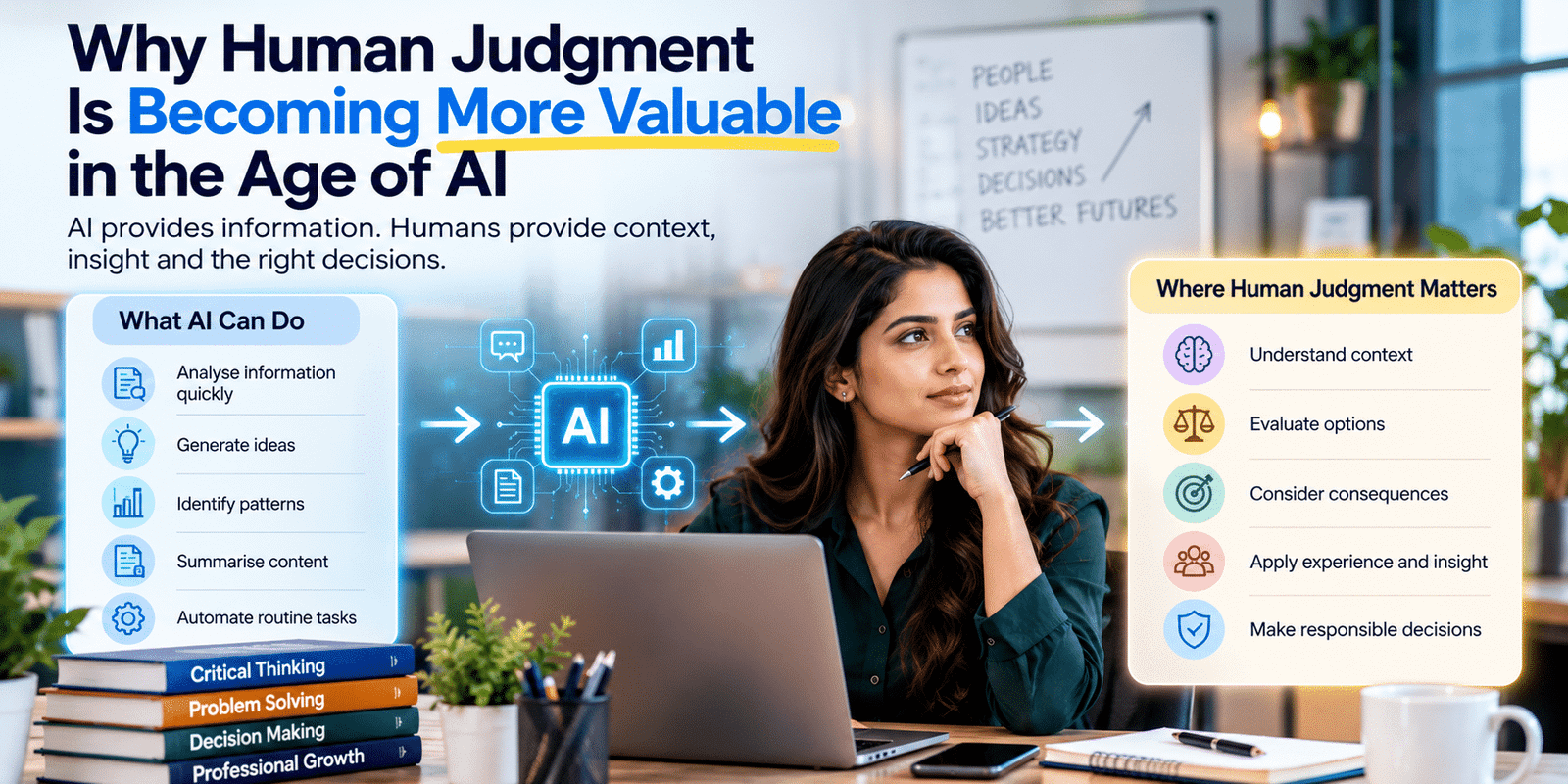
Human judgment in AI is becoming increasingly important as artificial intelligence takes on more tasks across modern workplaces. AI can analyse information, generate ideas, and support decisions, but professionals still need to understand context, evaluate information, consider consequences, and take responsibility for important decisions.
Professionals still need to understand context, question information, consider consequences, evaluate different options, and take responsibility for decisions. The World Economic Forum notes that as AI takes on more execution and prediction, human value is increasingly connected to defining problems, evaluating outcomes, setting direction, and making final decisions.
Why Human Judgment in AI Matters
AI can provide an answer quickly, but a quick answer is not always the right answer. A professional needs to determine whether the output makes sense for the specific situation.
For example, an AI system may recommend a particular business strategy based on historical data. A manager still needs to consider current market conditions, customer expectations, company priorities, risks, and information that may not be represented in the data.
This is where human judgment in AI becomes important.
What Is Human Judgment in the Age of AI?
Human judgment is the ability to evaluate information, understand context, consider alternatives, and make decisions when there is no completely certain answer.
AI can support this process by providing information or possible options. However, deciding which option is appropriate can require experience, context, values, and responsibility.
The World Economic Forum describes judgment as the ability to weigh trade-offs, navigate ambiguity, and decide what is appropriate in context.
What AI Can Do and What Humans Still Need to Decide
AI can perform many tasks quickly. It can summarise documents, analyse large amounts of information, generate ideas, and identify patterns.
However, professionals still need to decide:
- What problem should be solved?
- Which information actually matters?
- Is the AI output reliable?
- What risks could the decision create?
- Which option fits the situation?
- Who should be accountable for the final decision?
The distinction is becoming increasingly important as AI moves from simply assisting with tasks to influencing decisions.
Why AI-Generated Answers Need Human Evaluation
AI-generated information can appear confident and professional even when it contains errors or lacks important context.
Therefore, professionals should not treat every AI response as a final answer. Instead, they can verify important information, compare sources, examine assumptions, and consider whether the result makes sense.
Human evaluation becomes especially important when decisions involve customers, finances, employees, safety, compliance, or other significant consequences.
The Role of Critical Thinking in AI-Assisted Work
Critical thinking helps professionals look beyond the first answer they receive.
Instead of asking only, “What did the AI say?”, they can ask:
Why did it say this?
What evidence supports the answer?
What information might be missing?
Could there be another explanation?
What could happen if this recommendation is wrong?
These questions help people remain actively involved in the decision-making process.
Why Context Matters More Than a Quick Answer
The same recommendation may work in one situation and fail in another.
For example, an AI tool might recommend a particular marketing strategy based on successful campaigns from other companies. However, a professional still needs to understand the organisation’s target audience, budget, brand positioning, competitors, and business objectives.
AI can provide possibilities. Context helps determine which possibility makes sense.
Human Judgment and Decision-Making at Work
Modern workplaces are increasingly combining AI with human decision-making. A recruiter might use AI to organise candidate information, while a hiring manager evaluates whether a candidate is appropriate for the role.
Similarly, a financial professional may use AI to identify patterns while still assessing risk and business context.
The important point is that using AI does not automatically remove human responsibility.
Why Problem-Solving Cannot Be Fully Automated
Problem-solving often begins before a solution is identified.
Someone needs to understand what is actually wrong, determine what information is relevant, define the desired outcome, and consider possible consequences.
AI can support several parts of this process. However, people still need to decide whether the problem has been correctly understood.
This is one reason problem-solving and analytical thinking remain important capabilities in an AI-enabled workplace.
The Importance of Ethics and Accountability
Some decisions cannot be evaluated only by asking whether they are efficient.
Professionals may also need to consider fairness, privacy, safety, transparency, and potential consequences.
The World Economic Forum’s recent work on human-led AI emphasises three responsibilities that remain particularly important: setting direction, exercising judgment, and holding accountability.
How Professionals Can Work Alongside AI
Professionals can treat AI as a capable assistant rather than an automatic decision-maker.
A practical workflow could look like this:
Define the problem → Use AI for support → Review the output → Verify important information → Apply professional judgment → Make the decision
This approach allows technology to improve productivity while keeping human responsibility within the process.
Why Domain Knowledge Still Matters
Knowing how to use AI does not replace knowledge of a particular industry or profession.
A doctor, engineer, lawyer, marketer, financial analyst, teacher, or software developer brings specialised knowledge that helps them interpret AI-generated information.
Domain knowledge makes it easier to recognise when an answer is incomplete, unrealistic, or unsuitable for a particular situation.
Human Judgment in AI: Why It Matters
Human judgment can play different roles depending on the industry.
In healthcare, professionals may need to evaluate AI-supported information alongside patient-specific circumstances.
In finance, professionals may need to consider risk and changing market conditions.
In software development, engineers may review AI-generated code for security, performance, maintainability, and business requirements.
In marketing, teams may use AI to generate ideas while deciding which messages actually fit their audience and brand.
The technology changes, but the need for informed judgment remains.
How to Improve Decision-Making in an AI-Driven Workplace
Professionals can strengthen judgment by developing several habits:
- Question important assumptions.
- Look for information that challenges your first conclusion.
- Learn from real-world experience.
- Understand the limitations of AI tools.
- Discuss complex decisions with other people.
- Review the results of previous decisions.
- Take responsibility for outcomes.
- Continue developing domain expertise.
Good judgment develops through practice rather than through simply reading about decision-making.
Common Mistakes When Relying Too Much on AI
One common mistake is accepting an AI-generated answer because it sounds convincing.
Another is allowing AI to narrow the available options before the actual problem has been properly understood.
There is also a risk that professionals may gradually stop practising certain skills when AI performs those tasks for them. Recent World Economic Forum analysis has raised this concern around human oversight: if AI performs the work through which people traditionally developed expertise, the ability to question and override AI can weaken over time.
Building a Human-Centred Approach to AI
The goal does not have to be choosing between humans and AI.
A stronger approach is to understand where each can contribute.
AI can provide speed, scale, pattern recognition, and information processing. Humans can provide context, judgment, creativity, accountability, and the ability to understand consequences.
Combining these strengths can create a more balanced approach to AI adoption.
What Professionals Can Start Doing Today
Start by examining one task where you currently use AI.
Instead of simply accepting the first output, ask yourself:
What does the AI understand?
What does it not understand?
What should I verify?
What decision still requires my expertise?
This simple habit can help maintain active involvement while using AI more effectively.
Final Thoughts: Let AI Assist, But Keep Human Judgment
AI is becoming more capable, but greater AI capability does not make human judgment irrelevant. In many situations, it makes informed judgment more important.
As AI takes on more routine analysis and execution, professionals may increasingly need to focus on defining problems, evaluating outcomes, understanding context, and taking responsibility for decisions.
The future of work does not have to be about AI versus humans. It can be about understanding how technology and human capabilities can work together effectively.
Let AI assist the process. Keep humans responsible for the judgment.
Internal Links
Strong problem-solving skills remain important when working with AI because professionals still need to understand problems before choosing solutions. Learn more about problem solving for students and how practical thinking can be developed.
Professionals can also strengthen their approach to learning and career development through continuous learning.
Outbound Link
The World Economic Forum has also examined how AI is changing the balance between human judgment and machine capabilities in the workplace.