
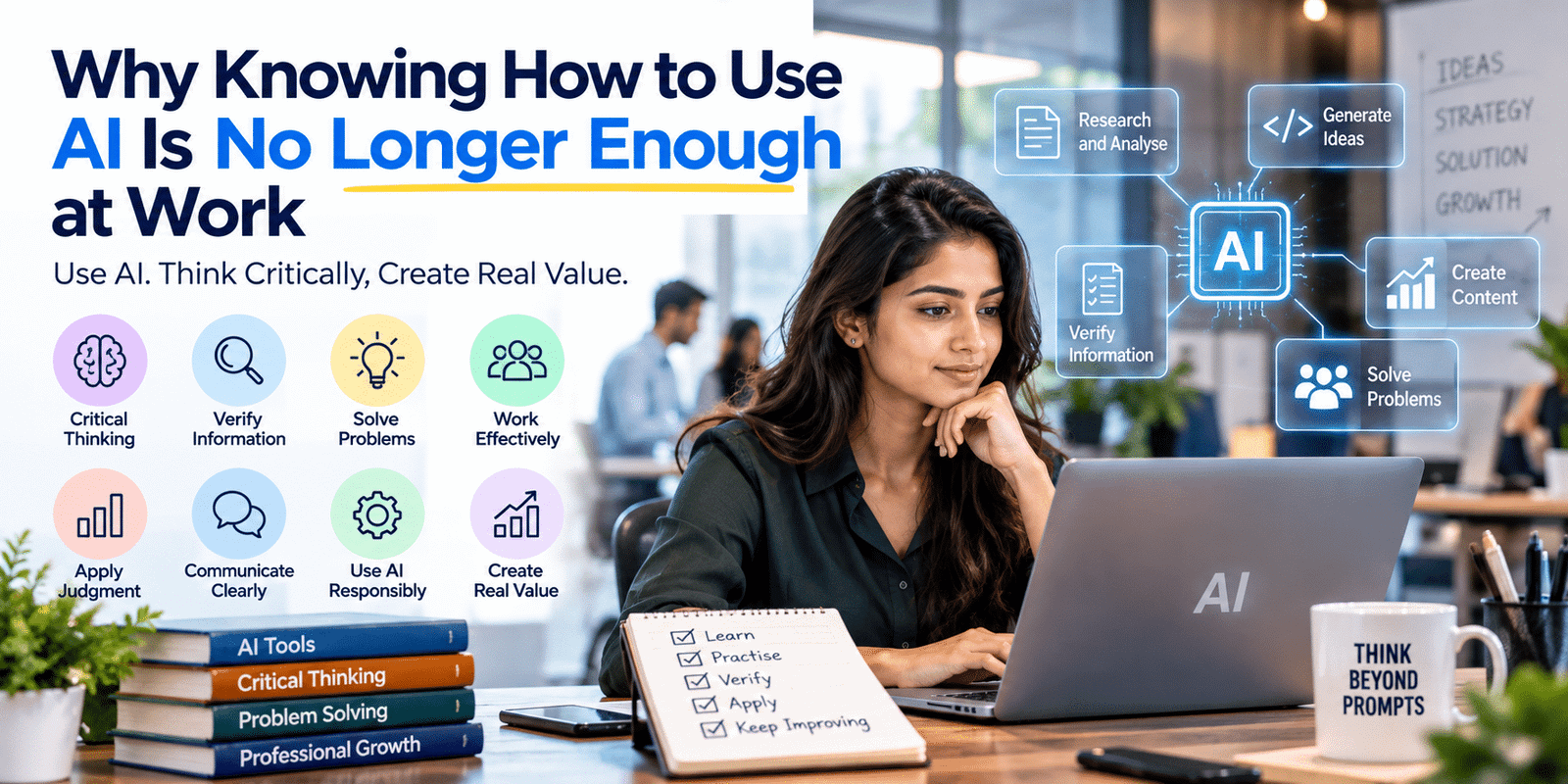
Why Knowing How to Use AI Is No Longer Enough at Work
AI skills at work are becoming increasingly important as professionals use artificial intelligence for research, writing, coding, analysis, communication, and everyday business tasks. However, knowing how to use an AI tool is only the beginning. Professionals also need to understand how to verify information, apply critical thinking, solve problems, and use AI responsibly.
The more important question is how effectively a person can work with AI. This includes understanding the problem, asking useful questions, checking AI-generated information, making sound decisions, and applying the results to real business situations.
Deloitte’s 2026 research shows that AI adoption is already widespread among India’s workforce, while organisations are also investing in AI upskilling. At the same time, the World Economic Forum has highlighted the growing importance of human judgment as AI becomes more common at work.
Why AI Skills at Work Are Changing
AI is moving from an optional productivity tool to something that is increasingly integrated into everyday workflows. Indian enterprises are already using AI across areas such as product development, strategy, operations, marketing, and supply chain.
As adoption grows, simply knowing how to use an AI chatbot may not be enough. Professionals need to understand where AI can add value, where human involvement is necessary, and how to combine technology with their existing expertise.
Knowing AI Tools vs Knowing How to Work With AI
There is a difference between using AI and working effectively with AI.
Someone may know how to generate a report using AI. Another professional may know how to define the objective, provide the right context, evaluate the output, identify errors, and turn the useful information into a business decision.
The second approach requires more than tool knowledge. It requires professional judgment and an understanding of the problem being solved.
Why AI Output Still Needs Human Judgment
AI can produce convincing answers that may still contain errors, missing context, or incorrect assumptions.
For this reason, professionals should not automatically accept every AI-generated result. They need to review information, compare it with reliable sources, and decide whether it is appropriate for the situation.
The World Economic Forum has specifically discussed how the spread of AI is increasing the importance of human judgment in work.
The Importance of Critical Thinking in AI-Assisted Work
Critical thinking becomes especially important when AI is involved in decision-making.
A professional should be able to ask:
- Is this information accurate?
- What evidence supports it?
- Is anything missing?
- Does the answer fit the actual situation?
- What could go wrong if we follow this recommendation?
- Do we need additional information before making a decision?
AI can help generate possibilities, but people still need to evaluate them.
Why Asking the Right Questions Matters
The quality of an AI response often depends on the quality of the instructions provided.
For example, instead of asking an AI tool to “write a marketing plan,” a professional could explain the target audience, business objective, budget, timeline, product, and expected outcome.
Better questions provide better context. More importantly, learning how to frame a problem clearly is a valuable professional skill even when AI is not involved.
How Professionals Can Verify AI-Generated Information
Verification should become a normal part of AI-assisted work.
Professionals can:
- Check important facts against reliable sources.
- Review calculations and assumptions.
- Compare AI-generated suggestions with internal data.
- Look for missing context.
- Test technical outputs before using them.
- Consider privacy, security, and compliance requirements.
This is particularly important when AI is used for decisions that affect customers, employees, finances, or business operations.
Why Problem-Solving Still Matters in an AI Workplace
AI can help identify patterns, generate ideas, and suggest solutions. However, professionals still need to understand the underlying problem.
For example, an AI tool might suggest five solutions for a customer-service issue. A professional must determine which solution is realistic, affordable, appropriate for the customer, and consistent with company policies.
The value therefore comes from combining AI capabilities with human problem-solving.
AI Skills at Work Across Different Industries
AI skills are not limited to software development.
A marketer may use AI to analyse campaign data. A finance professional may use it to identify patterns in reports. A designer may use AI during the creative process. A recruiter may use AI for parts of candidate screening. A customer-service professional may use AI to prepare responses.
The tools and use cases differ, but the underlying capabilities remain similar: understanding the task, using AI appropriately, checking results, and applying professional judgment.
How AI Is Changing Entry-Level Roles
AI is also changing what organisations expect from early-career professionals.
Deloitte’s 2026 India campus research reports that 35% of organisations surveyed said AI adoption is creating new entry-level roles or skill requirements, while 86% reported that AI or agentic AI is transforming recruitment processes.
This does not mean every entry-level role will require advanced AI development skills. Instead, professionals may increasingly need to understand how AI can support their particular role.
Why Communication Still Matters When Using AI
AI does not remove the need for communication.
Professionals still need to explain decisions, present ideas, discuss problems with colleagues, communicate with customers, and collaborate with teams.
In fact, when AI becomes part of a workflow, communication can become even more important because people need to explain how AI-generated information was used and why a particular decision was made.
The Risk of Depending Too Much on AI
AI can save time, but excessive dependence can create problems.
If professionals stop questioning results, they may overlook errors. If they use AI without understanding the underlying task, they may struggle when the tool produces an unexpected answer.
The goal should therefore not be to replace professional thinking with AI. Instead, professionals can use AI to support their thinking while remaining responsible for the final outcome.
How Professionals Can Build Better AI Skills
Developing AI skills does not necessarily mean becoming an AI engineer.
Professionals can start by:
- Learning the AI tools relevant to their role.
- Understanding basic AI concepts.
- Practising clear and specific prompting.
- Learning how to verify AI-generated information.
- Applying AI to real work problems.
- Reviewing the quality of AI-assisted work.
- Understanding privacy and responsible-use considerations.
- Keeping up with changes in AI capabilities.
Deloitte and nasscom’s AI skills framework similarly describes different levels of AI capability, ranging from general AI literacy and AI use to integrating AI into workflows and building AI systems.
What Employers May Look for Beyond AI Tool Knowledge
Knowing an AI tool may demonstrate technical familiarity, but employers may also need evidence that a person can use it effectively.
This could include the ability to:
- Understand business problems.
- Think critically.
- Communicate clearly.
- Analyse information.
- Make decisions.
- Solve unfamiliar problems.
- Work collaboratively.
- Learn new technologies quickly.
The combination of technical capability and human skills can become increasingly important as AI becomes embedded in professional workflows.
How to Combine AI Skills With Human Capabilities
A useful approach is to think of AI as one part of a larger professional skill set.
AI capability + domain knowledge + critical thinking + communication + problem-solving = stronger professional value.
For example, a software developer who understands coding, system design, testing, and AI-assisted development can use AI more effectively than someone who only knows how to generate code.
The same principle applies across other professions.
A Practical Framework for Using AI Responsibly at Work
Professionals can follow a simple process:
Understand → Ask → Generate → Verify → Improve → Apply
First, understand the problem. Then provide useful context and ask a clear question. Review the generated result carefully, verify important information, improve the output, and finally apply it to the real situation.
This keeps the professional involved throughout the process rather than treating AI as an automatic decision-maker.
What Professionals Can Start Doing Today
Start with one repetitive or time-consuming task in your current work.
Explore whether AI can help with it. Then compare the AI-assisted approach with your normal workflow.
Pay attention to what AI does well, where it makes mistakes, and where your own judgment is still necessary.
Over time, this creates a better understanding of how AI can support your specific role.
Final Thoughts: Use AI, But Keep Thinking
AI skills at work are becoming more important, but professional value is not simply about knowing how to use the latest tool.
The stronger capability is knowing when to use AI, how to use it effectively, how to verify its output, and when human judgment should take over.
As AI becomes more deeply integrated into professional workflows, the ability to combine technology with critical thinking, domain knowledge, communication, and problem-solving can become an important part of career development.
Internal Links
Professionals who want to strengthen their skills can also explore how continuous learning supports career growth.
Strong problem-solving skills remain valuable when working with AI because professionals still need to understand the problem before choosing a solution.
Outbound Links
The World Economic Forum highlights the growing importance of technological literacy, analytical thinking, and human capabilities as workplaces evolve.
Deloitte’s 2026 India research provides recent insights into how AI adoption is changing workplace skills and learning.