
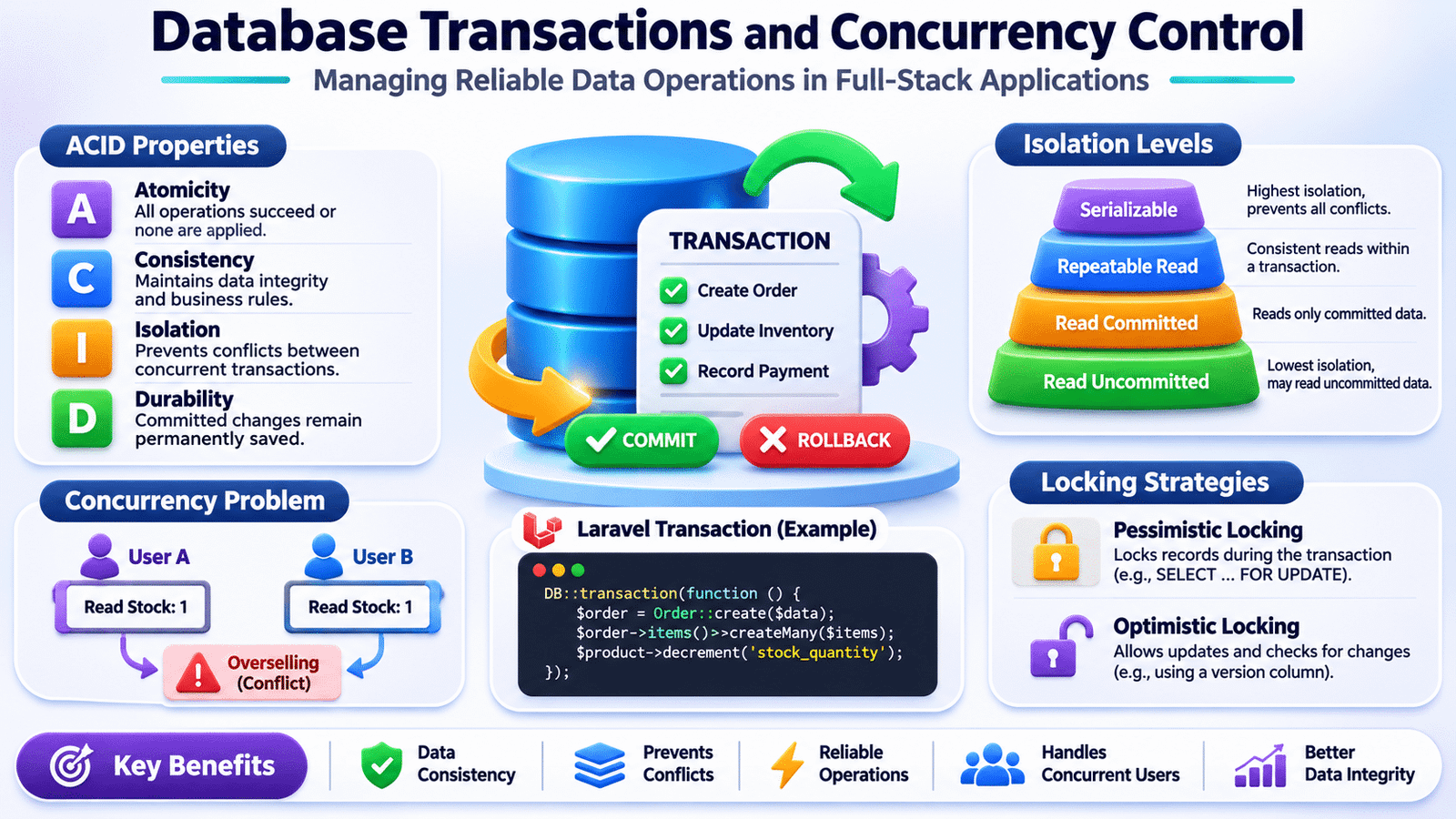
Modern applications frequently handle multiple operations that must work together to maintain accurate business information. An e-commerce platform, for example, may need to create an order, reserve product inventory, record payment information, and update the order status during checkout.
These operations are closely related. If the application creates an order but fails to update inventory, the system may contain inconsistent information. Similarly, if two customers attempt to purchase the last available product simultaneously, the application must prevent both transactions from incorrectly claiming the same stock.
These situations are not unusual in production applications. They are common challenges in systems that process payments, manage inventory, handle reservations, or update financial records.
Database transactions provide a mechanism for grouping related database operations into a logical unit. Concurrency control ensures that simultaneous operations do not interfere with one another in ways that compromise data accuracy.
For full-stack developers, understanding transactions, isolation levels, database locking, and concurrent execution is essential when building reliable applications.
This article explores how database transactions work, why concurrency problems occur, and how developers can handle these situations using MySQL and Laravel.
1. Understanding Database Transactions in Modern Applications
A database transaction is a group of database operations treated as one logical unit of work.
The operations within a transaction should either complete successfully together or be rolled back when an error prevents the transaction from completing.
Consider an online shopping application where a customer purchases a product.
The checkout operation may involve:
- Creating an order.
- Adding the selected products to the order.
- Reducing available inventory.
- Recording payment information.
- Updating the order status.
If the inventory update fails after the order has been created, the application should not leave an incomplete order in the database.
A transaction allows related database changes to be handled together.
A simplified workflow looks like this:
          Customer Checkout
                  |
                  v
           Begin Transaction
                  |
          +-------+-------+
          |       |       |
          v       v       v
       Create  Update   Record
       Order   Stock    Payment
          |       |       |
          +-------+-------+
                  |
                  v
            All Successful?
               /    \
             Yes     No
              |       |
              v       v
            COMMIT  ROLLBACK
              |       |
              v       v
          Save Data  Undo Changes
This helps maintain consistency between related database records.
2. Understanding the ACID Properties
Database transactions are commonly explained through four important properties known as ACID.
These properties describe the guarantees that transactional database operations aim to provide.
Atomicity
Atomicity means that a transaction is treated as a single unit.
Either all operations succeed, or the transaction is rolled back.
For example, if an application creates an order but fails while inserting its order items, the transaction can roll back the order creation as well.
Consistency
Consistency means that a transaction preserves the database’s defined rules and constraints.
For example, an order should not reference a non-existent customer, and a product’s stock quantity should not become negative if the business rules prohibit negative inventory.
Database constraints and application validations help maintain these rules.
Isolation
Isolation controls how concurrent transactions interact with one another.
When multiple users update related information simultaneously, the database must manage their operations according to the configured isolation level.
For example, two checkout requests should not both reduce the stock of the same product based on an outdated inventory value.
Durability
Durability means that successfully committed changes are retained according to the database’s durability guarantees.
After a transaction commits, the application should be able to rely on the committed data even if a later application request fails.
These four properties form the foundation of reliable transactional database operations.
3. Understanding COMMIT and ROLLBACK
Two important operations in transaction management are COMMIT and ROLLBACK.
COMMIT
COMMIT permanently applies the changes made within a successful transaction.
For example:
START TRANSACTION;

UPDATE accounts
SET balance = balance - 500
WHERE id = 1;

UPDATE accounts
SET balance = balance + 500
WHERE id = 2;

COMMIT;
This example transfers an amount between two accounts.
Both updates are committed together when the transaction succeeds.
ROLLBACK
ROLLBACK cancels the uncommitted changes made within the current transaction.
For example:
START TRANSACTION;

UPDATE products
SET stock_quantity = stock_quantity - 1
WHERE id = 101;

ROLLBACK;
The stock update is cancelled because the transaction is rolled back.
In real applications, rollback is particularly useful when one operation fails after other related changes have already been executed.
Developers should also understand that transaction behavior depends on the database engine and transaction boundaries. In MySQL, transactional tables such as InnoDB support these operations.
4. Understanding Concurrency in Database Applications
Concurrency occurs when multiple operations execute during overlapping periods.
Consider a ticket-booking platform with only one seat remaining.
Two customers open the application and attempt to book that seat at almost the same time.
Both requests may read the available seat count before either request completes its update.
Without appropriate concurrency control, both requests might believe that the seat is available.
This can lead to overselling or duplicate reservations.
A simplified scenario:
Customer A              Customer B
    |                       |
    v                       v
Read Available: 1      Read Available: 1
    |                       |
    v                       v
Book Seat              Book Seat
    |                       |
    +-----------+-----------+
                |
                v
       Both Requests Succeed
                |
                v
       Incorrect Inventory
Concurrency control helps prevent this kind of conflict.
Databases use transaction isolation, locking, and other mechanisms to coordinate simultaneous operations.
5. Common Concurrency Problems
When multiple transactions access the same records, several types of concurrency problems can occur.
Dirty Reads
A dirty read happens when one transaction reads data modified by another transaction that has not yet committed.
If the second transaction rolls back, the first transaction has read information that was never permanently saved.
Non-Repeatable Reads
A non-repeatable read occurs when a transaction reads the same record twice and gets different values because another transaction committed an update between those reads.
Phantom Reads
A phantom read occurs when a transaction repeats a query that returns a set of records and sees additional or missing rows because another transaction committed changes matching the query conditions.
Lost Updates
A lost update occurs when two transactions read the same value, independently calculate changes, and then overwrite each other’s results.
For example, two requests may both read a stock quantity of 10. One request reduces it to 9, while another also writes 9. One of the intended decrements is lost.
These problems demonstrate why applications need appropriate transaction and concurrency strategies.
6. Understanding Database Isolation Levels
Transaction isolation levels determine how much one transaction is protected from changes made by other concurrent transactions.
MySQL supports four standard isolation levels.
Read Uncommitted
This is the least restrictive isolation level.
Transactions may read uncommitted changes from other transactions, which means dirty reads are possible.
It is rarely suitable for business operations requiring dependable data.
Read Committed
A transaction reads only committed data.
However, repeating the same query may return different results if another transaction commits changes between the queries.
Repeatable Read
This isolation level provides consistent reads within a transaction according to MySQL InnoDB’s behavior.
It is the default isolation level in MySQL InnoDB.
It helps prevent non-repeatable reads, although locking reads and concurrent updates have additional behavior that developers should understand.
Serializable
Serializable provides the strictest standard isolation level.
It restricts concurrent transaction behavior more heavily to prevent serialization anomalies.
This can reduce concurrency and increase contention.
| Isolation level | Dirty reads | Non-repeatable reads | Phantom reads |
|---|---|---|---|
| Read Uncommitted | Possible | Possible | Possible |
| Read Committed | Prevented | Possible | Possible |
| Repeatable Read | Prevented | Prevented | Prevented for standard InnoDB consistent-read behavior |
| Serializable | Prevented | Prevented | Prevented |
The appropriate isolation level depends on the business operation, database engine, and consistency requirements.
Higher isolation is not automatically better for every application because it may reduce concurrency and increase locking overhead.
7. Understanding Pessimistic Locking
Pessimistic locking assumes that concurrent conflicts may occur and locks records while a transaction performs an operation.
Consider a product with one unit remaining.
Before reducing its stock, the application can lock the product record so another transaction cannot perform a conflicting locking update until the current transaction finishes.
MySQL supports row-level locking through SELECT ... FOR UPDATE.
Example:
START TRANSACTION;

SELECT stock_quantity
FROM products
WHERE id = 101
FOR UPDATE;

UPDATE products
SET stock_quantity = stock_quantity - 1
WHERE id = 101
AND stock_quantity > 0;

COMMIT;
The application should check whether the update affected a row and roll back if the product is unavailable.
The locking read must be performed inside a transaction.
Pessimistic locking is useful for:
- Inventory reservation.
- Ticket booking.
- Account balance updates.
- Limited-quantity purchases.
- Critical resource allocation.
However, locks should be held for as little time as possible. Long-running transactions can block other operations and increase deadlock risk.
8. Understanding Optimistic Locking
Optimistic locking assumes that conflicts are relatively uncommon.
Instead of locking a record throughout the operation, the application checks whether the record has changed since it was originally read.
A common approach uses a version column.
Consider a products table containing:
| id | name | stock_quantity | version |
|---|---|---|---|
| 101 | Laptop | 10 | 1 |
An application reads the product with version 1.
When updating the stock, it includes the expected version:
UPDATE products
SET stock_quantity = 9,
    version = version + 1
WHERE id = 101
AND version = 1;
If another transaction has already updated the record, the version will no longer be 1.
The update will affect zero rows, indicating that the application must reload the latest information and handle the conflict.
Optimistic locking is useful when:
- Conflicts are relatively uncommon.
- Users edit records over longer periods.
- The application needs to detect outdated updates.
- Locking records continuously would reduce concurrency.
The application must check the affected row count and define how conflicts should be communicated to users.
9. Implementing Database Transactions Using Laravel
Laravel provides a convenient database transaction API through its DB facade.
Consider an order creation workflow that needs to create an order and its associated order items.
A basic implementation looks like this:
use Illuminate\Support\Facades\DB;

DB::transaction(function () use ($orderData) {

    $order = Order::create([
        'user_id' => $orderData['user_id'],
        'total' => $orderData['total'],
        'status' => 'pending',
    ]);

    foreach ($orderData['items'] as $item) {
        $order->items()->create($item);
    }

});
Laravel automatically commits the transaction if the closure completes successfully.
If an exception occurs, Laravel rolls back the transaction.
This keeps related database changes together.
For operations that require additional error handling, developers can catch exceptions outside the transaction:
try {
    DB::transaction(function () use ($orderData) {
        // Perform related database operations.
    });
} catch (\Throwable $exception) {
    report($exception);

    throw $exception;
}
Error handling should preserve the failure information rather than silently ignoring exceptions.
10. Preventing Overselling with Laravel Row Locking
Consider a product inventory system where several customers may attempt to purchase the same product simultaneously.
The application should check stock and update it within a transaction.
Laravel provides lockForUpdate() for pessimistic locking.
use Illuminate\Support\Facades\DB;
use App\Models\Product;

DB::transaction(function () use ($productId) {

    $product = Product::where('id', $productId)
        ->lockForUpdate()
        ->firstOrFail();

    if ($product->stock_quantity < 1) {
        throw new \RuntimeException(
            'Product is out of stock.'
        );
    }

    $product->decrement('stock_quantity');

});
The transaction locks the selected product record before checking and updating its stock.
A second transaction attempting the same locking operation must wait until the first transaction releases the lock.
For operations involving multiple products, developers should consider locking records in a consistent order to reduce deadlock risk.
They should also validate product quantities and ensure all related order changes are part of an appropriate transaction boundary.
11. Handling Concurrent Payments and Duplicate Requests
Payment workflows require careful transaction and concurrency management.
Consider a customer clicking the payment button multiple times because the frontend appears unresponsive.
The backend may receive multiple requests for the same order.
If the application processes every request independently, it could accidentally create duplicate payment attempts or financial records.
A reliable implementation should consider:
- Unique payment references.
- Idempotency keys.
- Database uniqueness constraints.
- Payment status validation.
- Transaction boundaries.
- External payment provider responses.
For example, a payments table may include a unique idempotency key.
CREATE TABLE payments (
    id BIGINT PRIMARY KEY AUTO_INCREMENT,
    order_id BIGINT NOT NULL,
    idempotency_key VARCHAR(100) NOT NULL UNIQUE,
    status VARCHAR(30) NOT NULL,
    amount DECIMAL(12, 2) NOT NULL
);
The backend can use this key to identify repeated requests belonging to the same logical payment operation.
A database transaction can protect the creation and updating of local payment records.
However, a database transaction cannot automatically roll back a payment already completed by an external payment provider.
Distributed payment workflows therefore require additional mechanisms such as provider-side idempotency, transaction state management, reconciliation, and carefully designed recovery procedures.
12. Understanding Database Deadlocks
A deadlock occurs when two or more transactions wait for resources held by one another, preventing them from continuing.
Consider two transactions:
Transaction A             Transaction B
      |                         |
      v                         v
Lock Product 1             Lock Product 2
      |                         |
      v                         v
Request Product 2          Request Product 1
      |                         |
      +-----------+-------------+
                  |
                  v
             Deadlock
Transaction A holds Product 1 and waits for Product 2.
Transaction B holds Product 2 and waits for Product 1.
Neither transaction can proceed.
MySQL InnoDB detects deadlocks and rolls back one of the transactions so the other can continue.
How Developers Can Reduce Deadlocks
- Access records in a consistent order.
- Keep transactions short.
- Avoid unnecessary locks.
- Create appropriate indexes for locking queries.
- Avoid performing external API requests inside database transactions.
- Handle deadlock exceptions safely.
- Retry eligible transactions with a limited retry strategy.
Laravel’s transaction method supports a retry-attempt parameter for deadlocks:
DB::transaction(function () {
    // Perform transactional database operations.
}, 3);
The retry count should be chosen carefully. Retrying is suitable only when the operation is safe to execute again.
13. Managing Database Transactions with External Services
Modern applications often perform operations involving both databases and external services.
For example, an order workflow may need to:
- Create an order in MySQL.
- Request payment authorization from an external provider.
- Update the order status.
- Send a confirmation notification.
A database transaction can protect the database operations, but it cannot make the external payment provider part of the same MySQL transaction.
This distinction is important.
Holding database locks while waiting for an external API response can also create unnecessary blocking.
A better approach is to design the workflow around explicit business states.
For example:
Order Created
      |
      v
Payment Pending
      |
      v
Payment Authorization
      |
   +--+--+
   |     |
Success Failure
   |     |
   v     v
Confirmed Failed
The application can record each state transition and use background processing to handle notifications and other follow-up operations.
For complex distributed workflows, patterns such as the Saga Pattern can help coordinate operations across multiple services.
14. Testing Concurrent Database Operations
Transaction logic should be tested under realistic conditions.
A test that executes one request at a time may not reveal problems that appear when multiple users access the same records simultaneously.
Consider an inventory system with only one product remaining.
A concurrency test should verify that when two checkout requests attempt to purchase that product, only one request successfully reserves it.
Important scenarios to test include:
- Two requests updating the same product.
- Multiple users booking the same seat.
- Duplicate payment submissions.
- Transactions failing midway.
- Concurrent updates to account balances.
- Deadlock handling and retries.
- Rollback behavior after validation failures.
Developers should use a database engine and configuration that accurately represent production behavior.
For example, SQLite-based tests may not reproduce every locking and isolation behavior of MySQL InnoDB.
Concurrency tests should verify both the final database state and the API responses returned to users.
15. Monitoring Transaction Performance in Production
Transaction management should be monitored after deployment.
Important metrics include:
- Transaction execution time.
- Lock wait duration.
- Deadlock frequency.
- Transaction rollback count.
- Database connection usage.
- Long-running transactions.
- Failed payment operations.
- Query execution time.
Long-running transactions can hold locks and affect unrelated application operations.
Developers should investigate transactions that perform unnecessary work, wait for external services, or retrieve large amounts of data while holding locks.
Database monitoring helps identify these issues before they create significant production problems.
16. Common Database Transaction Mistakes
Several mistakes can affect transactional reliability.
Missing transaction boundaries: Related operations execute independently, leaving incomplete records when one operation fails.
Long-running transactions: Locks remain active unnecessarily and block other requests.
Ignoring concurrency: Multiple requests update the same records without conflict handling.
Using incorrect isolation assumptions: Application logic expects guarantees that the configured isolation level does not provide.
Ignoring deadlocks: Applications fail without appropriate error handling or safe retries.
Duplicating financial operations: Repeated requests create multiple payment or order records.
Calling external services inside transactions: Database locks remain held while the application waits for network operations.
Insufficient testing: Transaction logic works in simple tests but fails under simultaneous requests.
These problems can be avoided through clear transaction boundaries, appropriate locking, and realistic testing.
17. Best Practices for Reliable Database Transactions
Development teams should follow these practices when implementing transactional workflows:
- Group related database operations into transactions.
- Use constraints to enforce important data rules.
- Select isolation levels based on business requirements.
- Use pessimistic locking for critical shared resources when appropriate.
- Use optimistic locking for suitable low-conflict updates.
- Keep transactions as short as possible.
- Avoid external network calls inside database transactions.
- Handle deadlocks and transient failures safely.
- Use idempotency for payment and order workflows.
- Test concurrent operations using realistic database configurations.
- Monitor lock waits and transaction execution times.
- Document important business-state transitions.
Reliable transaction handling is not only about preventing database errors. It is about protecting the accuracy of business operations when multiple users and services interact with the same data.
18. Frequently Asked Questions
What are database transactions?
Database transactions group related operations into a logical unit that can be committed together or rolled back when an error occurs.
What are ACID properties?
ACID stands for Atomicity, Consistency, Isolation, and Durability. These properties describe important guarantees provided by transactional database systems.
What is concurrency control?
Concurrency control manages simultaneous database operations to prevent conflicting changes and maintain data consistency.
What is the difference between optimistic and pessimistic locking?
Pessimistic locking locks records while an operation is performed. Optimistic locking allows operations to proceed and checks whether the record changed before accepting an update.
What is a database deadlock?
A deadlock occurs when transactions wait for resources held by one another, preventing them from progressing until the database resolves the conflict.
How does Laravel handle database transactions?
Laravel provides DB::transaction() for grouping related operations and automatically committing or rolling them back based on the execution result.
What is the purpose of SELECT FOR UPDATE?
SELECT FOR UPDATE retrieves selected records with locks that prevent conflicting locking operations from modifying them until the transaction completes.
Why are transactions important in payment systems?
Transactions help maintain consistency between related local database records, while idempotency and external payment-provider mechanisms help prevent duplicate financial operations.
Final Thoughts
Database transactions and concurrency control are fundamental to building reliable full-stack applications.
As applications grow, multiple users may perform operations on the same records at nearly the same time. Without appropriate transaction management, this can result in duplicate orders, incorrect inventory, inconsistent financial records, and unexpected application behavior.
For full-stack developers working with Laravel and MySQL, understanding ACID properties, isolation levels, locking strategies, deadlocks, and concurrent execution provides the foundation for handling these challenges.
Reliable database operations require more than writing queries that work under normal conditions. They require designing workflows that remain accurate when operations fail, overlap, or execute simultaneously.
Internal links
Database Design for Full-Stack Applications
Database Performance Optimization
Message Queues for Full-Stack Developers