
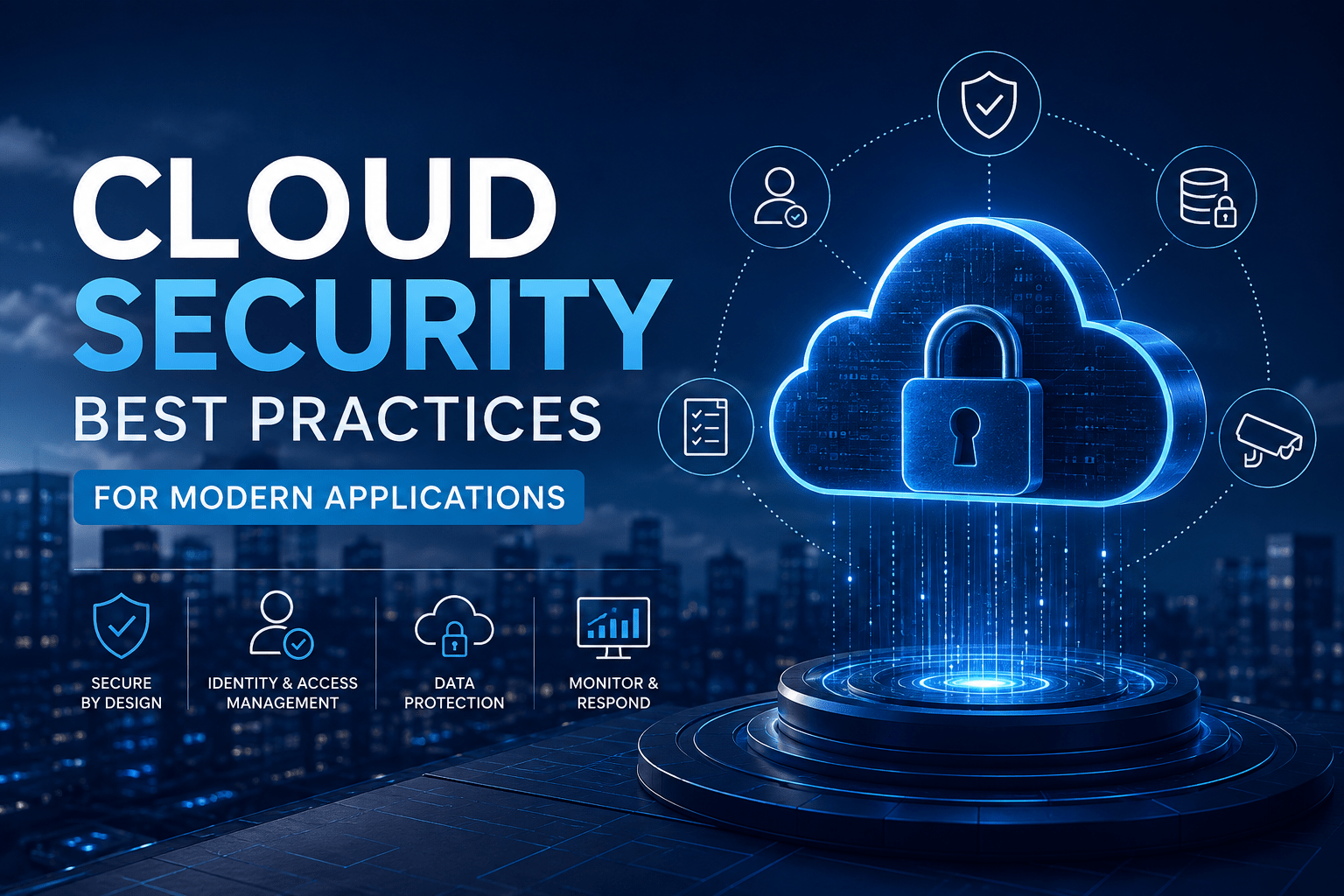
Cloud security is no longer something organizations address only during migration. As businesses increasingly rely on AWS, Microsoft Azure, Google Cloud, and hybrid environments, security has become an ongoing responsibility that spans applications, infrastructure, identities, and data.
This guide covers the cloud security best practices every organization should follow to reduce risks, strengthen defenses, and build secure cloud-native applications.
What Is Cloud Security?
Cloud security is the combination of policies, technologies, and processes used to protect cloud-hosted applications, infrastructure, and data. It includes identity and access management, encryption, network security, vulnerability management, monitoring, and compliance.
One of the most important concepts in cloud security is the shared responsibility model. Cloud providers secure the underlying infrastructure, while customers are responsible for securing their applications, identities, data, and configurations. Misunderstanding this responsibility remains one of the leading causes of cloud security incidents.
Why Cloud Security Matters
Cloud adoption has transformed how applications are built and deployed. Organizations now manage multiple cloud providers, microservices, containers, APIs, and third-party integrations, all of which expand the attack surface.
Cybercriminals increasingly automate attacks by scanning for exposed storage buckets, leaked credentials, vulnerable APIs, and outdated software. As a result, organizations must continuously monitor and secure their environments rather than relying on periodic security reviews.
Cloud Security Best Practices
1. Strengthen Identity and Access Management (IAM)
Identity is often the first target during a cloud attack. Protecting user accounts and service identities should be a top priority.
Best practices include:
- Enable multi-factor authentication (MFA) for every account.
- Follow the principle of least privilege.
- Rotate credentials regularly.
- Use temporary credentials instead of long-lived API keys.
- Review user permissions on a scheduled basis.
Strong IAM significantly reduces the risk of unauthorized access.
2. Adopt a Zero Trust Security Model
Traditional network perimeters no longer exist in cloud environments. Zero Trust assumes that no user, device, or workload should be trusted automatically.
Organizations should:
- Verify every request before granting access.
- Authenticate and authorize every user and service.
- Implement microsegmentation to isolate workloads.
- Continuously evaluate device and user behavior.
Zero Trust minimizes lateral movement if attackers gain access to part of the environment.
3. Encrypt Data and Protect Encryption Keys
Sensitive information should always be encrypted both at rest and in transit using industry-standard encryption.
Equally important is secure key management. Store encryption keys in dedicated key management services (KMS), rotate them regularly, and restrict access using role-based permissions.
4. Prevent Cloud Misconfigurations
Misconfigured cloud resources remain one of the leading causes of data breaches.
Organizations should continuously scan for:
- Public storage buckets
- Overly permissive security groups
- Unencrypted databases
- Exposed administrative interfaces
Cloud Security Posture Management (CSPM) solutions help identify and remediate these risks before they become security incidents.
5. Secure APIs
Modern applications depend heavily on APIs, making them attractive targets for attackers.
Protect APIs by:
- Enforcing authentication and authorization
- Implementing rate limiting
- Validating all user input
- Using API gateways
- Maintaining an inventory of exposed endpoints
Strong API security protects both applications and customer data.
6. Protect Containers and Kubernetes
Containerized applications require dedicated security controls.
Organizations should:
- Scan container images before deployment.
- Avoid running containers with root privileges.
- Apply Kubernetes network policies.
- Keep base images updated.
- Remove unnecessary software from images.
These practices reduce the attack surface and improve workload security.
7. Integrate Security into CI/CD
Security should be part of the software development lifecycle rather than a final deployment step.
Automate security testing using:
- Static Application Security Testing (SAST)
- Dynamic Application Security Testing (DAST)
- Software Composition Analysis (SCA)
- Secrets scanning
Finding vulnerabilities during development is significantly faster and less expensive than fixing them after production deployment.
8. Continuously Monitor Cloud Environments
Effective cloud security’s requires continuous visibility.
Centralize logs using Security Information and Event Management (SIEM) platforms and monitor for unusual logins, privilege escalation, unexpected network activity, and configuration changes.
Well-configured alerts help security teams respond before minor issues become major incidents.
9. Maintain Compliance
Compliance frameworks such as GDPR, HIPAA, PCI DSS, and SOC 2 should be integrated into daily operations rather than treated as annual audit exercises.
Automated compliance monitoring helps organizations remain secure while reducing audit preparation effort.
10. Train Employees
Technology alone cannot prevent every security incident.
Regular cybersecurity awareness training helps employees recognize phishing attacks, protect credentials, and report suspicious activity. Building a strong security culture remains one of the most effective defenses against modern cyber threats.
Common Cloud Security Mistakes
Many cloud security incidents result from avoidable mistakes, including:
- Assuming the cloud provider handles all security responsibilities.
- Leaving default configurations unchanged.
- Granting excessive permissions.
- Failing to monitor cloud environments continuously.
- Neglecting employee cybersecurity training.
Avoiding these common issues significantly strengthens an organization’s security posture.
Cloud Security Checklist
Before deploying cloud applications, verify that you have:
- Multi-factor authentication enabled
- Least privilege access controls
- Encryption for data at rest and in transit
- Continuous configuration monitoring
- Secure API authentication
- Container vulnerability scanning
- Automated SAST, DAST, and dependency scanning
- Centralized logging and alerting
- Regular compliance reviews
- Employee cybersecurity training
Frequently Asked Questions
What is cloud security?
Cloud security’s refers to the policies, technologies, and processes used to protect cloud infrastructure, applications, and sensitive data from cyber threats.
What is the shared responsibility model?
Cloud providers secure the underlying infrastructure, while customers are responsible for securing their applications, identities, data, and configurations.
Why is Identity and Access Management important?
IAM controls who can access cloud resources. Strong authentication and least-privilege permissions help prevent unauthorized access and reduce security risks.
What is the biggest cloud security risk?
Misconfigured cloud resources, weak credentials, and excessive user permissions are among the most common causes of cloud securities breaches.
Conclusion
Cloud security is not a one-time task—it is a continuous process that evolves alongside modern applications. By implementing strong identity controls, adopting Zero Trust principles, encrypting sensitive data, securing APIs, integrating security into CI/CD pipelines, and continuously monitoring cloud environments, organizations can significantly reduce cyber risks.
Ultimately, successful cloud security’s depends on combining the right technologies with skilled professionals who understand secure development and operational best practices. Building security into every stage of the cloud journey creates more resilient applications and stronger protection against today’s evolving cyber threats.
Internal Links
- How to identify security flaws before deployment
- Ways to reduce ransomware risks for businesses
- Essential software engineering interview concepts
- How AI is changing modern education