
Ask any science teacher what keeps them up at night, and budget usually comes up in the first minute. Lab equipment is expensive. Chemicals expire. Microscopes break. And a class of thirty students crowded around two working Bunsen burners isn’t exactly the recipe for deep learning.
This is the gap that virtual labs were built to close — and over the last decade, they’ve quietly become one of the most important tools in modern education.
What Is a Virtual Lab?
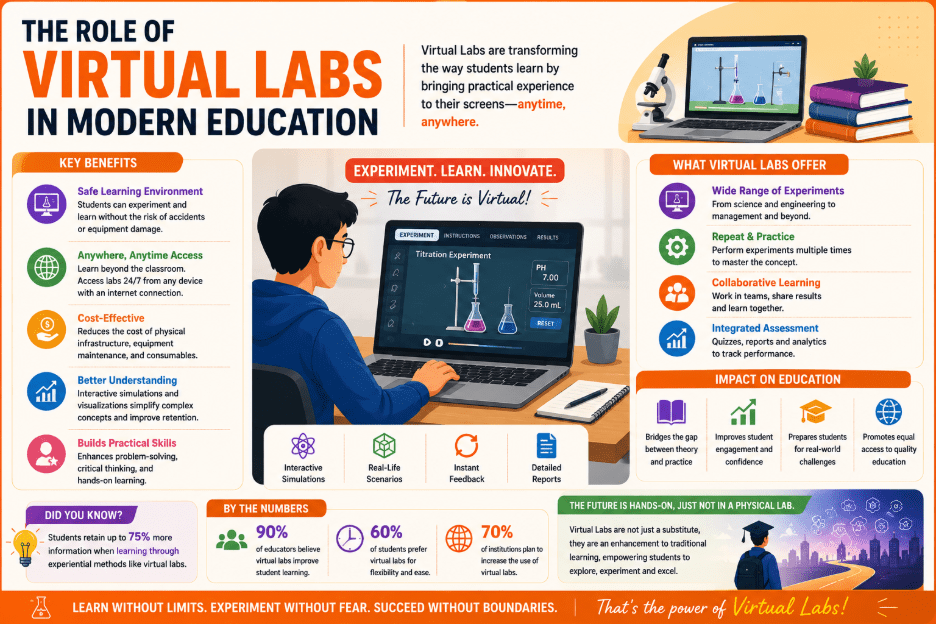
A virtual lab is a computer-based simulation of a real laboratory experiment. Instead of mixing chemicals on a bench or dissecting a specimen with a scalpel, students carry out the same procedure on a screen, with software standing in for the equipment and materials.
The best virtual lab platforms go further than a simple video or animation. They let a learner:
- Titrate a solution
- Wire a circuit
- Run a genetics cross
- Troubleshoot a network configuration
And crucially, they respond to what the student does step by step — the same way a physical lab would.
Why Virtual Labs Have Become Central to Modern Education
Three forces pushed virtual labs from a niche experiment into a mainstream part of online learning and classroom teaching alike.
1. Cost
Physical lab infrastructure is one of the biggest line items in a science or engineering department’s budget. Glassware breaks, reagents run out, and specialized machines need maintenance contracts.
A virtual laboratory is built once and can be used by thousands of students without buying a single test tube.
2. Access
Not every school has a fully equipped chemistry lab, and not every university has a spare CNC machine for undergraduates to practice on. Remote learning and distance education programs especially need a way to deliver hands-on learning to students who may never set foot on campus. A browser-based simulation solves that problem instantly.
3. The Pandemic
When campuses shut their doors, laboratory instruction didn’t stop — it moved online almost overnight. Institutions that already had virtual lab platforms in place kept teaching practical skills without interruption. Many that didn’t have one built or bought one in a hurry.
That shift never reversed. Faculty and students alike found real value in virtual labs, and they stayed even after classrooms reopened.
What Virtual Labs Actually Offer Students
It helps to look past the marketing language and ask what a student genuinely gains from a virtual lab session.
| Benefit | What It Means for Students |
|---|---|
| Repetition without cost | Repeat a titration or experiment ten times in an afternoon instead of getting one shot with limited reagent |
| Safety | Practice dangerous or expensive procedures — radioactive material, high-voltage circuits, surgical technique — before touching real equipment |
| Flexibility of pace | Pause, rewind, and work through a procedure at your own speed |
| Instant feedback | Get immediate correction if a measurement is off or a circuit is wired wrong |
| Access from anywhere | Log into a virtual chemistry lab from your bedroom at midnight with just a laptop |
Research on virtual laboratories in STEM has consistently found that this kind of repeated, low-stakes practice improves conceptual understanding — not just procedural memory.
Virtual Labs Aren’t Limited to Science Class
When people hear “virtual lab,” they usually picture chemistry beakers or biology dissections. But the concept has spread well beyond the science block:
- Engineering programs use virtual labs to simulate circuit design, robotics, and manufacturing processes
- Computer science and IT courses rely on virtual environments to teach networking, cybersecurity, and cloud infrastructure — since spinning up real servers for every student isn’t practical or safe
- Medical and nursing programs use simulation labs to practice patient scenarios before working with real patients
- Business and management courses now use simulated environments to let students run a virtual company, test pricing strategies, or manage a supply chain — without real-world risk
At its core, a virtual lab is any environment where a learner can practice a skill by doing it — safely and repeatedly — rather than just reading or watching how it’s done.
From the Lab to the Job: Virtual Labs and Career Readiness
Here’s where virtual labs earn their keep beyond the classroom. Employers don’t hire students for what they memorized — they hire for what they can actually do. A student who has only ever read about REST APIs or database design is at a real disadvantage compared to one who has built and broken things in a simulated environment first.
How Vyasa Nexus Connects Simulation to Career Outcomes
This is a big part of what platforms like Vyasa Nexus are built around. Rather than treating labs as an isolated academic exercise, Vyasa Nexus connects hands-on, simulation-based practice directly to career outcomes:
- Industry Project Packs — real-world simulation kits modeled on actual industry problems, so lab work looks like the work students will do in their first job
- Career Readiness Bootcamps — structured, outcome-focused training built on that foundation
- Placement & Internship Access Pass — turns practice into an actual internship placement, closing the loop between “I learned it in a simulation” and “I did it on the job”
- AI Productivity Packs — round out the practical skill set that recruiters are increasingly asking for
What This Means for Institutions
The same logic applies on a larger scale for institutions. A learning management system that includes simulation and virtual lab capability:
Lets institutions offer practical, lab-based courses without the overhead of a fully staffed physical facility for every subject
Gives faculty a way to prove learning outcomes with data, not just attendance records