
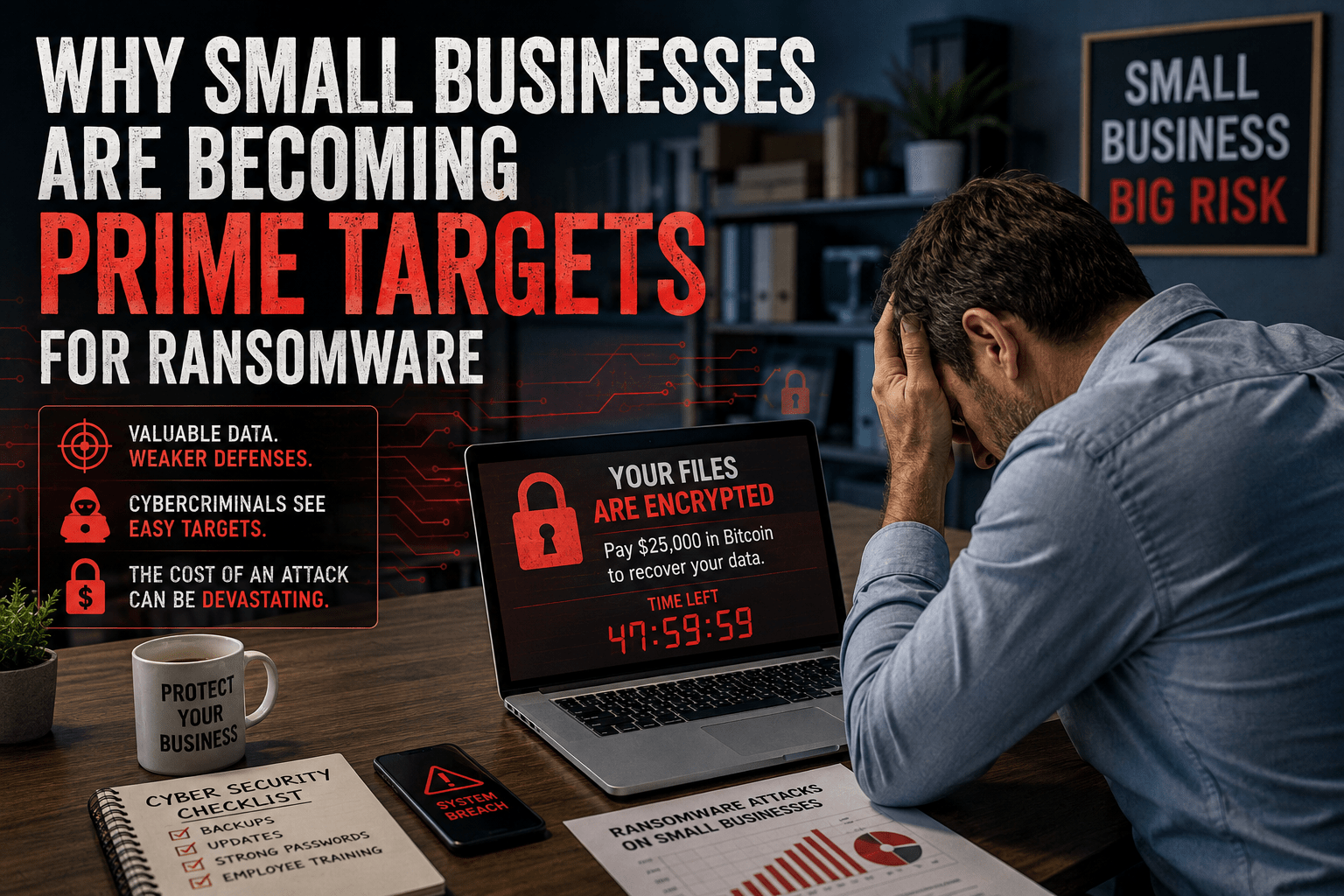
why hackers target small businesses: A hardware store in Ohio. A dental practice in Tampa. A three-person accounting firm that files taxes for half the small businesses in town. None of these businesses expected to become victims of cybercrime. Yet one morning, employees couldn’t log in, files were encrypted, and a ransom note demanded payment in cryptocurrency.
Unfortunately, this scenario is becoming increasingly common. Small businesses are no longer overlooked by cybercriminals. In fact, they have become some of the most attractive targets for ransomware attacks.
Why Do Hackers Target Small Businesses?
Hackers target small businesses because they offer the perfect balance of valuable data and weak cybersecurity. While large corporations invest heavily in security teams, monitoring tools, and incident response plans, many small businesses operate with limited IT budgets, outdated software, and minimal cybersecurity training.
Modern ransomware attacks are also highly automated. Attackers don’t need to choose victims individually—they scan the internet for vulnerable systems and exploit whichever businesses have the weakest defenses.
According to recent cybersecurity reports, ransomware is involved in the vast majority of security breaches affecting small businesses, highlighting how dramatically the threat landscape has shifted.
Why Small Businesses Are Easy Targets
Several factors make small businesses attractive to cybercriminals:
Limited Cybersecurity Resources
Most small businesses cannot afford dedicated cybersecurity professionals. IT responsibilities are often handled by a general technician or outsourced provider, leaving little time for proactive security management.
Valuable Business Data
Small companies still store customer records, payment information, employee data, financial documents, and intellectual property. This information is just as valuable to attackers as data held by larger organizations.
Outdated Systems
Many businesses delay software updates to avoid disrupting daily operations. Unfortunately, unpatched operating systems, applications, and remote access tools frequently contain vulnerabilities that attackers actively exploit.
The “We’re Too Small” Myth
One of the biggest misconceptions is that hackers only target large companies. In reality, ransomware campaigns are largely opportunistic. Automated tools search for exposed systems across the internet, and any vulnerable organization can become a victim regardless of its size.
How Ransomware Usually Gets In
Most ransomware attacks begin with surprisingly ordinary mistakes rather than sophisticated hacking.
Common entry points include:
- Phishing emails containing malicious links or attachments
- Weak or reused passwords
- Accounts without multi-factor authentication (MFA)
- Unpatched software vulnerabilities
- Exposed remote desktop or VPN services
Human error also plays a significant role. Without regular cybersecurity awareness training, employees may unknowingly click malicious links or provide login credentials to attackers.
The Real Cost of a Ransomware Attack
The ransom itself is often only a small part of the overall financial impact.
Businesses also face costs related to:
- System recovery and forensic investigations
- Lost productivity during downtime
- Legal and regulatory compliance
- Customer notification requirements
- Reputation damage
- Lost revenue and business opportunities
For many small businesses, even a few weeks of downtime can have long-lasting financial consequences. Customers may lose trust, vendors may question security practices, and rebuilding operations often costs far more than the ransom demand itself.
How Small Businesses Can Protect Themselves from hackers
The good news is that effective ransomware protection doesn’t always require expensive enterprise solutions.
Small businesses should focus on these essential security practices:
- Enable multi-factor authentication on all business accounts.
- Keep operating systems and software updated.
- Maintain regular offline or cloud backups and test them frequently.
- Train employees to recognize phishing emails and social engineering attacks.
- Use strong, unique passwords supported by a password manager.
- Limit administrator privileges to only those who truly need them.
- Create and regularly update an incident response plan.
These simple measures significantly reduce the likelihood of a successful ransomware attack and improve recovery if one occurs.
Why Employee Training Matters
Technology alone cannot stop every cyberattack. Even the best security software cannot prevent an employee from clicking a convincing phishing email.
Building cybersecurity awareness across the organization is one of the most effective investments a business can make. Regular training helps employees recognize suspicious emails, protect sensitive information, and respond appropriately when something seems unusual.
Organizations that combine strong security practices with ongoing employee education are generally far more resilient against ransomware than those relying solely on technical defenses.
Frequently Asked Questions
Why are small businesses targeted by hackers?
Small businesses often have weaker cybersecurity, limited IT resources, and valuable customer data, making them easier and more profitable targets for ransomware attacks.
What is the most common way ransomware infects a business?
Phishing emails remain the most common entry point, followed by weak passwords, outdated software, and unsecured remote access services.
Can small businesses recover from ransomware?
Yes, but recovery can be costly and time-consuming. Businesses with tested backups and a well-prepared incident response plan typically recover much faster than those without them.
What is the best defense against ransomware?
A combination of multi-factor authentication, regular software updates, secure backups, and employee cybersecurity training provides the strongest protection against ransomware.
Conclusion
Ransomware is no longer a problem reserved for large enterprises. Today’s cybercriminals increasingly target small businesses because they often have valuable data but fewer security defenses. The good news is that reducing your risk doesn’t require an unlimited budget. By implementing basic cybersecurity best practices, keeping systems updated, training employees, and preparing for incidents before they happen, small businesses can significantly improve their resilience against ransomware and protect both their operations and their customers.
Internal Links
- Technical Interview Preparation: The Complete Guide
- AI-Powered Learning: How Artificial Intelligence Is Transforming Education
- The Science of Forgetting: How to Remember Anything You Study
- Active Recall and Spaced Repetition: The Study Techniques That Actually Work
- 12 Proven Study Motivation Tips for Long Study Sessions
- Best Note-Taking Methods for Students
- Effective Time Management Strategies for Students
Outbound Links
- https://www.cisa.gov
- https://www.nist.gov/cyberframework
- https://owasp.org
- https://www.microsoft.com/security
- https://www.crowdstrike.com
- https://www.ibm.com/topics/ransomware
- https://www.cloudflare.com/learning/security/
- https://www.fbi.gov/investigate/cyber
- https://www.cisa.gov/stopransomware
- https://attack.mitre.org