
Introduction
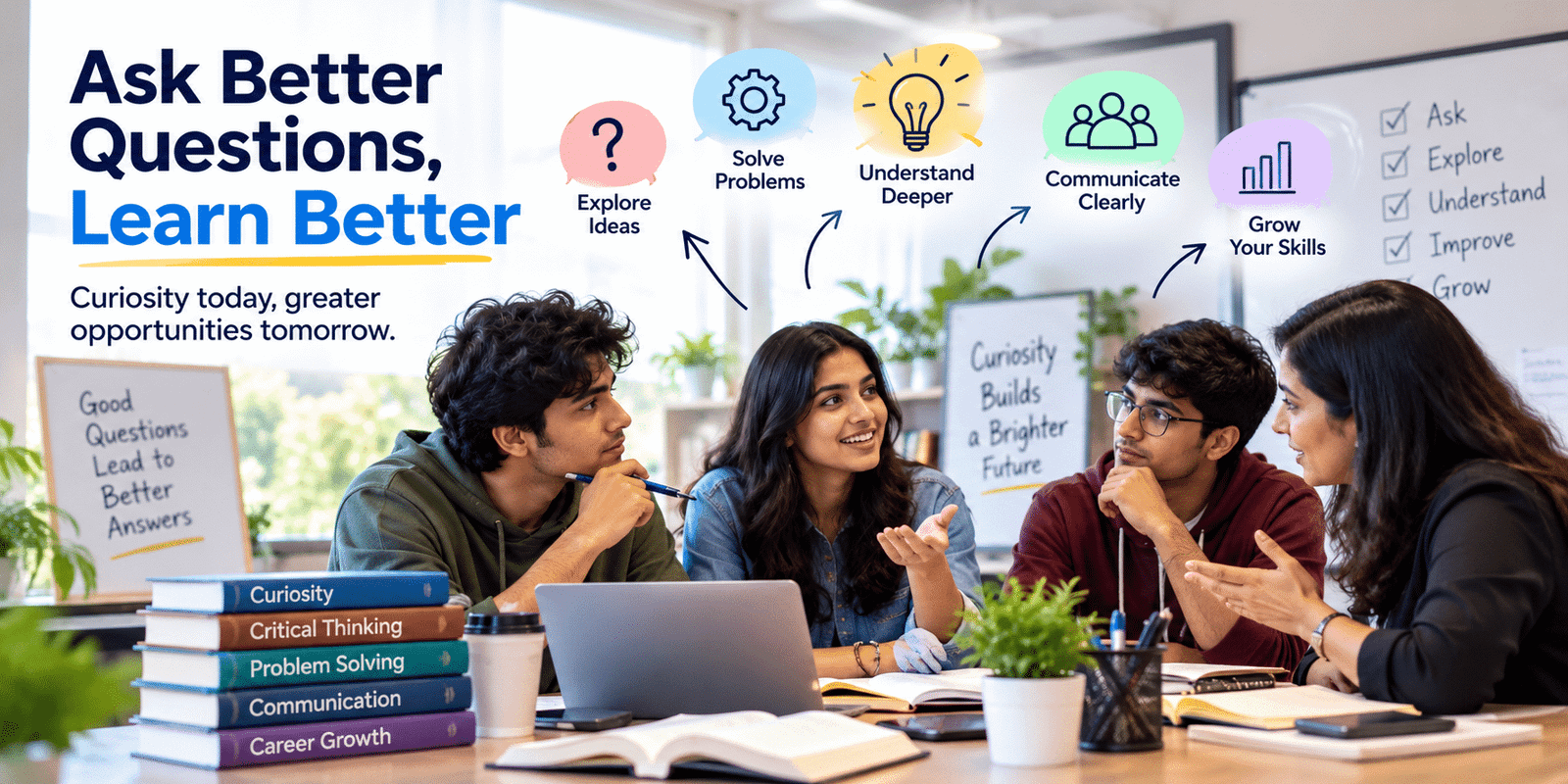
Asking questions for students can improve understanding, encourage curiosity, and help them solve problems more effectively. Instead of simply memorizing information, students can use thoughtful questions to explore concepts, identify gaps in their knowledge, and learn how ideas can be applied in real situations.
Why Asking Questions Is an Important Learning Skill
A student who asks questions is not simply looking for an answer. A good question can reveal what the student understands, what they are confused about, and what they want to explore further.
For example, instead of asking, “What is an API?”, a student who already understands the basic definition might ask, “Why would a project use an API instead of directly accessing the database?”
The second question moves from basic information toward understanding and application.
Why Students Sometimes Avoid Asking Questions
Many students hesitate to ask questions because they are worried about being judged or appearing less knowledgeable.
Some students may also believe that they should understand everything on their own. Others may simply not know how to frame their question.
Creating opportunities to practise questioning can help students become more comfortable with inquiry. Education practitioners have identified fear of judgment, lack of confidence, and an overemphasis on answers as some reasons students may hesitate to ask questions.
The Difference Between Asking Questions and Asking Better Questions
Not every question leads to deeper learning.
Consider these two questions:
“Is this project correct?”
and
“Which part of this project could be improved, and why?”
The first question mainly asks for a judgment. The second invites explanation and gives the student something specific to learn from.
Better questions often begin with how, why, what if, which, or what could be improved.
How Better Questions Improve Understanding
When students ask questions, they are forced to think about what they already know and what they still need to understand.
For example, while learning a programming concept, a student might ask:
- Why is this approach used?
- What happens if the input changes?
- Is there another way to solve this problem?
- When would this approach become inefficient?
- How could this concept be used in a real project?
These questions encourage students to explore the topic instead of simply memorising its definition.
How Asking Questions Helps Students Solve Real Problems
Real-world problems rarely come with clearly defined answers.
Before solving a problem, students often need to understand what the actual problem is. Asking questions can help them identify the cause, limitations, requirements, and possible solutions.
In science and engineering education, asking questions and defining problems are treated as foundational parts of inquiry and problem-solving.
Why Questions Matter During Projects
Projects give students an excellent opportunity to practise asking better questions.
Suppose a student is developing a website and notices that the page is loading slowly. Instead of immediately changing the code, the student could ask:
“Which part of the page is taking the most time to load?”
Then they might investigate network requests, image sizes, database queries, or other possible causes.
The quality of the question can influence the direction of the investigation.
Asking Better Questions During Internships
Internships can introduce students to unfamiliar tools, processes, and workplace expectations.
Instead of silently struggling with a task, students can ask specific questions such as:
“I understand the first part of the process, but I am not sure how this data should be validated. Could you explain what I should check?”
This shows that the student has already tried to understand the task and has identified the specific area where clarification is needed.
How Students Can Ask Better Questions to Mentors
Students can make their questions more useful by providing context.
Instead of:
“It is not working. What should I do?”
Try:
“I tried connecting the API and checked the authentication settings, but I am receiving a 401 response. Could you help me understand what I should check next?”
The second question gives the mentor enough information to understand the situation and provide more targeted guidance.
Why Asking Questions for Students Is an Important Learning Skill
Asking better questions can also help students become more independent learners.
Instead of waiting for someone to provide every answer, students can use questions to guide their own research.
For example:
Question: Why is my application slow?
Next questions:
- Where is the delay happening?
- How can I measure it?
- What tools can help me investigate?
- What changes could improve performance?
- How can I verify whether the solution worked?
The student is now using questions to create a learning path.
How Better Questions Help During Interviews
Questions are also important during job interviews.
At the end of an interview, students are often given an opportunity to ask questions. Asking something thoughtful about the role, team, learning opportunities, or responsibilities can create a more meaningful conversation.
For example:
“What would you expect a new graduate in this role to learn during the first few months?”
This is more informative than simply asking whether the company is hiring.
Examples of Weak Questions vs Better Questions
| Basic Question | Better Question |
|---|---|
| “Is this correct?” | “Which part could be improved?” |
| “Why isn’t this working?” | “Where does the process fail, and what have I already checked?” |
| “What should I learn?” | “Which skills would help me perform this role effectively?” |
| “Can you explain this?” | “Could you explain why this approach is preferred here?” |
| “Is there another way?” | “What alternative approaches could solve this problem?” |
The goal is not to make every question complicated. It is to make questions clear, specific, and useful.
How Students Can Practise Asking Better Questions
Students can build this skill through simple daily habits.
Ask one deeper question
After learning a topic, ask:
“Why does this work?”
Ask one practical question
Then ask:
“Where could I use this?”
Ask one alternative question
Finally, ask:
“Is there another way to approach this?”
This small habit can gradually change how students approach learning.
Common Mistakes Students Make When Asking Questions
Students should avoid:
- Asking questions without first understanding the basic information
- Asking very broad questions
- Repeating information that is already available
- Being afraid to ask for clarification
- Asking only for answers instead of explanations
- Giving up when the first question does not produce a useful answer
A good question often develops through a few smaller questions.
A Simple Framework for Asking Better Questions
Students can use this five-step approach:
1. Understand
Identify what you already know.
2. Identify the Gap
Find the exact part you do not understand.
3. Add Context
Explain what you have already tried.
4. Ask Clearly
Frame one specific question.
5. Follow Up
Use the answer to ask a deeper question if necessary.
This approach can be useful in classrooms, projects, internships, interviews, and professional environments.
What Students Can Start Doing Today
Students do not need to wait for a difficult project to practise questioning.
After every class or study session, they can write down:
- One thing they understood
- One thing they found confusing
- One question they want to investigate
- One practical situation where the concept could be used
Over time, these questions can become a personal learning roadmap.
Final Thoughts: Better Questions Lead to Better Learning
Students are often encouraged to find the correct answer. However, meaningful learning also begins with knowing what to ask.
Better questions can help students understand concepts more deeply, investigate problems, communicate with mentors, learn independently, and approach unfamiliar situations with curiosity.
The goal is not to ask more questions simply for the sake of asking. The goal is to ask questions that lead to better understanding.
Outbound Links
Students can explore practical approaches to developing better questions through this Edutopia resource
Students can also learn how questioning can support problem definition and deeper learning.
Internal Links
Asking better questions can also strengthen students’ problem-solving abilities.
Students can also develop stronger communication skills by learning how to express their questions clearly.
Practical projects give students opportunities to investigate problems and ask meaningful questions.