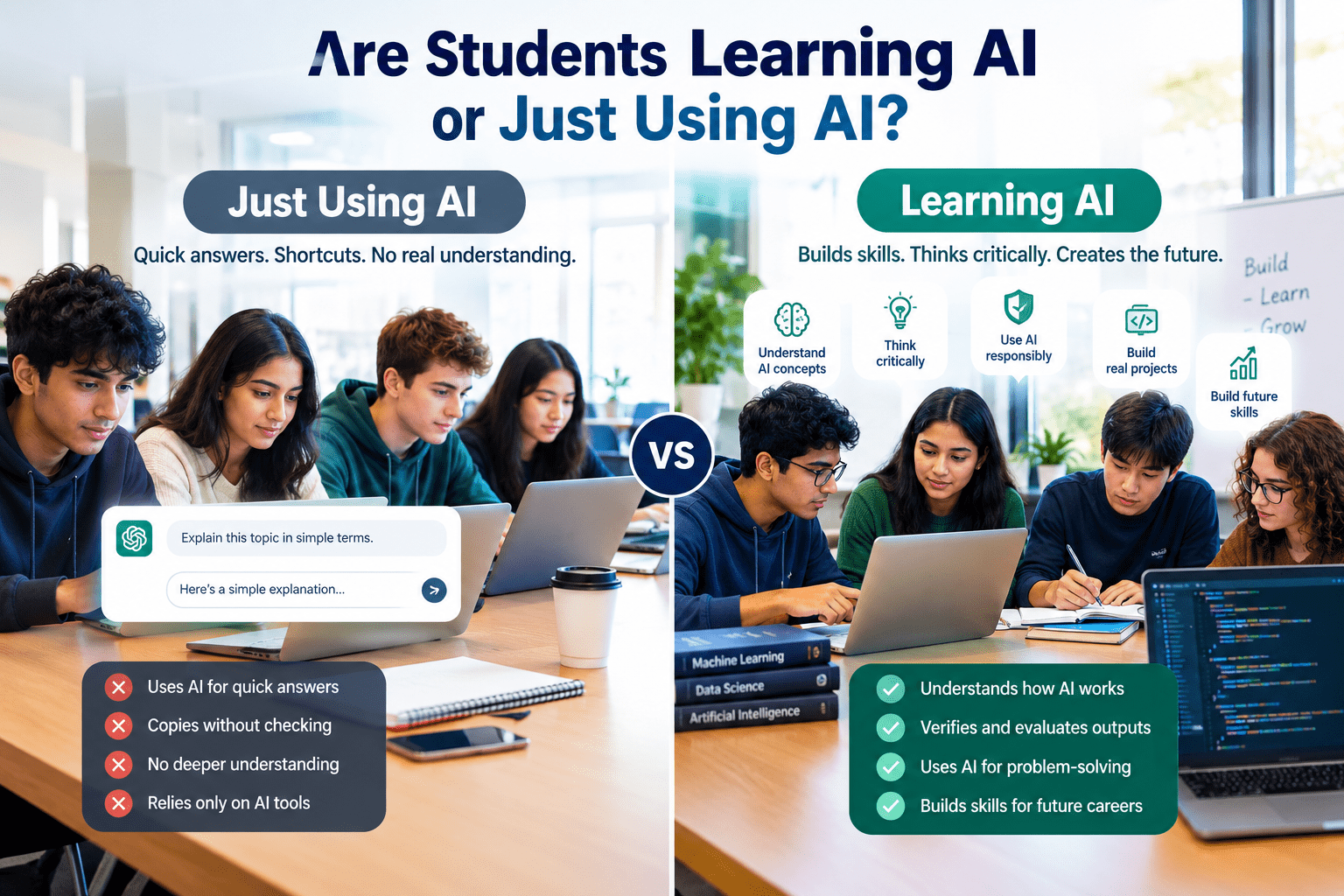
Students learning AI are facing a new question: are they actually understanding artificial intelligence, or are they simply using AI tools to get quick answers? As AI becomes part of education, students need more than the ability to use ChatGPT or other AI tools. They need to understand how AI works, evaluate its answers, recognize its limitations, and use it responsibly.
But there is an important question that deserves more attention:
Are students actually learning AI, or are they simply using AI?
There is a major difference between the two.
Using an AI tool means knowing how to ask it for an answer. Learning AI means understanding what the technology can do, where it can fail, how to evaluate its output, and how to use it responsibly.
As AI becomes part of education and the workplace, students need more than access to AI tools. They need AI literacy.
What Does It Mean to Learn AI?
Learning AI does not mean that every student needs to become a machine learning engineer.
For most students, AI literacy starts with understanding the basics.
Students should know what artificial intelligence is, how machine learning differs from traditional software, what generative AI does, why AI systems can make mistakes, and how data influences AI systems.
They should also understand that an AI-generated answer is not automatically a correct answer.
The OECD and European Commission’s 2026 AI Literacy Framework describes AI literacy as a combination of knowledge, skills, and attitudes that helps learners understand AI, evaluate its outputs, and use it responsibly and creatively.
UNESCO’s AI Competency Framework for Students similarly includes AI techniques and applications, ethics, human-centred thinking, and AI system design. It organizes student development around understanding, applying, and creating with AI.
That is very different from simply knowing how to open an AI chatbot.
Using AI Is Not the Same as Understanding AI
Imagine two students are given the same programming problem.
Student A immediately asks an AI tool to generate the complete code, copies the answer, and submits it.
Student B uses AI to understand the problem, asks for explanations, reviews the generated code, tests it, finds errors, and changes the solution independently.
Both students used AI.
But only one of them is developing a deeper understanding of the problem.
This distinction matters because AI can make it extremely easy to skip the difficult part of learning.
The difficult part is often where learning happens: thinking through a problem, making mistakes, asking questions, comparing solutions, and explaining an answer in your own words.
Recent discussions around AI in education have highlighted the same concern: AI can support learning when it acts as a tutor or guide, but it can become a shortcut when students use it to avoid the thinking process.
Why AI Literacy Matters for Students
AI is not limited to computer science classrooms.
Students studying business, engineering, medicine, design, finance, law, media, education, and other fields are likely to encounter AI in their academic and professional lives.
That makes AI literacy a broader digital skill.
A student with good AI literacy should be able to:
- Understand the basic concepts behind artificial intelligence
- Use generative AI tools effectively
- Write clear and useful prompts
- Check AI-generated information
- Identify possible errors or hallucinations
- Protect personal and confidential information
- Understand basic AI ethics
- Recognize bias and limitations
- Use AI without giving up independent thinking
- Apply AI to real-world problems
A 2026 systematic review of AI literacy research in school education identified AI knowledge and skills, generative AI competency, ethics and societal implications, critical thinking, adaptability, and preparation for AI-related careers as important parts of student AI literacy.
The Problem With Treating AI as an Answer Machine
The biggest problem is not that students use AI.
The problem is how they use it.
If a student uses AI to explain a difficult concept and then studies the explanation, AI can become a useful learning assistant.
If the same student asks AI to complete an assignment and never understands the answer, the tool may have replaced learning rather than supported it.
This difference is becoming increasingly important as generative AI becomes more common in education.
Students still need foundational knowledge, reading skills, reasoning, and problem-solving ability. AI should add to those abilities rather than replace them.
Recent OECD discussion of PISA findings has also emphasized the importance of students being able to evaluate information, distinguish fact from opinion, and critically assess AI-generated content.
What Should Students Actually Learn About AI?
Students do not all need the same level of technical AI education.
However, there are several areas that can benefit almost every student.
1. AI Fundamentals
Students should understand basic concepts such as machine learning, generative AI, training data, algorithms, and AI models.
They do not need to master advanced mathematics before learning these ideas.
2. Prompting and AI Interaction
Knowing how to communicate with AI is becoming a useful skill.
Students can learn how to provide context, define a goal, give relevant information, ask for explanations, and refine their questions.
But prompting should be treated as one part of AI literacy, not the whole skill.
3. AI Verification
Students should learn to question AI-generated answers.
They can check important claims against reliable sources, compare multiple explanations, test code, verify calculations, and look for missing context.
This is one of the most important skills in an AI-powered information environment.
4. AI Ethics and Responsible Use
Students should understand issues involving privacy, copyright, bias, misinformation, academic integrity, and responsible use of AI.
Using an AI system responsibly requires more than technical knowledge.
5. Practical AI Projects
Students learn more when they build something.
Instead of only watching tutorials about AI, students can create small projects that solve genuine problems.
For example, they could build a simple chatbot, analyze a dataset, create an AI-assisted study tool, experiment with image classification, or develop a project that uses an AI API.
Project-based learning has also been studied as a way to develop students’ AI problem-solving and ethical understanding.
AI Should Become a Learning Tool, Not a Learning Replacement
The goal should not be to keep students away from AI.
It should be to teach them how to use it properly.
A useful rule is simple:
Do not use AI to avoid thinking. Use AI to improve your thinking.
Students can ask AI to explain a difficult concept, provide alternative approaches, generate practice questions, review code, challenge an argument, or identify gaps in their understanding.
Then the student still has to think, verify, and learn.
That approach turns AI from an answer generator into a learning partner.
What AI Skills Will Students Need for Future Careers?
The workplace is also changing as AI becomes part of more occupations.
The International Labour Organization’s 2026 research on the changing skills landscape notes growing importance for AI literacy alongside cognitive, digital, and socioemotional skills, as workplaces adopt AI technologies.
For students, this means technical AI knowledge is only one part of the picture.
Future-ready students may need a combination of:
- AI literacy
- Critical thinking
- Problem-solving
- Communication
- Adaptability
- Digital skills
- Data literacy
- Domain knowledge
- Creativity
- Ethical decision-making
The students who understand both their field and how AI can be applied to that field can build a stronger foundation for changing workplaces.
How Students Can Start Learning AI
Students do not need to wait for a formal AI course.
They can start with simple steps:
- Learn the basic concepts of artificial intelligence.
- Use AI tools to understand difficult subjects rather than simply obtain answers.
- Practice writing better prompts.
- Verify important information from reliable sources.
- Learn about AI ethics and privacy.
- Build small AI-related projects.
- Document what they build in a portfolio.
- Continue learning as AI technology changes.
The goal is not to become an AI expert overnight.
The goal is to become a student who understands how to learn and work with AI.
Final Thought
The question is no longer whether students will use artificial intelligence.
They already are.
The more important question is whether they will understand it well enough to use it responsibly and effectively.
There is a difference between using AI and learning AI.
Using AI can help a student finish a task.
Learning AI can help a student understand the technology, question its answers, solve problems with it, and make better decisions about when to use it.
The future of AI education should therefore not be about teaching students to depend on AI.
It should be about teaching students to think better with AI.
FAQs
Is using ChatGPT the same as learning AI?
No. Using ChatGPT is one example of using generative AI. Learning AI involves understanding how AI works, recognizing its limitations, evaluating its outputs, and using it responsibly.
Why is AI literacy important for students?
AI literacy helps students understand and evaluate AI systems instead of simply accepting their outputs. It also supports responsible use, critical thinking, problem-solving, and preparation for technology-enabled workplaces.
Do students need to learn coding to learn AI?
Not necessarily. Coding can be useful for students pursuing technical AI careers, but basic AI literacy can be developed without becoming a programmer.
How can students use AI without becoming dependent on it?
Students can use AI for explanations, practice questions, brainstorming, feedback, and learning support while continuing to solve problems, verify information, and develop their own understanding.
What are the most important AI skills for students?
Important skills include AI literacy, critical thinking, prompt skills, information verification, data literacy, problem-solving, AI ethics, adaptability, and practical experience with AI tools.
Internal Links for Vyasa Nexus
- AI Courses for Students
- Coding Skills for Students
- Problem-Solving Skills for Students
- Communication Skills for Students
- Adaptability Skills for Students
- Professional Portfolio for Students
- Proof of Work for Students
- Prompt Injection Explained
outbound links
The OECD and European Commission’s 2026 AI Literacy Framework describes AI literacy as a combination of knowledge, skills, and attitudes that helps learners understand AI, evaluate its outputs, and use it responsibly and creatively.
UNESCO’s AI Competency Framework for Students similarly includes AI techniques and applications, ethics, human-centred thinking, and AI system design.
The International Labour Organization’s 2026 research on the changing skills landscape notes growing importance for AI literacy alongside cognitive, digital, and socioemotional skills as workplaces adopt AI technologies.