
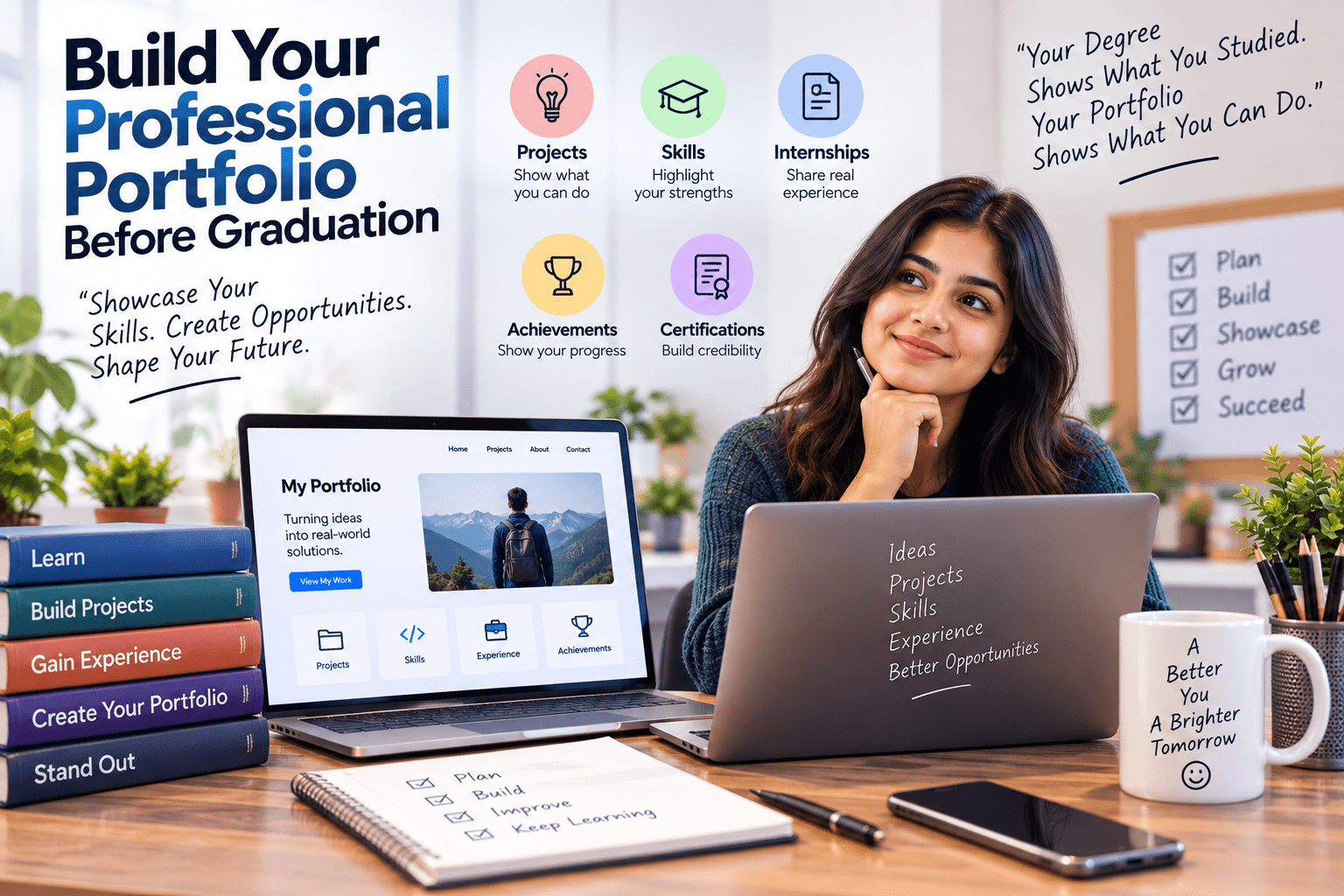
A professional portfolio for students can showcase what they have learned, built, and achieved before graduation. It gives students a practical way to present their projects, skills, internships, and experiences to recruiters, mentors, and potential employers.
A professional portfolio for students can become a personal record of their growth and a useful way to present their work to recruiters, mentors, educators, and potential employers.
Why a Professional Portfolio for Students Matters
Students often spend years developing skills but may not have an organized place to showcase them.
A portfolio brings their learning together in one place. For example, instead of simply saying that they know a programming language, design tool, or analytical method, students can show examples of how they have used those skills. As a result, their learning becomes more visible and meaningful.
This can make their learning more visible and meaningful.
What Is a Student Professional Portfolio?
A professional portfolio is a collection of a student’s work, experiences, achievements, and skills.
Depending on the student’s field, it may include:
- Academic or personal projects
- Internship experience
- Technical skills
- Research work
- Certifications
- Presentations
- Competitions
- Volunteering
- Achievements
- Relevant coursework
- Links to completed work
The portfolio does not need to be complicated. Even a simple, well-organized collection can demonstrate a student’s progress.
Why a Resume Alone May Not Be Enough
A resume provides a short summary of a student’s background. However, it usually cannot show the complete story behind their work.
For example, a resume might say:
Developed a web application using React and JavaScript.
A portfolio can go further by showing the project, explaining the student’s contribution, describing the challenges they faced, and presenting the final result.
This gives others a better understanding of the student’s practical abilities.
What Students Should Include in Their Portfolio
Students should focus on including work that represents their actual abilities.
A strong portfolio can include three to five meaningful projects rather than a large collection of unfinished or copied work.
Each project can explain:
- What problem the project addresses
- What technologies or tools were used
- What the student contributed
- Challenges encountered
- How those challenges were solved
- What was learned
- The final outcome
This turns a project from a simple entry into evidence of learning.
How Projects Demonstrate Real Skills
Projects provide students with an opportunity to demonstrate how they apply knowledge.
A software student might include a web application. A data student could showcase an analysis project. A design student could present a collection of design work. A research-oriented student might include research papers or experiments.
The important point is not the size of the project. It is whether the work demonstrates understanding, effort, problem-solving, and practical application.
Including Internships and Practical Experience
Internships can add valuable evidence to a student’s portfolio.
Students can describe the type of work they performed, the tools they used, the problems they encountered, and what they learned during the experience.
Even when an internship involves smaller responsibilities, documenting the learning process can help demonstrate professional growth.
Students should focus on their actual contributions rather than exaggerating their role.
How Students Can Showcase Technical Skills
Technical skills are easier to understand when they are connected to real work.
Instead of simply listing:
Java, SQL, React, Git
a student can demonstrate these skills through relevant projects.
For example, a project might show how the student used Java for backend development, SQL for data management, React for the user interface, and Git for version control.
This gives context to the skills listed on the resume.
Why Communication and Presentation Matter
A portfolio is not only about the work itself. It is also about how clearly the work is presented.
Students should explain their projects in simple language and organize information so that someone unfamiliar with the project can understand it.
Clear descriptions, screenshots, project links, and short explanations can make a portfolio easier to review.
This also gives students an opportunity to practice professional communication.
Building a Portfolio Without Work Experience
Students do not need a full-time job to start building a portfolio.
They can begin with:
- Personal projects
- College projects
- Open-source contributions
- Hackathons
- Research activities
- Community projects
- Freelance work
- Technical experiments
- Volunteer activities
A student who has no professional experience can still demonstrate initiative and practical learning through meaningful work.
How to Keep Your Portfolio Updated
A portfolio should grow along with the student.
After completing a project, students can add it immediately instead of waiting until graduation.
They can periodically remove outdated work, improve project descriptions, update skills, and add new achievements.
Keeping the portfolio updated also helps students remember what they have learned and gives them material to discuss during interviews.
Common Portfolio Mistakes Students Should Avoid
A portfolio can lose its value if it contains too much irrelevant or low-quality content.
Students should avoid:
- Copying projects without understanding them
- Adding too many unfinished projects
- Claiming skills they cannot demonstrate
- Using complicated descriptions
- Including irrelevant information
- Forgetting to check project links
- Ignoring spelling and formatting
- Creating a portfolio and never updating it
Quality and authenticity are more important than quantity.
How a Portfolio Can Support Internship and Job Applications
When students apply for internships or jobs, a portfolio can give recruiters additional evidence of their abilities.
It can also help students during interviews.
Instead of trying to remember every detail about their work, students can use their projects as examples when answering questions about problem-solving, teamwork, technical skills, challenges, and achievements.
A portfolio therefore becomes useful not only during applications but also during conversations with recruiters and interviewers.
How a Professional Portfolio for Students Showcases Real Skills
Building a portfolio can also help students recognize their own progress.
A first project may seem simple. After several months of learning and practice, students may be able to look back and see how much their skills have developed.
This progress can encourage them to take on more challenging projects and continue learning.
How Vyasa Nexus Can Help Students Build Practical Experience
Vyasa Nexus focuses on connecting learning with practical skills, projects, internships, and career preparation.
For students, these experiences can provide meaningful work that can eventually become part of their professional portfolio.
The goal is not simply to collect certificates. It is to develop skills, apply knowledge, and create evidence of what students can accomplish.
What Students Can Start Doing Today
Students do not need to wait until their final year to create a portfolio. Instead, they can start with one project they have already completed.
They can start with one project they have already completed.
Write down what the project was about, what they contributed, which skills they used, what challenges they faced, and what they learned.
Then continue adding meaningful work as they progress through college.
A portfolio built gradually can become much stronger than one created a few weeks before graduation.
Final Thoughts: Start Building Before You Graduate
Students do not have to wait for their first job to start building a professional identity.
A professional portfolio for students can show their journey from learning concepts to applying them in practical situations.
Start small, stay honest, keep learning, and document your progress.
Don’t wait for experience to find you. Start creating evidence of your abilities today.
Outbound Links
Students can use professional networking platforms to showcase their experience and connect with career opportunities
Students in technical fields can use GitHub to showcase projects and demonstrate their practical development work.
Internal Links
Students can use project-based learning to develop practical work that can later become part of their portfolio.
Understanding recruiter expectations can help students decide which skills and projects to showcase.
A strong portfolio can also give students useful projects and experiences to discuss during technical interviews
Internship experience can provide practical work that students can include in their professional portfolio.