
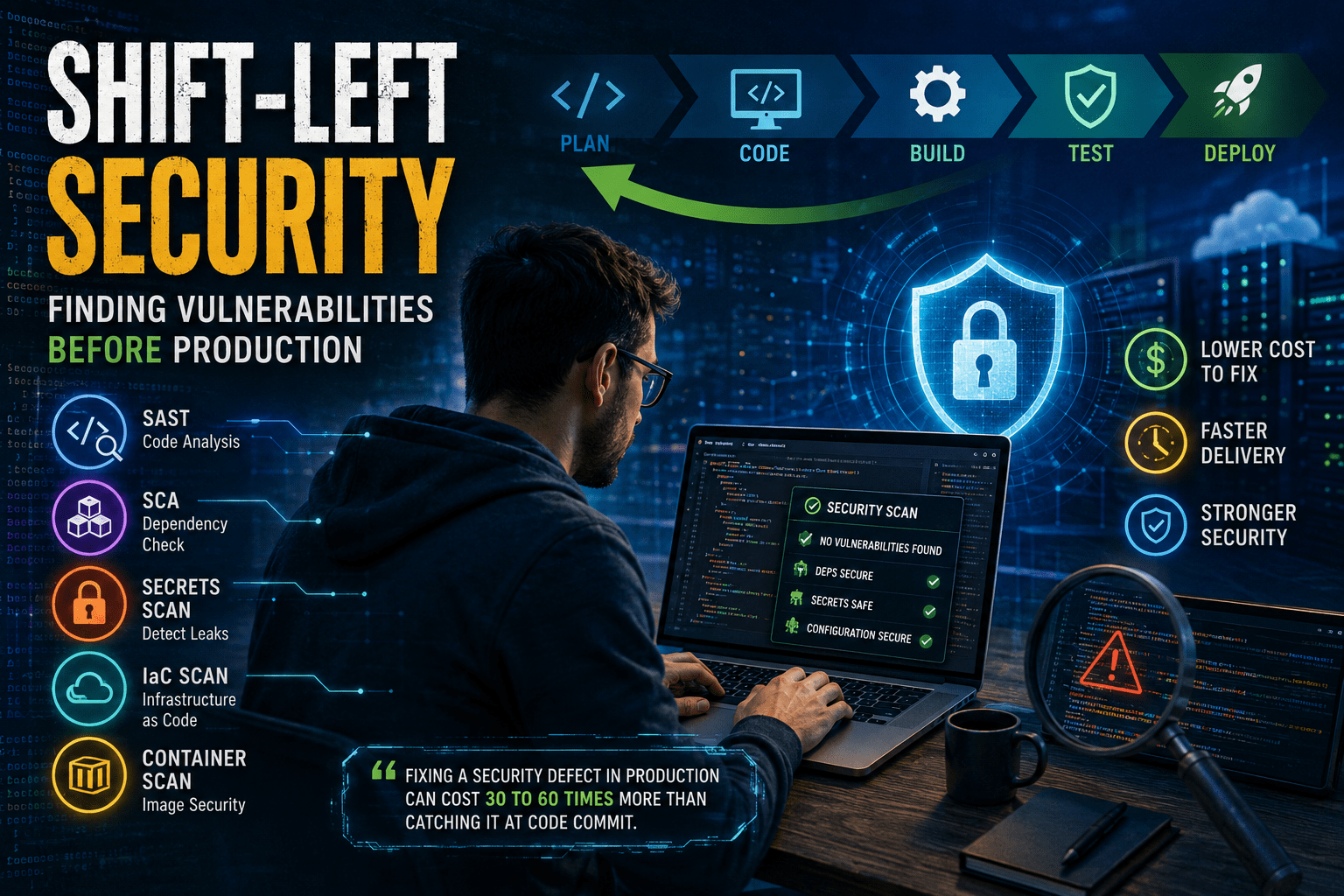
There’s an old rule in software engineering that never goes out of style: the later you find a bug, the more it costs to fix. Security vulnerabilities are no exception Shift-Left Security. A flaw discovered while a developer is writing code might take minutes to resolve, but the same issue found after deployment can lead to costly outages, data breaches, compliance penalties, and damaged customer trust.
This is why left has become a core principle of modern software development. Instead of treating security as a final checkpoint before release, shift-left integrates security testing into every stage of development, allowing teams to identify and fix vulnerabilities before they reach production.
What Is Shift-Left Security?
Shift-left is the practice of moving security testing earlier in the Software Development Life Cycle (SDLC). Rather than waiting until an application is ready for release, developers identify security issues while writing code, reviewing pull requests, and building software through CI/CD pipelines.
As a key part of DevSecOps,left encourages developers, operations teams, and security engineers to share responsibility for application security.
In practice, this means:
- Detecting SQL injection vulnerabilities during development.
- Blocking pull requests that introduce vulnerable dependencies.
- Scanning Infrastructure as Code (IaC) templates before deployment.
- Detecting accidentally committed API keys or secrets.
- Running automated security checks throughout the CI/CD pipeline.
Finding vulnerabilities early makes remediation faster, cheaper, and far less disruptive.
Why Left Security Matters
Modern development teams ship software faster than ever, making traditional end-of-project security reviews increasingly ineffective.
Several factors have accelerated the adoption of left security:
- Security defects are significantly less expensive to fix during development than after production.
- Organizations continue to face rising data breach costs.
- AI-assisted coding generates software faster but also increases the likelihood of introducing security flaws.
- Applications rely heavily on open-source libraries that require continuous vulnerability monitoring.
By integrating automated security testing into everyday development, organizations reduce security debt while improving software quality and delivery speed.
Shift-Left vs. Shift-Right Security
Shift-left security focuses on preventing vulnerabilities before software reaches production. Shift-right security complements this approach by identifying issues that only appear in live environments.
| Shift-Left Security | Shift-Right Security |
|---|---|
| During development | After deployment |
| Prevents vulnerabilities early | Detects runtime attacks |
| Uses automated code analysis | Uses penetration testing and monitoring |
| Lower remediation costs | Higher remediation costs |
Successful organizations combine both approaches. Preventing vulnerabilities early reduces the number of security issues that require expensive production fixes later.
Core Components of Shift-Left Security
A successful shift-left strategy combines several security practices.
Static Application Security Testing (SAST)
Analyzes source code without running the application to identify insecure coding patterns such as SQL injection, hardcoded credentials, and buffer overflows.
Software Composition Analysis (SCA)
Scans third-party libraries and dependencies for known vulnerabilities, outdated packages, and licensing risks.
Dynamic Application Security Testing (DAST)
Tests running applications to discover runtime vulnerabilities that static analysis cannot detect.
Infrastructure as Code (IaC) Scanning
Reviews Terraform, Kubernetes, and CloudFormation templates for insecure cloud configurations before infrastructure is deployed.
Secrets Scanning
Detects API keys, passwords, tokens, and certificates accidentally committed to source code repositories.
How to Implement Shift-Left Security
Organizations can begin with a few practical steps:
- Integrate SAST and SCA tools into CI/CD pipelines.
- Automatically scan every pull request before merging.
- Block builds only for high and critical vulnerabilities.
- Add secrets and IaC scanning to deployment workflows.
- Assign ownership for every identified vulnerability.
- Verify that issues are resolved before releasing software.
- Continue monitoring production environments using shift-right security practices.
The goal is to make security an automated part of development rather than a last-minute approval process.
Common Challenges
Although shift-left offers significant benefits, implementation comes with challenges.
The most common include:
- Alert fatigue caused by excessive low-priority findings.
- False positives that reduce developer confidence.
- Multiple security tools that don’t integrate well.
- Limited secure coding knowledge among development teams.
Organizations overcome these challenges by prioritizing high-risk vulnerabilities, integrating tools into existing workflows, and investing in developer security training.
Why Developer Training Matters
Security tools can identify vulnerabilities, but developers still need the skills to understand and fix them correctly.
Learning secure coding practices, DevOps fundamentals, CI/CD automation, and cloud security helps developers build secure applications from the beginning rather than relying solely on automated scanners.
At Vyasa Nexus, learners gain practical experience through career readiness bootcamps and industry project packs that simulate real software engineering and DevOps workflows. Building these skills early prepares developers to implement modern security practices confidently in professional environments.
Frequently Asked Questions
What is shift-left security?
Shift-left is the practice of identifying and fixing security vulnerabilities during software development instead of waiting until just before deployment.
Is shift-left security part of DevSecOps?
Yes. left is a core DevSecOps practice that integrates security into the development lifecycle from the earliest stages.
Which tools support shift-left security?
Common tools include Static Application Security Testing (SAST), Software Composition Analysis (SCA), Dynamic Application Security Testing (DAST), Infrastructure as Code (IaC) scanners, and secrets detection tools.
Does shift-left security replace penetration testing?
No. Shift left reduces vulnerabilities before deployment, while penetration testing and runtime monitoring remain essential for identifying issues in production environments.
Conclusion
Shift-left security has become an essential software development practice because it helps organizations find vulnerabilities before they become expensive production incidents. By integrating automated security testing into the development lifecycle, teams improve software quality, reduce remediation costs, and deliver more secure applications.
The most successful organizations combine automation with well-trained developers who understand secure coding principles and can respond quickly to security findings. In today’s DevSecOps environment, building security early is no longer optional—it’s a competitive advantage.
Internal Links
- Why Hackers Target Small Businesses – Ransomware Guide 2026
- Technical Interview Preparation: The Complete Guide
- AI-Powered Learning: How Artificial Intelligence Is Transforming Education
- The Science of Forgetting: How to Remember Anything You Study
- Active Recall and Spaced Repetition: The Study Techniques That Actually Work
- 12 Proven Study Motivation Tips for Long Study Sessions
- Best Note-Taking Methods for Students