
Why Most Goals Fail Before They Start
Ask any student or young professional what they want out of the next year, and you will hear something like “get better grades” or “find a good job.” These are not goals. They are wishes. A wish has no shape. It cannot be measured, tracked, or finished. This is the reason so many New Year’s resolutions and semester plans quietly disappear by February.
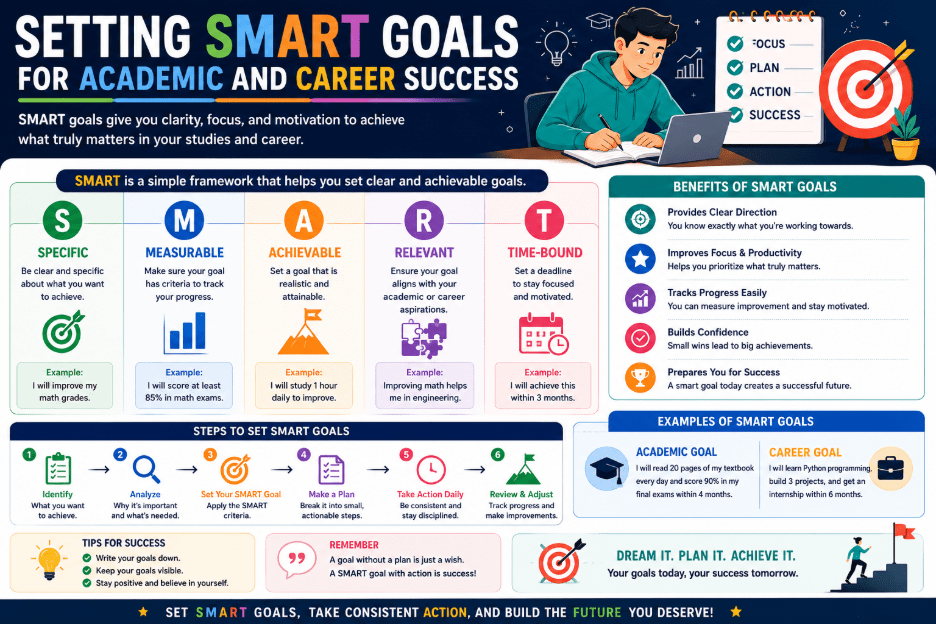
The SMART goal framework fixes this problem. It was first laid out by management consultant George T. Doran in a 1981 paper on corporate objectives, and it has since become the standard tool used by schools, career counselors, and workplaces around the world. SMART stands for Specific, Measurable, Achievable, Relevant, and Time-bound. Put those five words together, and a vague wish turns into a plan you can actually follow.
This guide walks through each part of the SMART framework, shows how to apply it to both academic goals and career goals, and gives you real examples you can adapt for your own life.
What Does SMART Actually Stand For?
Specific
A specific goal answers the basic questions: what exactly do you want to accomplish, and why does it matter? “Improve my grades” is not specific. “Raise my chemistry grade from a B- to an A-” is specific. The more precise the target, the easier it is to build a plan around it.
Measurable
If you cannot measure it, you cannot know when you have reached it. Numbers, percentages, and checklists turn a fuzzy hope into a clear finish line. Instead of “get better at public speaking,” try “give four presentations this semester and score at least 85% on each rubric.”
Achievable
A goal should stretch you, not break you. Setting out to learn three new programming languages in a month while carrying a full course load is not realistic, and failing at an unrealistic goal often does more harm to motivation than not setting one at all. Achievable goals account for your actual schedule, resources, and current skill level.
Relevant
Every goal you set should connect to something bigger. A short-term academic goal should support your degree plan. A short-term career goal should move you toward the kind of work you actually want to do. If a goal does not serve your larger direction, it is probably a distraction dressed up as productivity.
Time-bound
A deadline creates urgency. Without one, a goal can drift indefinitely. “Improve my resume” can wait forever. “Rewrite and finalize my resume by the end of this month, before fall internship applications open” cannot.
SMART Goals for Academic Success
Academic goals cover more than test scores. They include study habits, research skills, and the personal discipline that keeps a semester on track. A few examples:
- Grade improvement: “I will raise my overall GPA from 3.1 to 3.5 by the end of this academic year by attending every lecture, completing weekly review sessions, and meeting with my professor during office hours at least twice a month.”
- Study habits: “I will build a consistent study routine by using a planner every day and reviewing my notes each evening for thirty minutes, starting this week and continuing through finals.”
- Research and writing skills: “I will strengthen my academic writing by drafting one practice essay every two weeks and getting feedback from the writing center before each deadline.”
- Time management: “I will reduce late assignments to zero this semester by mapping out every due date at the start of each month and setting reminders three days before each one.”
Notice the pattern. Each goal names a clear outcome, a way to track it, a workload that fits a normal schedule, a reason it matters, and a date.
SMART Goals for Career Success
Career goals often stretch across months or years, so it helps to break them into smaller, time-bound steps. Here are examples that apply to students and early-career professionals alike:
- Internship or job search: “I will secure a summer internship in marketing by updating my resume and LinkedIn profile this month, applying to fifteen positions by March 1st, and completing at least two mock interviews with my school’s career center.”
- Networking: “I will build five new professional connections in my field by attending three industry events this term and following up with each contact within a week.”
- Skill building: “I will complete an online certification in data analysis within ten weeks, studying for one hour four days a week, to strengthen my resume before graduation.”
- Career clarity: “I will identify three potential career paths that match my strengths by talking to two professionals in each field and completing a career assessment by the end of the month.”
Career planning works best when it overlaps with academic planning rather than sitting apart from it. A capstone project chosen around a real industry problem, for example, does double duty: it satisfies a degree requirement and builds a portfolio piece for job applications.
Turning SMART Goals Into a Daily Habit
Writing a SMART goal once is easy. Keeping it alive is the hard part. A few habits make the difference between a goal that gets finished and one that quietly fades:
- Write it down. A goal that lives only in your head is easy to forget or reshape in your favor. Put it somewhere you will see it daily: a planner, a phone note, or a wall calendar.
- Break it into weekly steps. A semester-long goal feels distant. A weekly task list feels doable. Break the big goal into small pieces you can check off.
- Review progress on a set schedule. Once a week, look back at what you did and what you missed. Adjust the plan rather than abandoning the goal.
- Ask for accountability. Tell a professor, mentor, friend, or advisor what you are working toward. People tend to follow through more often when someone else knows the plan.
- Revisit the goal when circumstances change. Life shifts: course loads change, job markets move, health comes first sometimes. A good goal bends without breaking. Adjust the timeline or the target rather than dropping it.
A Simple SMART Goal Worksheet
When you sit down to write your own goal, work through these five questions in order:
- Specific: What exactly am I trying to do?
- Measurable: How will I know I have done it?
- Achievable: Do I have the time, resources, and skill to reach this?
- Relevant: Why does this matter to my larger academic or career plan?
- Time-bound: When will this be finished?
Answer all five, and you have a working goal rather than a wish.
Final Thoughts
Academic success and career success are not separate tracks. They feed each other. The discipline built from finishing a research paper on time is the same discipline that gets a project delivered on deadline at a first job. The SMART framework gives structure to both, turning broad ambitions into steps you can actually complete this week, this month, and this year.
Start small. Pick one goal from your studies and one from your career plans. Write them using the five SMART elements above. Review them every week. That single habit, repeated consistently, tends to matter more than any amount of motivation on its own.