
Every student runs into problems — a tough math question, a group project falling apart, a schedule with no room left for anything but stress. What separates students who cope well from those who don’t usually has nothing to do with intelligence. It comes down to whether they’ve learned how to solve problems in a calm, structured way.
Problem-solving isn’t a subject you study once and forget. It’s a skill, and like any skill, it grows with practice. Schools that focus only on memorizing facts often miss this. The real world doesn’t hand out multiple-choice questions — it hands out messy situations with no obvious answer, and the students who thrive are the ones who know how to think their way through them.
Below is a look at the problem-solving skills every student should work on, why each one matters, and how to start building it today.
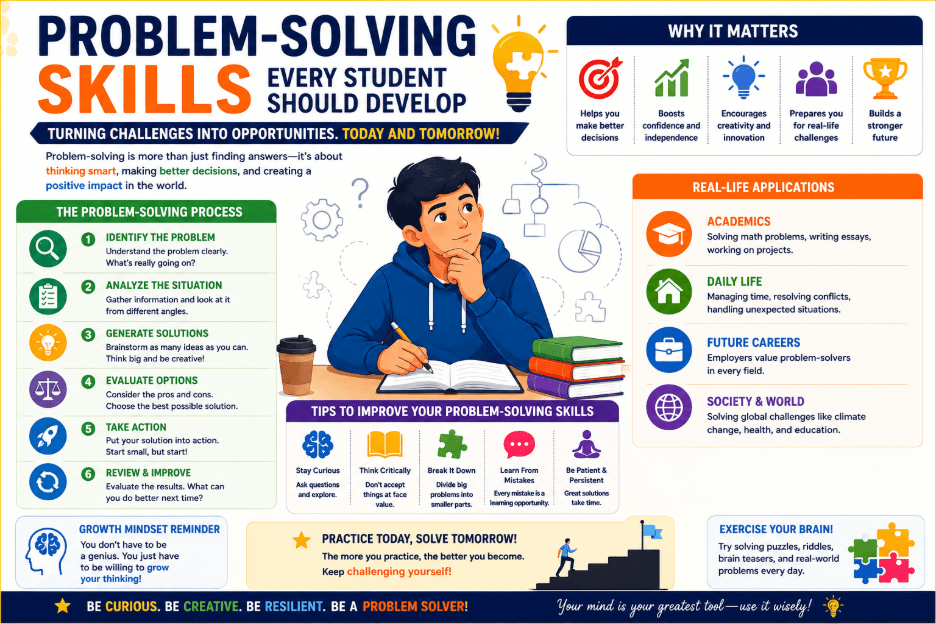
Why Problem-Solving Skills Matter for Students
These skills aren’t just useful for passing exams. They shape how a person handles setbacks, makes decisions, and works with others for the rest of their life. Employers consistently rank problem-solving and critical thinking among the top qualities they look for in new graduates — often ahead of technical skills. Colleges look for it too, often without saying so directly, in how a student writes essays, handles interviews, or describes challenges they’ve overcome.
A student who develops strong problem-solving abilities early tends to:
- Handle exam pressure without falling apart
- Make better decisions under time constraints
- Work through disagreements in group projects
- Adapt when plans change at the last minute
- Build confidence that comes from having solved hard things before
None of this happens by accident. It’s built, step by step, through specific habits of thinking.
1. Critical Thinking
Critical thinking is the foundation of every other skill on this list. It means questioning assumptions, weighing evidence before forming an opinion, and not accepting the first explanation just because it sounds reasonable.
Students who practice critical thinking learn to ask:
- Is this source reliable?
- What am I missing?
- Is there another way to look at this?
These questions slow a person down just enough to avoid careless mistakes, whether they’re reading a history textbook or debugging code.
Try this: Get in the habit of asking “why” at least three times before accepting an answer. It trains the brain to dig past the surface.
2. Analytical Thinking
Analytical thinking is what happens after critical thinking opens the door. It’s the ability to break a large, confusing problem into smaller, manageable pieces — a word problem in algebra, a long research paper, a packed exam week.
Strong analytical thinkers don’t panic when they see a complicated question. They start by identifying what they know, what they don’t know, and what steps might connect the two. This is one of the most transferable skills on this list — it applies just as well to a chemistry lab as it does to planning a part-time job around a class schedule.
3. Decision-Making Under Uncertainty
Not every problem comes with complete information, and waiting for perfect certainty often means missing the deadline entirely. Learning to make a reasonable decision with the information available — and adjust later if needed — is a skill many adults still struggle with.
Try this: Practice low-stakes decisions on purpose. Choosing a research topic, picking a project partner, deciding how to allocate study time before an exam — these are all small training grounds for bigger decisions later, like choosing a college major or a career path.
4. Creative Thinking
Not every problem has a textbook answer. Creative thinking is the willingness to look at a situation from an angle nobody else has tried — it’s what separates a student who copies a standard essay structure from one who finds a fresh way to make the same argument.
This skill often gets undervalued in traditional classrooms because it can’t be measured with a simple right-or-wrong answer. But it matters enormously in real life, where the best solution is rarely the obvious one. Brainstorming without judgment, trying unconventional study methods, or approaching an old problem with a new tool all help keep this skill sharp.
5. Collaborative Problem-Solving
Very few problems in the real world get solved alone. Group projects, team sports, student organizations, and eventually workplaces all require solving problems together — which means listening, compromising, and sometimes setting aside a personal preference for a better group outcome.
Collaborative problem-solving also teaches patience. Not everyone thinks at the same speed or in the same way, and learning to work with different thinking styles pays off well beyond the classroom.
6. Emotional Regulation Under Pressure
This one rarely makes it onto official skill lists, but it belongs here. A student who understands algebra perfectly can still freeze during a timed test if they haven’t learned how to manage stress. Emotional regulation is what lets a clear head actually apply the other skills on this list when it counts.
Simple techniques help keep the thinking part of the brain in charge:
- Slowing down breathing before a test
- Taking a short break when frustration builds during homework
- Naming the emotion instead of letting it take over
7. Reflective Thinking
The final skill is often the most overlooked: looking back at a solved problem and asking what worked, what didn’t, and what could be done differently next time. Without reflection, a student can repeat the same mistake in slightly different situations for years.
Try this: Keep a short journal after a difficult test, project, or disagreement — even just three or four sentences. It builds a habit of learning from experience rather than just moving past it.
How Students Can Practice These Skills Every Day
Developing problem-solving skills doesn’t require a special course. It happens in ordinary moments:
- Working through a hard homework question without immediately asking for the answer
- Debating a topic with a friend and trying to see their side honestly
- Planning a study schedule around a busy week
- Fixing a mistake in a project instead of starting over
- Asking a teacher a follow-up question instead of just accepting the first explanation
Over time, these small habits add up to a person who can walk into almost any unfamiliar situation and figure out a way forward.
Final Thoughts
Problem-solving skills for students aren’t a single skill — they’re a set of habits that reinforce each other. Critical thinking sharpens judgment. Analytical thinking organizes the chaos. Decision-making moves things forward. Creativity opens new paths. Collaboration multiplies the effort. Emotional regulation keeps it all steady. Reflection makes sure the lesson sticks.
No student develops all of these overnight, and that’s fine. The goal isn’t perfection — it’s progress. A student who is a little better at solving problems this month than last month is already on the right track.
Looking for more resources on student growth and academic success? Explore the study skills and learning strategies section on Vyasa Nexus, or read our related guide on critical thinking exercises for students and time management tips for busy students.