
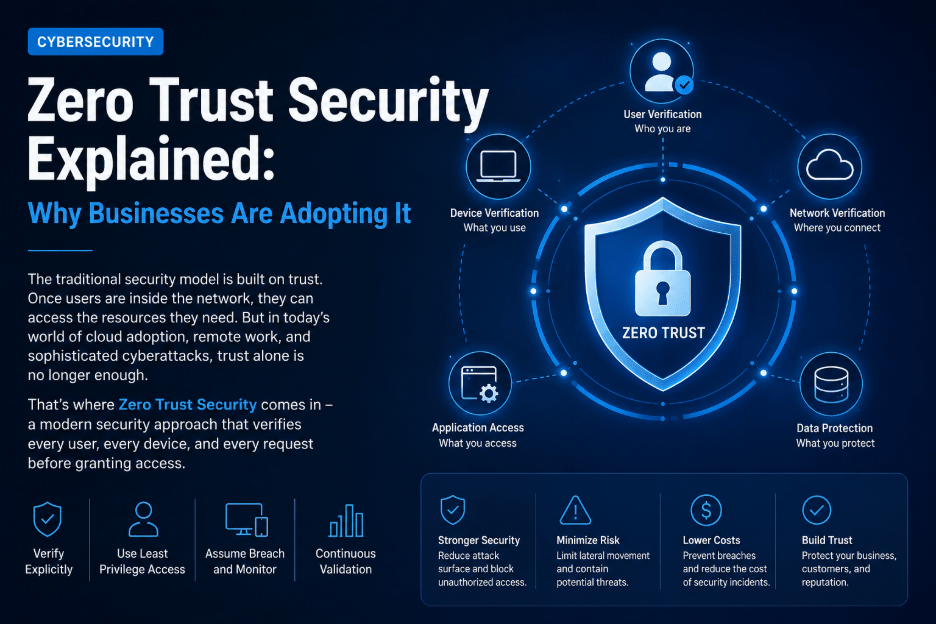
For years, businesses relied on a simple approach to cybersecurity: build a strong perimeter, protect the network, and trust anyone who gained access. This strategy worked when employees sat in the same office, used company-issued devices, and connected through a single corporate network.
That environment no longer exists.
Today, employees work from homes, airports, coworking spaces, and coffee shops. Organizations depend on cloud platforms, SaaS applications, personal devices, and third-party vendors to keep operations running. The traditional network perimeter has disappeared, making older security models far less effective against modern cyber threats.
This shift has driven organizations toward a different approach known as Zero Trust Security.
Instead of assuming users or devices are trustworthy because they are already inside the network, Zero Trust verifies every access request. Every login, device, application, and connection must continuously prove it can be trusted before access is granted.
Businesses of every size are now adopting Zero Trust because it helps reduce the impact of cyberattacks, protects sensitive information, and supports today’s distributed workforce. Recent industry research also shows that adoption has increased rapidly over the past few years, making Zero Trust one of the fastest-growing cybersecurity strategies worldwide.
What Is Zero Trust Security?
Zero Trust Security is a cybersecurity framework based on one simple principle:
Never trust. Always verify.
Unlike traditional security models that automatically trust users after they enter the network, Zero Trust treats every request as potentially risky. Whether the request comes from an employee inside the office or someone working remotely, the system verifies the user’s identity, device, permissions, and security posture before granting access.
The concept was introduced by former Forrester analyst John Kindervag in 2010. Since then, it has evolved into one of the most widely accepted security models and is now included in official cybersecurity guidance from organizations such as the National Institute of Standards and Technology (NIST) and the Cybersecurity and Infrastructure Security Agency (CISA).
A simple way to understand Zero Trust is to imagine a building with multiple security checkpoints instead of a single front entrance.
In a traditional security model, someone who enters the building can often move freely inside.
With Zero Trust, every restricted area requires additional verification. Even after logging in successfully, users must continue proving that they are authorized to access sensitive resources. This continuous verification significantly reduces opportunities for attackers to move through the network.
Why the Traditional Security Model No Longer Works
Traditional cybersecurity relied on a strong perimeter. Firewalls separated trusted internal systems from the outside world. Once users authenticated themselves and entered the network, they usually received broad access with few additional security checks.
That approach worked well when organizations controlled every device, application, and network connection.
Modern business environments look very different.
Employees regularly connect from remote locations using laptops, smartphones, and tablets. Critical business applications now run on cloud platforms instead of company-owned data centers. Organizations also collaborate with contractors, suppliers, and external partners who require temporary access to internal systems.
These changes have greatly expanded the number of potential entry points for attackers.
Several factors have accelerated this shift:
Remote and Hybrid Work
Employees no longer work exclusively from corporate offices. They access business systems from homes, hotels, airports, and public Wi-Fi networks. Security teams can no longer assume every connection comes from a trusted environment.
Cloud Computing
Many organizations now store applications and sensitive data on cloud platforms rather than local servers. While cloud services improve flexibility and scalability, they also reduce the effectiveness of perimeter-based security.
Bring Your Own Device (BYOD)
Personal laptops, smartphones, and tablets frequently access company resources. These devices may not meet the same security standards as managed corporate hardware, increasing the overall attack surface.
Third-Party Access
Businesses increasingly depend on contractors, consultants, and vendors. These external users often require access to internal systems without becoming permanent employees, making access control much more complicated.
Credential Theft
Stolen usernames and passwords remain one of the most common ways attackers breach organizations. According to the Verizon 2025 Data Breach Investigations Report, credential abuse contributed to approximately one in five security breaches.
In traditional environments, attackers who obtain valid credentials can often move across multiple systems without raising immediate suspicion.
Zero Trust addresses this problem by verifying every request continuously instead of relying on a single login. Even if attackers steal legitimate credentials, they face additional security checks that limit their ability to move laterally across the network.