
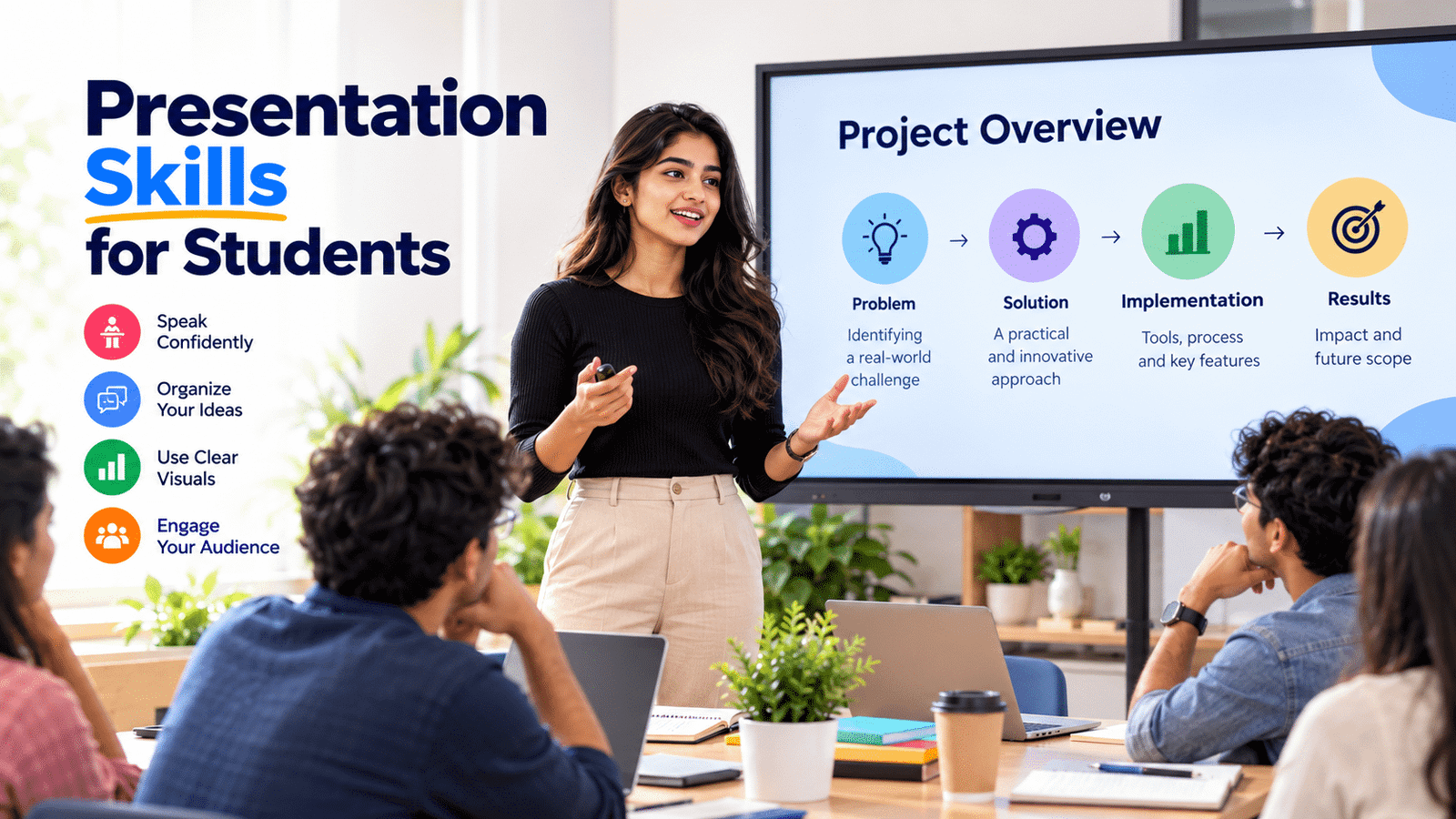
Presentation Skills for Students: Why They Matter
Presentation skills for students are important for explaining ideas clearly, sharing knowledge, and communicating confidently with different audiences. These skills help learners present academic projects, participate in classroom discussions, and prepare for professional meetings and job interviews. Developing presentation abilities before graduation can support both academic and career growth.
Presentation skills for students are important because they help learners explain ideas, organize information, communicate with an audience, and develop confidence when speaking in front of others.
These skills are useful in classrooms, group discussions, project demonstrations, interviews, and professional meetings. Students who practise presenting their ideas can become better at explaining what they know and making their communication more effective.
In this article, we will explore why presentation skills matter, how students can improve them, common mistakes to avoid, and practical ways to become more confident presenters.
1. Why Presentation Skills for Students Matter
Presentation skills help students communicate information in a clear and organized way. Whether explaining a classroom topic or presenting a final-year project, students need to make their ideas understandable to others.
For example, a student who develops a software application may understand how it works but struggle to explain its features and purpose. A well-organized presentation can help the student explain the problem, demonstrate the application, and describe the results.
Presentation skills also encourage students to think carefully about the information they share. They learn to identify important points, organize their thoughts, and explain complex topics using simple language.
These abilities are useful beyond academic activities. In professional environments, employees may need to present project updates, explain proposals, share research findings, and communicate results to colleagues or clients.
Developing these skills before graduation can help students prepare for both academic and professional responsibilities.
2. What Are Presentation Skills?
Presentation skills are the abilities required to prepare and deliver information effectively to an audience.
They involve more than speaking in front of people. A good presentation combines planning, communication, organization, visual support, and audience engagement.
Important presentation skills include:
- Clear communication: Explaining information using simple and understandable language.
- Organization: Arranging ideas in a logical sequence.
- Confidence: Speaking comfortably and maintaining a positive attitude.
- Body language: Using appropriate gestures, posture, and eye contact.
- Time management: Completing the presentation within the available time.
- Visual communication: Using slides, images, charts, and examples to support important points.
- Audience engagement: Keeping listeners interested through questions, examples, and explanations.
Students can develop these abilities through classroom presentations, seminars, project demonstrations, and group activities.
The goal is not to deliver a perfect presentation every time. It is to communicate useful information clearly and improve with regular practice.
3. Why Students Struggle With Presentations
Many students feel nervous when speaking in front of an audience. They may worry about making mistakes, forgetting information, receiving questions, or being judged by others.
Some students also prepare their slides without planning what they want to explain. As a result, they may read directly from the screen instead of communicating naturally.
Another common challenge is limited practice. Students who prepare only once may find it difficult to manage their speaking speed, remember important points, or handle unexpected questions.
Language difficulties and a lack of confidence can also affect presentations. However, these challenges do not mean that someone cannot become a good presenter.
Students can improve gradually by practising short presentations, preparing clear notes, learning the topic properly, and requesting feedback from teachers or classmates.
Confidence develops through preparation and experience rather than appearing immediately.
4. How to Organize Ideas Before a Presentation
A successful presentation begins with a clear plan. Before creating slides or speaking, students should understand the topic and decide what information the audience needs.
A simple structure can make presentations easier to prepare and follow.
Start With an Introduction
Introduce the topic and explain why it matters. A short question, interesting fact, or practical example can help attract the audience’s attention.
Explain the Main Points
Divide the topic into a few important sections. Present each idea in a logical order and support it with relevant examples.
Use Practical Examples
Examples help audiences understand how information applies to real situations. For instance, when presenting a topic about environmental protection, students can discuss waste management or water conservation in their local communities.
End With a Clear Conclusion
Summarize the main ideas and remind the audience of the most important message.
Students should avoid including too much information. A presentation is more effective when the audience can understand and remember its central points.
5. How to Create Clear and Effective Presentation Slides
Presentation slides should support the speaker rather than replace the explanation.
Students sometimes add complete paragraphs, too many images, and unnecessary animations to their slides. This can make the presentation difficult to follow.
Instead, use short headings, important keywords, simple explanations, and relevant visuals.
For example, a slide about time management could include three points: prioritize tasks, plan deadlines, and reduce distractions. The presenter can explain each point using examples instead of placing the entire explanation on the slide.
Students should also choose readable fonts, maintain consistent formatting, and use suitable contrast between text and background.
Charts and diagrams can help explain numerical information or processes. However, visuals should be relevant to the topic and easy to understand.
Before presenting, review every slide to check spelling, readability, image quality, and information accuracy.
6. How Body Language and Voice Improve Presentations
The way students speak and use body language can influence how audiences understand their message.
Standing comfortably, maintaining appropriate eye contact, and using natural gestures can make a presentation feel more engaging.
Voice also matters. Speaking too quickly may make it difficult for listeners to follow the explanation, while speaking too softly may prevent people from hearing important information.
Students should practise speaking at a comfortable pace and using pauses between important points.
They should avoid reading every sentence directly from their slides. Instead, understand the topic and explain it naturally using short notes when necessary.
Body language should feel natural rather than forced. Students do not need to memorize gestures or maintain constant eye contact with every person.
The main objective is to communicate clearly and help the audience remain connected to the topic.
7. How to Overcome Presentation Anxiety
Feeling nervous before a presentation is common, especially when speaking in front of a large audience for the first time.
Students can manage this anxiety through preparation and regular practice.
Understand your topic: When you know the subject well, it becomes easier to explain ideas and respond to questions.
Practise aloud: Rehearse the presentation several times instead of reading it silently.
Start with a small audience: Practise in front of a friend, family member, or small group before presenting to a larger audience.
Prepare short notes: Write down important points to help you remember the structure without memorizing every sentence.
Use controlled breathing: Take a few slow, comfortable breaths before starting to help settle your nerves.
Accept small mistakes: Forgetting a word or making a minor mistake does not mean the entire presentation has failed. Continue calmly and focus on communicating the main message.
With experience, students can become more comfortable speaking in front of different audiences.
8. How to Explain Projects and Ideas Confidently
Project presentations allow students to demonstrate their understanding and explain how they applied their knowledge.
Instead of simply showing the final result, students should explain the purpose of the project, the problem they wanted to solve, the approach they followed, and what they learned.
For example, a student presenting a mobile application could explain:
- What problem the application addresses.
- Who the intended users are.
- Which tools and technologies were used.
- What challenges occurred during development.
- How the final application works.
- What improvements could be made in the future.
This structure helps audiences understand the student’s contribution and the thinking behind the project.
Students should also prepare for questions. They do not need to know every possible answer, but they should understand their work well enough to explain important decisions.
If they do not know an answer, they can acknowledge it honestly and explain how they would investigate the question.
9. Common Presentation Mistakes to Avoid
Students can improve their presentations by identifying and avoiding common mistakes.
Reading Directly From Slides
Slides should contain supporting information, not a complete speech. Explain the content naturally instead of reading every line.
Adding Too Much Information
Too many details can make it difficult for audiences to identify the main message. Focus on the most relevant points.
Speaking Too Quickly
Speaking too fast may reduce clarity. Practise a comfortable pace and pause between important ideas.
Ignoring the Audience
A presentation should involve communication with listeners. Avoid focusing entirely on the screen or notes.
Using Irrelevant Visuals
Images and charts should support the explanation. Decorative elements that do not add meaning can distract the audience.
Failing to Practise
Without rehearsal, students may struggle with timing, transitions, and confidence. Practise the presentation before the actual session.
Ignoring the Time Limit
A presentation that exceeds its allotted time may leave important points unfinished. Rehearse with a timer and adjust the content when necessary.
10. Practical Ways to Improve Presentation Skills
Students can develop presentation abilities through regular activities and small improvements.
Present a topic every week: Choose a subject you understand and explain it to a friend or small group.
Participate in classroom activities: Volunteer to explain answers, introduce topics, or present group assignments.
Record your practice: Record yourself speaking and review your clarity, pace, posture, and use of notes.
Learn from good presenters: Observe how teachers, speakers, and professionals organize their ideas and engage audiences.
Request feedback: Ask classmates or teachers what worked well and what could be improved.
Practise explaining complex topics simply: Try explaining a difficult concept using everyday examples and straightforward language.
Prepare for questions: Think about what the audience might ask and practise answering clearly.
Review every presentation: After completing a presentation, identify one strength and one area to improve next time.
Consistent practice helps students develop a natural speaking style and communicate ideas more effectively.
11. How Presentation Skills Prepare Students for Professional Life
Presentation skills are useful in many workplace situations. Employees may need to explain project progress, share research, introduce new ideas, demonstrate products, or communicate with customers.
For example, a software developer may need to demonstrate a completed feature to a project team. A marketing professional may present campaign results to a manager. A researcher may explain findings to colleagues.
In these situations, the ability to organize information and communicate it clearly can make professional collaboration easier.
Students who practise presentations during college can become more comfortable explaining their knowledge, answering questions, and sharing their contributions.
These abilities also complement other important workplace qualities such as communication, teamwork, critical thinking, and problem-solving.
Read our guide on skills recruiters look for in freshers to explore additional skills that can help students prepare for employment.
12. Frequently Asked Questions
Why are presentation skills important for students?
Presentation skills help students explain ideas clearly, share knowledge, present projects, participate in academic activities, and prepare for professional communication.
How can students improve presentation skills?
Students can improve through regular practice, classroom participation, presentation rehearsals, feedback, and observing effective speakers.
How can students overcome fear of public speaking?
Students can start with small audiences, understand their topics, practise aloud, prepare short notes, and gradually increase their speaking experience.
What makes a good student presentation?
A good presentation has a clear introduction, organized main points, relevant examples, readable slides, confident communication, and a meaningful conclusion.
Are presentation skills useful for job interviews?
Yes. Presentation abilities can help candidates explain projects, describe their experience, communicate ideas, and respond to questions during professional discussions.
Do students need PowerPoint skills to become good presenters?
PowerPoint and other presentation tools can be useful, but good presenting also requires clear communication, preparation, audience awareness, and an understanding of the topic.
Final Thoughts
Presentation skills for students are not limited to speaking in front of a classroom. They involve organizing ideas, explaining information, engaging audiences, and communicating knowledge effectively.
Students can begin improving these abilities through small presentations, project demonstrations, classroom discussions, and regular practice.
Do not wait until a major seminar or job interview to develop presentation confidence. Choose a topic you understand, prepare a few key points, and practise explaining it clearly.
Every presentation provides an opportunity to learn, improve, and become a more confident communicator.
Outbound Links
Students can explore Toastmasters International to learn more about public speaking, communication, and presentation skills.