
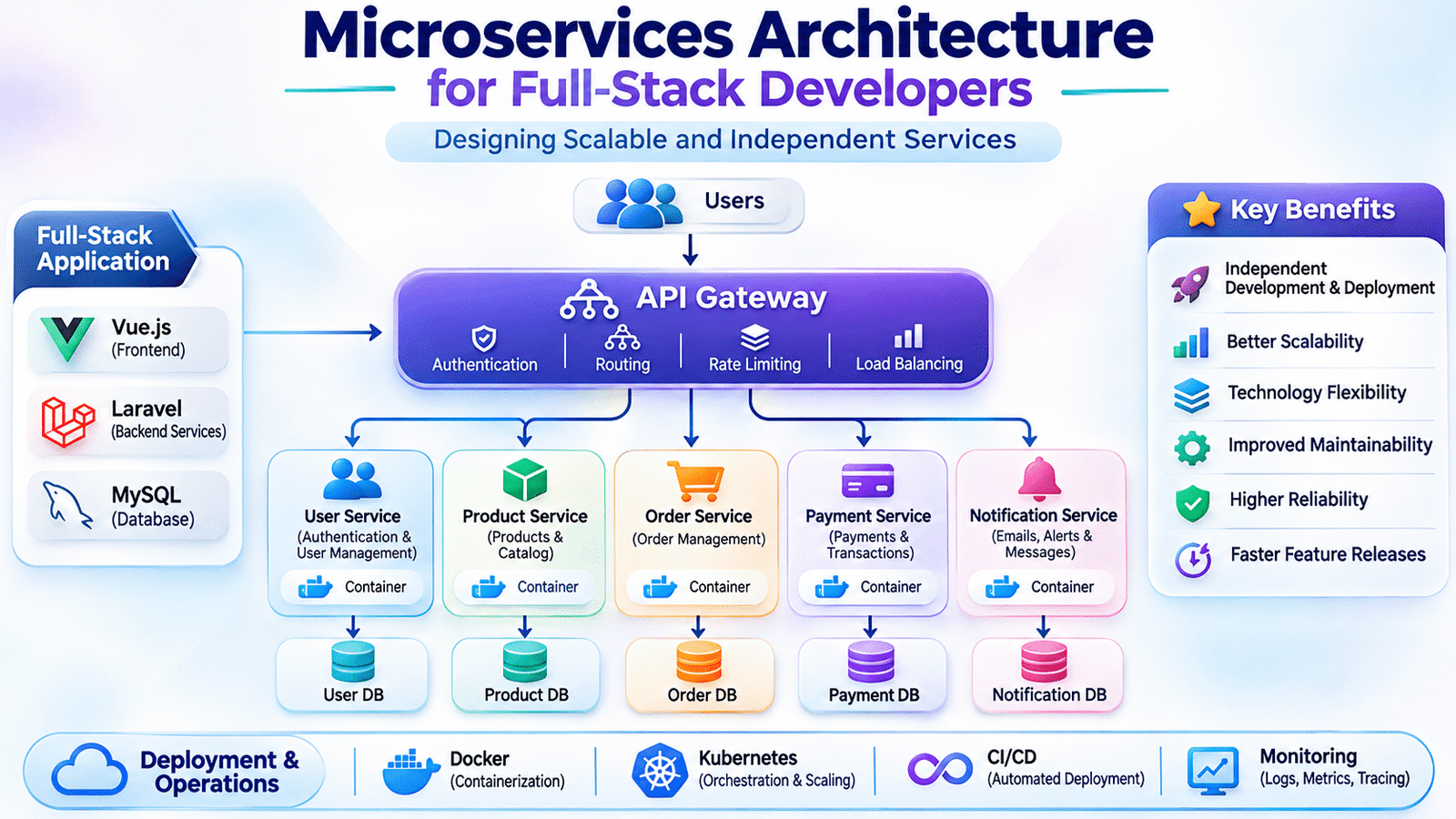
Microservices architecture is a modern software design approach that divides large applications into smaller, independently deployable services. It helps development teams build, maintain, and scale complex applications while keeping business functionalities separate and manageable.
Consider an e-commerce platform that supports thousands of users. It may contain separate business functionalities for user accounts, product catalogs, inventory, orders, payments, and notifications. As these functionalities grow, changes in one area can affect other parts of the application, making development, testing, and deployment more complicated.
This is one of the situations where microservices architecture becomes valuable.
Microservices architecture is an approach to software design in which an application is divided into smaller, independently deployable services. Each service is responsible for a specific business capability and communicates with other services through well-defined interfaces.
Instead of managing every business operation inside one large application, development teams can organize functionality into independent services with clearly defined responsibilities.
For full-stack developers, understanding microservices architecture is important when working with applications that require independent deployments, distributed processing, scalability, and long-term maintainability.
Let’s explore how microservices work and how they are implemented in real-world application environments.
Understanding Microservices Architecture in Modern Application Development
Microservices architecture organizes an application into multiple smaller services, each responsible for a specific business function.
For example, an e-commerce application could contain:
- User Service – Manages registration, authentication, and user profiles.
- Product Service – Manages product information and categories.
- Inventory Service – Tracks available product quantities.
- Order Service – Handles order creation and order management.
- Payment Service – Processes payment-related operations.
- Notification Service – Sends emails, messages, and notifications.
Each service can have its own business logic, deployment lifecycle, and data-management strategy.
For example, the Payment Service can be updated independently without necessarily deploying the Product Service.
This separation allows development teams to organize systems around business capabilities rather than keeping every feature inside a single application module.
However, independent services also introduce additional complexity in communication, monitoring, security, and data consistency.
2. Monolithic Architecture vs. Microservices Architecture
Before understanding microservices in detail, it is important to understand how they differ from a monolithic application.
In a monolithic architecture, multiple business functionalities are implemented within one application and commonly deployed as a single unit.
In a microservices architecture, business capabilities are divided into independently deployable services.
Consider the following comparison:
| Area | Monolithic Architecture | Microservices Architecture |
|---|---|---|
| Application structure | Single application | Multiple independent services |
| Deployment | Usually deployed together | Services can be deployed independently |
| Scaling | Often scales the entire application | Individual services can scale separately |
| Database | Commonly shared database | Services manage their own data |
| Communication | Often internal function calls | APIs or asynchronous messaging |
| Development | Can become complex as codebase grows | Services can have focused ownership |
| Operations | Generally simpler initially | Requires distributed monitoring and management |
A monolithic architecture is not automatically a bad choice. For smaller applications, it can be easier to develop, test, deploy, and maintain.
Microservices become useful when independent development, deployment, scaling, or team ownership provides enough benefit to justify the additional infrastructure and operational complexity.
The architecture should be selected based on actual business and technical requirements rather than adopting microservices simply because they are popular.
3. Designing Services Around Business Responsibilities
One of the most important decisions in microservices development is deciding how to divide an application into services.
Services should represent meaningful business capabilities rather than simply separating every database table or controller into an individual service.
Consider an online shopping platform.
A possible service structure is:
User Service: Handles user registration, profile management, and account-related operations.
Product Service: Manages product information, descriptions, categories, and pricing.
Inventory Service: Maintains stock availability and inventory updates.
Order Service: Creates orders and coordinates order-related business operations.
Payment Service: Handles payment requests, transaction status, and payment confirmations.
Notification Service: Sends transactional emails and other notifications.
Each service should have a clearly defined responsibility and communicate with other services through documented contracts.
This makes it easier for development teams to understand where a particular business operation belongs.
4. Understanding Service Communication
Microservices need to communicate with each other to complete business workflows.
For example, when a customer places an order, the application may need to:
- Receive the order request.
- Validate product information.
- Check inventory availability.
- Calculate the order amount.
- Process payment.
- Confirm the order.
- Send a notification.
These operations may involve several independent services.
There are two common communication approaches.
Synchronous Communication
In synchronous communication, one service sends a request to another service and waits for its response.
REST APIs are commonly used for this purpose.
For example, the Order Service may request product information from the Product Service:
GET /api/products/101The Product Service might return:
{
  "id": 101,
  "name": "Laptop",
  "price": 55000,
  "available": true
}
The Order Service can use this response to continue processing the request.
Synchronous communication is useful when the requesting service needs an immediate response.
However, it creates dependencies between services. If the Product Service is unavailable or slow, the Order Service may also experience delays.
Asynchronous Communication
In asynchronous communication, a service publishes an event or message without requiring the receiving service to respond immediately.
For example, after an order is successfully created, the Order Service may publish an OrderCreated event.
The Notification Service can consume this event and send a confirmation email.
Message brokers such as RabbitMQ and Apache Kafka are commonly used for asynchronous communication.
This approach helps services perform background operations independently and reduces direct dependencies between them.
However, teams must handle duplicate messages, retries, message ordering, and eventual consistency.
5. Understanding API Gateways in Microservices
When an application contains multiple services, exposing every service directly to frontend clients can make communication difficult to manage.
An API Gateway provides a common entry point for incoming API requests.
For example, a Vue.js frontend may communicate with an API Gateway rather than directly connecting to every backend service.
A simplified architecture looks like this:
          Vue.js Frontend
                 |
                 v
             API Gateway
                 |
       +---------+---------+
       |         |         |
       v         v         v
    User      Product    Order
   Service    Service   Service
                           |
                           v
                     Payment Service
The API Gateway can handle responsibilities such as:
- Request routing.
- Authentication integration.
- Rate limiting.
- Request validation.
- Logging.
- Response aggregation.
- API version routing.
For example, a frontend request to /api/products can be routed to the Product Service, while /api/orders can be routed to the Order Service.
The gateway simplifies frontend integration, but it should not become a place where all business logic is implemented.
6. Database Management in Microservices
Database design is one of the most important architectural considerations in a microservices system.
In a monolithic application, several modules may access the same database.
In a microservices architecture, each service should own and control its business data.
For example:
- User Service manages user data.
- Product Service manages product data.
- Inventory Service manages stock records.
- Order Service manages order records.
- Payment Service manages transaction records.
This is commonly described as the database-per-service approach.
The database technology does not necessarily need to be the same for every service. One service may use MySQL, while another may use PostgreSQL or a different storage technology based on its requirements.
A major advantage is that services can evolve their data structures independently.
However, sharing data across services becomes more complicated.
For example, the Order Service may need product information, but it should not directly depend on the Product Service’s internal database tables.
Instead, the services can communicate through APIs, events, or carefully designed data synchronization mechanisms.
This helps maintain service ownership and reduces direct database dependencies.
7. Handling Distributed Transactions and Data Consistency
In a monolithic application, several database operations may be grouped into one transaction.
Microservices introduce a different challenge because related operations may happen across multiple independent databases.
Consider an order workflow:
- The Order Service creates an order.
- The Inventory Service reserves stock.
- The Payment Service processes payment.
- The Order Service confirms the order.
If payment fails after stock has been reserved, the system must release that reservation and update the order status.
A traditional database transaction cannot automatically coordinate independent databases across all these services.
The Saga pattern is one approach used to manage distributed business transactions.
A Saga divides a business workflow into smaller local transactions. If a step fails, compensating actions can reverse or correct the effects of previously completed steps.
For example:
- Create order.
- Reserve inventory.
- Process payment.
- Confirm order.
If payment fails, the workflow can release reserved inventory and mark the order as failed.
This approach requires careful design because compensating actions are business operations rather than simple database rollbacks.
Developers should also understand eventual consistency, where related services may temporarily hold different views of information before updates are synchronized.
8. Implementing Microservices Using Laravel
Laravel can be used to build individual services within a microservices architecture.
For example, a development team may maintain separate Laravel applications for Product Service and Order Service.
Each application can have its own:
- Routes and controllers.
- Business services.
- Validation rules.
- Database configuration.
- Authentication integration.
- Automated tests.
- Deployment pipeline.
A simplified Product Service endpoint might look like:
use App\Models\Product;
use Illuminate\Support\Facades\Route;

Route::get('/products/{id}', function ($id) {
    return Product::findOrFail($id);
});
The Order Service can communicate with the Product Service through an HTTP client:
use Illuminate\Support\Facades\Http;

$response = Http::timeout(5)
    ->get(
        config('services.product.url') . '/api/products/101'
    );

if ($response->failed()) {
    throw new RuntimeException(
        'Unable to retrieve product information.'
    );
}

$product = $response->json();
This is a simplified example. Production implementations should include authentication between services, request validation, retry policies, error handling, logging, and appropriate timeout configuration.
The service URL should be managed through environment-specific configuration rather than hardcoded into application logic.
9. Integrating Microservices with a Vue.js Frontend
The frontend generally communicates with the backend through an API Gateway or a backend-for-frontend layer.
Consider a Vue.js application displaying a user’s order history.
The frontend can call a single endpoint:
const response = await fetch('/api/orders');

if (!response.ok) {
    throw new Error('Unable to retrieve orders');
}

const orders = await response.json();
The API Gateway can route the request to the Order Service and, where necessary, coordinate responses from other services.
The frontend does not need to know which internal service owns every database table or business operation.
This separation keeps frontend development focused on user interactions and API contracts while backend services manage their individual business responsibilities.
API response structures should remain consistent and well documented so that independent frontend and backend teams can work without unnecessary integration problems.
10. Authentication and Security Between Services
Microservices introduce additional security requirements because requests may travel between multiple independent services.
Authentication at the frontend entry point is only one part of the security model.
For example, a user may authenticate through an identity service and receive an access token.
The API Gateway can validate the token before forwarding authorized requests to backend services.
Services may also need to authenticate with each other.
Common approaches include:
- OAuth 2.0 and OpenID Connect.
- JWT-based access tokens.
- Service-to-service credentials.
- Mutual TLS for service communication.
- Role-based and permission-based authorization.
Developers should avoid assuming that requests are trustworthy simply because they originate inside the internal network.
Each service should enforce the authorization rules relevant to its business responsibilities.
Sensitive credentials should be stored using secure secret-management systems and rotated according to organizational security requirements.
https://www.enigmacommunity.com
11. Containerization and Deployment of Microservices
Microservices are often deployed using containers because each service can have its own runtime and dependencies.
For example, a platform may contain:
- Product Service container.
- Order Service container.
- Payment Service container.
- Notification Service
Internal links
Cloud Deployment for Full-Stack Applications
Kubernetes for Full-Stack Developers
Docker for Full-Stack Developers