
Machine Learning (ML) has moved from being a niche research field to a driving force behind modern technology. From personalized recommendations to fraud detection, ML is shaping how businesses operate and how people interact with digital systems. In this deep dive, we’ll explore what Machine Learning really is, how it works, its types, and why it matters.
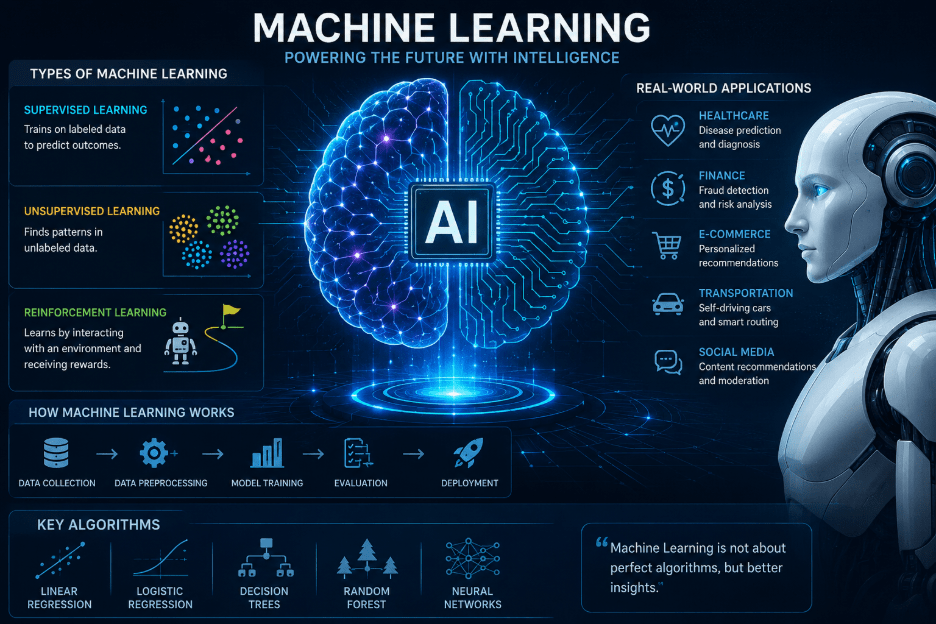
What is Machine Learning?
Machine Learning is a subset of Artificial Intelligence that enables systems to learn from data and improve their performance without being explicitly programmed. Instead of writing fixed rules, developers train models on data so they can identify patterns and make decisions.
At its core, ML revolves around three key components:
- Data – The foundation for learning
- Algorithms – The methods used to process data
- Models – The output that makes predictions or decisions
Types of Machine Learning
1. Supervised Learning
This is the most common type of ML, where models are trained on labeled data.
Examples:
- Email spam detection
- House price prediction
Popular algorithms:
- Linear Regression
- Decision Trees
- Support Vector Machines
2. Unsupervised Learning
Here, the model works with unlabeled data and tries to find hidden patterns.
Examples:
- Customer segmentation
- Market basket analysis
Popular techniques:
- Clustering (K-Means)
- Dimensionality Reduction (PCA)
3. Reinforcement Learning
In this approach, an agent learns by interacting with an environment and receiving rewards or penalties.
Examples:
- Game-playing AI
- Robotics
A well-known example is AlphaGo, which defeated human champions in the game of Go.
How Machine Learning Works
The ML process typically follows these steps:
- Data Collection
Gathering relevant and high-quality data
- Data Preprocessing
Cleaning and transforming data into usable formats
- Model Training
Feeding data into algorithms to learn patterns
- Evaluation
Testing the model using metrics like accuracy and precision
- Deployment
Integrating the model into real-world applications
Key Algorithms You Should Know
- Linear Regression – Predicts continuous values
- Logistic Regression – Used for classification problems
- Decision Trees – Tree-like model for decisions
- Random Forest – Ensemble of decision trees
- Neural Networks – Inspired by the human brain
Neural networks are the backbone of modern deep learning systems and are widely used in applications like image recognition and natural language processing.
Real-World Applications of Machine Learning
Machine Learning is everywhere:
- Healthcare – Disease prediction and diagnosis
- Finance – Fraud detection and risk analysis
- E-commerce – Personalized recommendations (like those used by Amazon)
- Transportation – Self-driving cars
- Social Media – Content recommendations and moderation
Challenges in Machine Learning
Despite its power, ML comes with challenges:
- Data Quality Issues – Poor data leads to poor models
- Overfitting – Model performs well on training data but fails in real-world scenarios
- Bias and Fairness – Models may reflect biases in data
- Computational Cost – Training large models requires significant resources
The Future of Machine Learning
Machine Learning continues to evolve rapidly. With advancements in deep learning, automation, and computing power, ML is becoming more accessible and impactful.
Emerging trends include:
- AutoML – Automating model creation
- Explainable AI (XAI) – Making models more transparent
- Edge AI – Running ML models on local devices
- Generative AI – Creating text, images, and more
Conclusion
Machine Learning is not just a technological trend—it’s a foundational pillar of modern innovation. Whether you’re a beginner or a tech professional, understanding ML opens doors to countless opportunities in today’s data-driven world.