
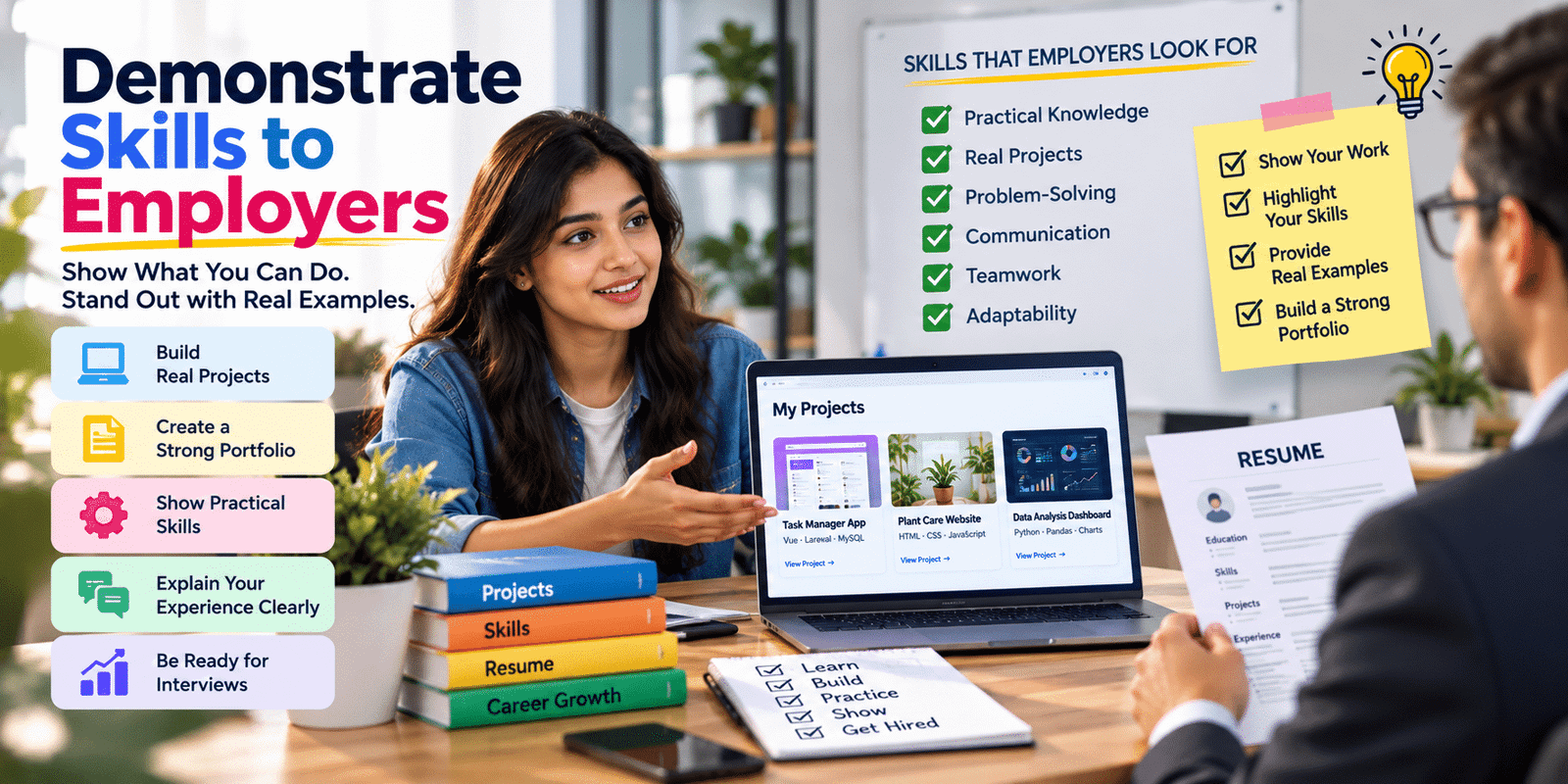
How Students Can Demonstrate Skills to Employers
Having skills is important when preparing for a career, but students must also learn how to demonstrate those skills to employers. Recruiters may see many candidates with similar qualifications, certifications, and academic backgrounds. What helps a candidate stand out is the ability to show how their knowledge can be applied to real tasks.
Demonstrate skills to employers means providing clear evidence of what you can do through projects, practical experience, portfolios, and specific examples. Instead of simply claiming to be good at problem-solving or communication, students can show how they used these abilities to complete a task or overcome a challenge.
In this article, we will explore how students can demonstrate their abilities, present their skills effectively, and prepare stronger evidence for resumes, portfolios, and job interviews.
1. Why Students Need to Demonstrate Their Skills to Employers
Students often spend years learning theoretical concepts, completing examinations, and earning qualifications. Although these achievements are valuable, employers may also want to understand how candidates apply their knowledge in practical situations.
For example, a student who lists programming as a skill can make that claim more convincing by presenting a working application, explaining the code, or describing a technical problem they solved.
Similarly, a student who claims to have strong communication skills can demonstrate them through a presentation, a group project, or a clear explanation of a complex topic.
Learning to demonstrate skills to employers helps students communicate their abilities more clearly. It also encourages them to focus on developing practical experience instead of relying only on statements in a resume.
2. The Difference Between Knowing a Skill and Proving It
Knowing a skill means understanding a concept or being able to perform a particular task. Demonstrating a skill means providing evidence that shows how you use that knowledge.
For example, a student may understand the principles of web development after completing an online course. However, building a responsive website demonstrates that the student can apply those principles in practice.
The same difference applies to professional skills. Understanding teamwork is not the same as contributing effectively to a group project. Knowing the meaning of problem-solving is not the same as explaining how you identified and resolved a specific problem.
Students should therefore look for opportunities to turn what they learn into practical outcomes.
This does not mean every skill requires a large project. Small assignments, presentations, case studies, and documented examples can also provide useful evidence of ability.
3. Why Certificates Alone May Not Show Practical Ability
Certificates can show that students completed a course or training program. They can also indicate an interest in learning and developing new knowledge.
However, a certificate does not always show how well someone can apply the material independently. Employers may still need to understand what the student learned and whether they can use that knowledge in a relevant situation.
For example, completing a data analysis course is a useful achievement. A small project analyzing a dataset, identifying patterns, and explaining the results provides additional evidence of practical ability.
Students should not ignore certificates. Instead, they should combine relevant qualifications with projects, examples, and explanations that demonstrate what they can do.
This combination gives employers a more complete picture of a candidate’s preparation and potential.
4. How Students Can Use Projects to Demonstrate Skills
Projects provide opportunities to apply knowledge, solve problems, and produce something that others can review.
Students can create projects related to their chosen career, such as a website, a data analysis report, a marketing campaign, a financial model, or a design portfolio.
A useful project should have a clear purpose. Students should be able to explain the problem they wanted to solve, the approach they selected, the tools they used, and the outcome they achieved.
For example, a student developing a task management application could explain how they organized tasks, designed the interface, stored information, and handled errors.
Projects also help students identify gaps in their understanding. When something does not work as expected, they can investigate the issue, test solutions, and improve the result.
Our guide on project-based learning explains how practical activities help students apply concepts and build useful experience.
5. How to Present Skills Effectively on a Resume
A resume should communicate relevant skills clearly and support them with meaningful examples wherever possible.
Instead of listing many skills without context, students should prioritize abilities that relate to the role they are applying for.
For example, a student applying for a frontend development position might list HTML, CSS, JavaScript, responsive design, and relevant frameworks they can actually use.
They can strengthen these skills by including a short description of a related project.
A project entry might explain that they built a responsive website, implemented interactive features, and tested the layout across different screen sizes.
Students should keep descriptions accurate and avoid claiming experience they do not have. They should also be prepared to answer questions about every skill listed on their resume.
A clear resume helps employers identify relevant experience and gives candidates a foundation for discussing their abilities during interviews.
6. How Portfolios Help Employers Evaluate Candidates
A portfolio brings examples of work together in one place. It allows students to present projects, explain their contributions, and show how their skills have developed.
The content of a portfolio depends on the career field. A software development portfolio may include project descriptions, source code, screenshots, and working demonstrations. A design portfolio may include selected designs and explanations of the creative process.
Students can also include writing samples, research projects, presentations, or case studies when these are relevant to their goals.
Each portfolio item should explain what the student contributed and what the project demonstrates. If a project was completed by a team, students should clearly identify their own responsibilities.
Our guide on building a professional portfolio before graduation provides additional guidance on organizing and presenting work.
A focused portfolio with a few meaningful examples can be more useful than a large collection of unfinished or unrelated projects.
7. How to Explain Your Skills During Interviews
Interviews give students an opportunity to explain how they use their skills and respond to challenges. Clear examples can make answers more convincing than general statements.
Students can prepare by thinking about situations in which they completed a task, worked with others, solved a problem, or learned something new.
The STAR method can help organize these answers:
- Situation: Explain the context or challenge.
- Task: Describe what you needed to accomplish.
- Action: Explain the steps you personally took.
- Result: Describe the outcome and what you learned.
For example, when discussing problem-solving, a student could explain a technical issue they encountered during a project, the steps they took to investigate it, and how they tested their solution.
Students should be honest about the results and avoid exaggerating their contribution. If a project did not produce the expected outcome, they can still explain what they learned and how they would approach the problem differently next time.
Practicing these explanations can help students communicate their abilities more confidently during interviews.
8. How Internships and Real-World Experience Provide Evidence
Internships and other practical experiences can help students understand how their skills work in professional settings.
During an internship, students may contribute to tasks, collaborate with colleagues, use workplace tools, and learn how projects are managed. These experiences can provide examples of communication, teamwork, technical ability, and accountability.
Students who do not have access to internships can still develop evidence through academic projects, personal projects, volunteering, student organizations, or community activities.
The important point is to describe the experience accurately and explain what was learned.
For example, a student who helped organize a college event could discuss planning activities, coordinating with team members, managing deadlines, and responding to unexpected issues.
Such examples can demonstrate transferable skills even when the student has not yet held a full-time job.
9. Common Mistakes Students Should Avoid
Students can make their skills easier to evaluate by avoiding several common mistakes.
Listing Skills Without Examples
A long list of abilities does not always explain how those abilities were developed or applied. Include relevant projects or experiences that support important claims.
Exaggerating Experience
Do not describe yourself as an expert in a tool or subject if you are still learning its fundamentals. Accurate descriptions build credibility and help you prepare for technical questions.
Including Too Many Unrelated Projects
Select projects that relate to your career direction. A focused collection makes it easier for employers to understand your strengths.
Failing to Explain Your Contribution
When presenting team projects, describe what you personally completed and how your work contributed to the outcome.
Ignoring Presentation Quality
Broken links, incomplete descriptions, spelling errors, and confusing layouts can make good work harder to evaluate. Review your resume and portfolio before sharing them.
Preparing Only for Technical Questions
Professional roles often require communication, collaboration, planning, and adaptability. Prepare examples that demonstrate these abilities as well as technical knowledge.
10. Practical Ways to Build Evidence of Your Skills
Students can begin demonstrating their abilities before graduation by taking small, consistent steps.
Choose a career direction. Research roles that interest you and identify the skills commonly required for those positions.
Create practical work. Build projects, complete assignments, or participate in activities that let you apply relevant knowledge.
Document your process. Record the problem, your approach, the tools you used, and the outcome.
Request feedback. Ask teachers, mentors, or peers to review your work and identify areas for improvement.
Improve your examples. Use feedback to refine projects, correct mistakes, and make your work easier to understand.
Organize your evidence. Add selected examples to your resume or portfolio, depending on their relevance.
Practice explaining your work. Prepare a short explanation of what you did, why you chose your approach, and what you learned.
Update your materials regularly. Replace weaker examples with more relevant work as your skills develop.
These actions help students build a growing record of their abilities instead of waiting until they begin applying for jobs.
11. How Demonstrating Skills Supports Career Growth
Demonstrating skills is useful not only during job applications but also throughout a professional career.
Employees often need to explain their work, communicate progress, share results, and show how their contributions support a team’s objectives. The ability to provide clear evidence of performance can help others understand their value.
Students who develop this habit early can become better at reflecting on their strengths, identifying areas for improvement, and communicating their achievements accurately.
It also supports continuous learning. When students try to demonstrate a skill through practical work, they may discover gaps that require further practice.
Over time, building skills and documenting progress can help learners make more informed decisions about training, career opportunities, and professional development.
12. Frequently Asked Questions
How can students demonstrate skills to employers without work experience?
Students can use academic assignments, personal projects, portfolios, volunteer activities, presentations, and practical exercises. They should explain their contributions and what each example demonstrates.
Are certificates enough to prove skills?
Certificates can demonstrate course completion, but practical examples often provide additional evidence of how students apply their knowledge. Combining relevant certificates with projects can create a stronger picture of their abilities.
What projects should students include in a portfolio?
Students should select projects relevant to their career goals. Examples may include websites, data analysis reports, design work, research projects, presentations, or case studies.
How can students explain their skills in interviews?
Students can prepare specific examples and use the STAR method to explain the situation, their responsibility, the actions they took, and the result.
Do students need an online portfolio?
Not every career requires an online portfolio, but it can be useful in fields where work samples help demonstrate ability. Students should choose a format appropriate to their industry and the type of work they want to showcase.
How often should students update their resume and portfolio?
Students should review their materials whenever they complete meaningful projects, gain relevant experience, develop new skills, or prepare to apply for a particular opportunity.
Final Thoughts
Having skills is an important starting point, but students also need to communicate what they can do and provide evidence that supports their claims.
Learning to demonstrate skills to employers helps students turn academic knowledge into practical examples through projects, portfolios, internships, and clear interview answers.
Start with one skill you want to demonstrate. Create a small project or identify an experience that shows how you use it, document your contribution, and practice explaining what you learned.
With consistent effort, students can build a clearer picture of their abilities and become better prepared for internships, job applications, and future career opportunities.
Outbound links
Students can explore the National Careers Service for career guidance and information about developing skills for employment.