
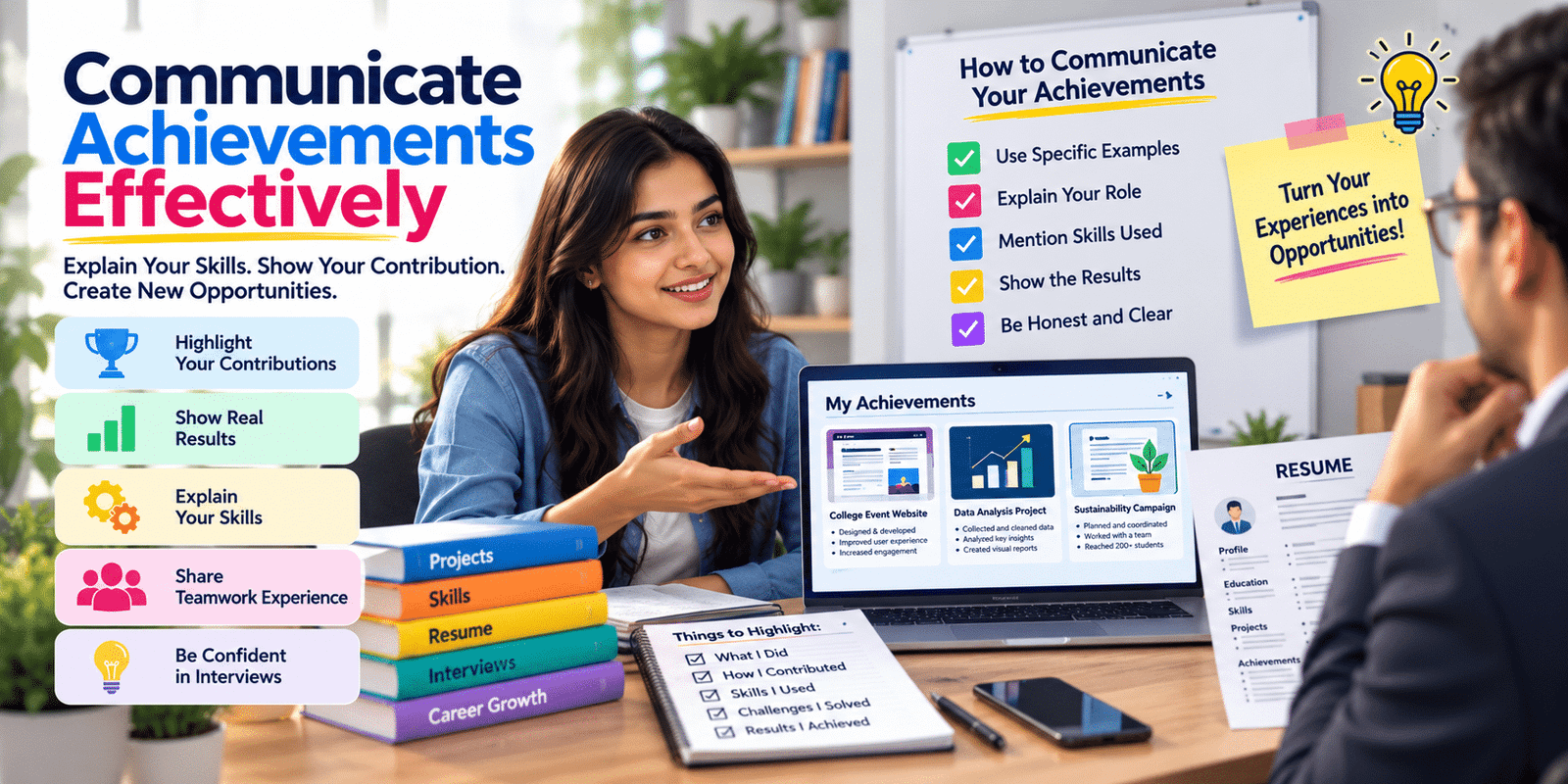
How Students Can Communicate Their Achievements
Learning to communicate achievements effectively helps students explain their skills, contributions, and results clearly. Through academic projects, internships, competitions, and personal learning, students gain experiences that can support their future careers. Explaining these achievements with specific examples helps recruiters and professional contacts understand what students can do.
Learning to communicate achievements effectively helps students present their abilities clearly in resumes, interviews, portfolios, and professional conversations. Instead of simply listing activities, they can explain the value of their work and provide examples that support their skills.
In this article, we will explore how students can identify meaningful achievements, describe their contributions, communicate confidently, and prepare for future career opportunities.
1. Why Students Should Communicate Achievements Effectively
Students often focus on completing assignments, earning grades, and developing new skills. However, they may find it difficult to explain these accomplishments when applying for internships or jobs.
For example, a student may have developed a website as part of a college project. Simply saying, “I completed a website project,” does not explain the student’s contribution or the skills they used.
A stronger explanation would describe the purpose of the website, the features the student developed, the challenges they solved, and the tools they used.
Learning to communicate achievements effectively helps students provide meaningful information instead of relying on general statements. It also helps recruiters, teachers, and mentors understand what students have learned and what they can contribute.
This ability is useful throughout a career because professionals regularly need to explain their progress, present results, and discuss their contributions.
2. What Counts as a Meaningful Achievement?
Students sometimes assume that achievements must involve awards, high grades, or major competition results. In reality, meaningful achievements can come from many different experiences.
An achievement may include completing a practical project, improving a skill, helping organize an event, solving a difficult problem, or contributing to a team.
For example, a student who learns a new programming language and uses it to build a small application has demonstrated initiative and practical learning.
Similarly, a student who helps coordinate a college event may develop planning, communication, and teamwork skills.
The important point is to identify what you did, what skills you used, and what the experience helped you accomplish.
Students should be honest about their achievements and avoid exaggerating their responsibilities. Even small accomplishments can provide useful examples when they are explained clearly.
3. Why Students Struggle to Explain Their Accomplishments
Many students find it uncomfortable to talk about their achievements. Some worry that they may appear boastful, while others do not know which details are important to mention.
Another common challenge is using vague statements. For example, saying “I am good at teamwork” does not explain how the student worked with others or what the team accomplished.
Students may also focus only on the final result and forget to explain the effort, decisions, and problem-solving involved.
To improve, students can prepare examples before interviews or professional conversations. They should identify a few meaningful experiences and write down their responsibilities, actions, and results.
Practicing these explanations can make it easier to discuss achievements naturally without exaggerating or minimizing contributions.
4. How to Describe Achievements on a Resume
A resume should help employers understand a student’s relevant experience quickly. Achievement statements are more useful when they explain an action and its outcome rather than simply naming a responsibility.
For example, instead of writing:
“Worked on a college website project.”
A student could write:
“Developed a responsive college event webpage using HTML and CSS, improving the presentation of event information across desktop and mobile screens.”
The second example explains the work completed and the skills applied.
Students can improve resume descriptions by following these steps:
- Start with a clear action verb, such as developed, organized, designed, analyzed, or coordinated.
- Explain the task or problem you worked on.
- Mention relevant tools or skills.
- Describe the result when it can be stated accurately.
- Keep the description concise and relevant to the job.
If measurable results are available, include them honestly. Never invent percentages, numbers, or outcomes simply to make an achievement appear more impressive.
5. How to Talk About Achievements in Interviews
Interviews give students an opportunity to explain their experiences in greater detail. Employers may ask about projects, challenges, teamwork, learning experiences, or situations where a candidate took initiative.
Students should prepare specific examples rather than memorizing generic answers.
The STAR method can help organize responses:
- Situation: Describe the context or challenge.
- Task: Explain what you needed to accomplish.
- Action: Describe the steps you personally took.
- Result: Explain the outcome and what you learned.
For example, when discussing a group project, a student could explain the project’s objective, their assigned responsibility, how they coordinated with teammates, and how their contribution helped complete the work.
If the project did not go as planned, students can still explain what happened, how they responded, and what they would improve next time.
Practicing with the STAR method helps students give structured answers while keeping the focus on real experiences.
6. Using Projects to Show Your Contributions
Projects are useful because they provide concrete examples of what students can do. They also give students opportunities to explain their decisions, technical abilities, and problem-solving approaches.
A student working on a data analysis project, for example, could explain how they collected or prepared the data, selected an analysis method, interpreted the results, and presented their findings.
A design student could describe the purpose of a design, the needs of its intended audience, and the decisions made during the creative process.
Students should clearly distinguish their own contributions from the work completed by teammates. This is especially important when presenting group assignments or collaborative projects.
Our guide on professional portfolios for students explains how learners can organize their work and present examples of their abilities.
Documenting project goals, responsibilities, challenges, and results makes it easier to explain achievements in resumes and interviews later.
7. How to Explain Achievements Without Exaggerating
Communicating achievements effectively does not mean making every accomplishment sound extraordinary. It means explaining the work accurately and showing why it matters.
Students should use specific language and avoid unsupported claims such as “I am the best programmer” or “I single-handedly completed the entire project” when those statements are not accurate.
Instead, explain the actual contribution. For example, a student could say, “I developed the login page and helped test the application’s user interface as part of a four-person team.”
This statement clearly describes the student’s role without taking credit for the entire project.
Students should also be transparent about the level of support they received. If a teacher or mentor helped them understand a concept, they can still explain how they applied that knowledge independently afterward.
Honest communication builds credibility and makes it easier to answer follow-up questions confidently.
8. Common Mistakes to Avoid
Students can improve how they present their achievements by avoiding these common mistakes.
Using Vague Statements
Statements such as “I worked hard” or “I learned many skills” do not provide enough detail. Explain what you did and which abilities you developed.
Listing Activities Without Explaining Their Value
Mentioning a competition, internship, or project is useful, but describing your contribution makes the experience more meaningful.
Taking Credit for Other People’s Work
Clearly identify your responsibilities in group projects. Accurate descriptions show professionalism and respect for collaborators.
Inventing Results
Never add false statistics, awards, responsibilities, or project outcomes. Use only information you can support with genuine examples.
Giving Answers That Are Too Long
Prepare clear explanations that focus on the most relevant details. Add more information when the interviewer asks follow-up questions.
Forgetting What You Learned
Achievements are not only about results. Explaining what you learned and how you improved can demonstrate reflection and a willingness to grow.
9. Practical Ways to Improve Achievement Communication
Students can build this skill through regular practice rather than waiting until their first job interview.
Maintain an achievement record. Keep a simple document containing projects, assignments, volunteering, internships, certifications, and other meaningful experiences.
Write short descriptions. For each experience, record your role, actions, skills used, and outcome.
Practice speaking. Explain one achievement aloud in about a minute. Focus on clarity rather than memorizing every word.
Ask for feedback. Request suggestions from teachers, mentors, or peers about whether your explanation is clear and specific.
Update your resume and portfolio. Add relevant achievements as you gain experience and remove outdated or unrelated information when necessary.
Prepare examples for common interview questions. Think about situations involving problem-solving, teamwork, leadership, communication, and learning from mistakes.
These habits help students become more comfortable discussing their work and make it easier to prepare professional applications.
10. How Communication of Achievements Supports Career Growth
The ability to explain achievements remains useful after graduation. Employees often need to share project updates, present results, discuss performance, and explain their contributions to managers or teammates.
Clear communication helps others understand what has been completed, which challenges were addressed, and what value the work created.
It also supports professional development conversations. When employees can describe their progress with specific examples, they can discuss their strengths and identify areas where further learning may be useful.
Students who practice this skill early can enter professional environments better prepared to explain their work, ask for feedback, and communicate their contributions.
You can also explore our guide on skills recruiters look for in freshers to learn about other qualities that may support career readiness.
11. Frequently Asked Questions
How can students communicate achievements effectively?
Students can communicate achievements effectively by describing what they did, explaining their personal contribution, identifying the skills they used, and sharing accurate results or lessons learned.
What achievements can students include on a resume?
Students can include relevant academic projects, internships, volunteering, competitions, leadership activities, practical assignments, and personal projects that demonstrate useful skills.
How can students talk about achievements without sounding boastful?
Focus on facts, actions, and results rather than making broad claims about yourself. Explain your contribution honestly and acknowledge teammates when the work was collaborative.
What is the STAR method for explaining achievements?
The STAR method stands for Situation, Task, Action, and Result. It helps candidates organize examples by describing the context, responsibility, actions taken, and outcome.
Do students need major awards to demonstrate achievements?
No. Small projects, skill improvements, meaningful contributions, and examples of overcoming challenges can also demonstrate learning and ability.
How often should students update their achievement records?
Students can update their records whenever they complete a meaningful project, internship, competition, or other experience. Reviewing the record every month or academic term can help keep it useful.
Final Thoughts
Learning to communicate achievements effectively helps students explain the value of their experiences instead of simply listing activities or qualifications.
By describing their contributions clearly, using specific examples, and presenting results honestly, students can improve their resumes, prepare stronger interview answers, and build more informative portfolios.
Start by choosing one meaningful achievement. Write down the challenge, your contribution, the skills you used, and the result. Practice explaining it clearly and update your professional materials as you gain new experiences.
Over time, this simple habit can help students communicate their abilities with greater confidence and prepare for future career opportunities.
Outbound links
Students can explore the National Careers Service for career guidance and information about preparing for employment.