
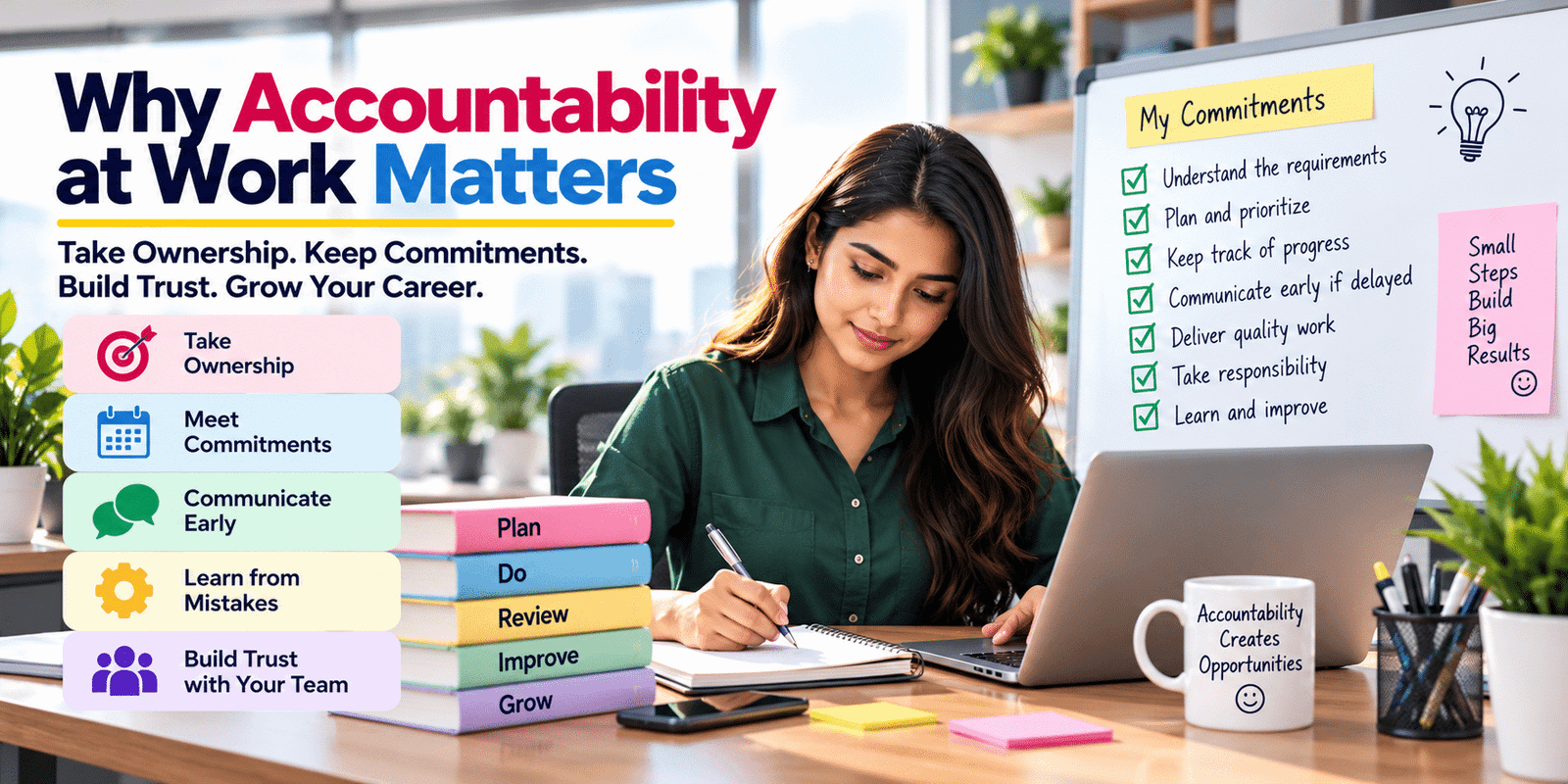
Why Accountability Is an Essential Skill for Professional Growth
Accountability at work is an important professional skill that helps employees take ownership of their responsibilities, meet commitments, and learn from their mistakes. In any workplace, people depend on one another to complete tasks, share information, and achieve common goals. When employees follow through on their commitments and communicate honestly, they help build trust across the team.
Accountability is not about blaming yourself for every problem or accepting responsibility for things beyond your control. It means understanding your role, being honest about your actions, addressing problems when they arise, and taking appropriate steps to improve the outcome.
For students and freshers, developing accountability early can help build a reputation for reliability and prepare them to handle professional responsibilities with confidence.
1. Why Accountability at Work Matters
Workplaces depend on employees who can be trusted to complete their tasks, communicate progress, and address problems honestly. When someone makes a commitment, other team members may organize their own work around that promise.
If an employee misses a deadline without communicating the delay, the impact may extend to the entire project. Other employees may have to wait, adjust their schedules, or complete additional work at short notice.
Accountability helps prevent these situations by encouraging people to monitor their progress and communicate concerns early.
For example, if an employee realizes that a report will not be ready on time, an accountable response is to inform the manager, explain the reason, and discuss a realistic completion plan.
This approach does not guarantee that mistakes or delays will never happen. Instead, it helps the team understand the situation and decide what to do next.
Over time, consistent accountability can strengthen professional relationships and help employees become more dependable contributors.Practising accountability at work helps employees communicate delays early and keep their commitments realistic.
2. What Does Professional Accountability Really Mean?
Professional accountability means accepting ownership of your actions, decisions, commitments, and the parts of a task that fall within your control.
It involves more than completing assigned work. It also means communicating honestly, following agreed processes, acknowledging mistakes, and taking corrective action when necessary.
An accountable professional typically:
- Understands the expected outcome before starting a task.
- Keeps track of deadlines and commitments.
- Communicates progress and potential delays.
- Admits mistakes instead of hiding them.
- Takes reasonable steps to correct problems.
- Learns from feedback and previous experiences.
- Follows through on agreed next steps.
For example, if an employee sends an incorrect report, accountability means acknowledging the error, correcting the report, informing the relevant people if necessary, and identifying how to prevent the same mistake.
It does not require the employee to accept blame for unrelated issues. Accountability should be based on facts, responsibilities, and the person’s actual contribution to the situation.
3. The Difference Between Accountability and Responsibility
Responsibility and accountability are related, but they are not exactly the same.
Responsibility refers to the tasks or duties assigned to someone. An employee may be responsible for preparing a report, testing a feature, or responding to a customer.
Accountability involves owning the commitments and outcomes associated with that work, including communicating progress and addressing problems.
For example, a developer may be responsible for implementing a feature. If a technical issue delays delivery, accountability means explaining the problem, identifying the next steps, and providing a realistic update.
Accountability does not mean that one person controls every factor affecting the outcome. Projects often depend on other people, resources, approvals, and changing requirements.
A professional should own their contribution while communicating dependencies and risks that are outside their control.
Understanding this difference helps employees avoid two extremes: ignoring their commitments or accepting unfair responsibility for everything that happens.
4. How Taking Ownership Builds Workplace Trust
Trust develops when people can rely on what others say and do. Employees build trust by keeping commitments, communicating honestly, and responding constructively when something goes wrong.
Taking ownership demonstrates that you take your work seriously. Colleagues do not need to assume that a task has been completed simply because you said you would do it; they can rely on clear updates and confirmed results.
Consider a team member who discovers an error shortly before a presentation. Instead of hiding the problem, the employee informs the team, corrects the information, and checks the final version.
This response shows honesty and a willingness to protect the quality of the work.
Trust is not built by never making mistakes. It is built by being transparent about problems and making a genuine effort to address them.
Consistent accountability at work can strengthen trust between colleagues and managers.
Employees who practise accountability can help create a working environment where people communicate more openly and coordinate their responsibilities more effectively.
5. Why Avoiding Mistakes Can Damage Professional Growth
Everyone makes mistakes while learning and working. The important question is how the mistake is handled.
When employees hide errors, blame others without checking the facts, or ignore problems, the same issues may continue. Managers may also struggle to understand what support or process improvements are needed.
For example, if a fresher repeatedly submits work in the wrong format but never asks for clarification, the underlying misunderstanding may remain unresolved.
Acknowledging the problem creates an opportunity to learn. The employee can clarify the requirements, correct the current work, and use a checklist for future submissions.
Accountability also encourages reflection. Instead of asking only, “Who caused this problem?” professionals can ask, “What happened, what was my contribution, and what can I do differently next time?”
This approach supports improvement without treating every mistake as a personal failure.
However, accountability should not be used to excuse unfair blame or a workplace culture that punishes people for honestly reporting problems. Employees need reasonable expectations and an appropriate opportunity to learn.
6. How to Admit Mistakes Without Losing Confidence
Admitting a mistake can feel uncomfortable, especially when the work is important or other people are affected. Some employees worry that acknowledging an error will damage their professional reputation.
In practice, hiding a known mistake can create a bigger problem if the issue is discovered later.
A professional response should be clear, factual, and focused on correction.
You can follow these steps:
Acknowledge the mistake. State what happened without making excuses or blaming someone else prematurely.
Explain the impact. Describe what needs to be corrected and who may be affected.
Take corrective action. Identify what you are doing to resolve the issue.
Communicate the next step. Provide a realistic timeline or explain what support is required.
Learn from the situation. Determine whether a checklist, review, clarification, or process change could prevent recurrence.
For example:
“I noticed that I used an outdated figure in the report. I am correcting it now and will send the revised version by 3 PM. I will also verify the source data before submitting future reports.”
This response demonstrates ownership and a practical commitment to improvement.
Confidence does not come from pretending to be perfect. It can grow from knowing how to respond responsibly when things go wrong.
7. How Freshers Can Demonstrate Accountability
Freshers do not need years of experience to demonstrate accountability. They can start by developing reliable habits in everyday assignments.
Before beginning a task, make sure you understand what is expected, when it is due, and how the result will be evaluated. Ask questions when requirements are unclear rather than making assumptions.
During the task, track your progress and inform the relevant person if a problem affects the timeline.
After completing the work, check that the requirements have been met and confirm completion when appropriate.
Freshers can also demonstrate accountability by:
- Arriving prepared for meetings and assigned activities.
- Following agreed instructions and procedures.
- Keeping commitments realistic.
- Asking for help before a small problem becomes a major delay.
- Accepting constructive feedback.
- Correcting mistakes instead of repeating them.
- Giving honest updates about progress.
For example, if you are learning a new tool and discover that a task is taking longer than expected, explain what you have tried, what is blocking progress, and what guidance you need.
This shows that you are taking ownership of the task even when you cannot solve every problem independently.
8. How to Take Ownership When a Project Goes Wrong
Projects can encounter unexpected challenges, including technical failures, changing requirements, resource limitations, and delays from dependencies.
When something goes wrong, accountability begins with understanding the facts. Avoid assigning blame before you know what happened.
First, identify the issue and its impact. Next, clarify which actions are within your control and which require support from other people.
Then communicate the situation to the appropriate team members. Explain what has happened, what has already been attempted, and what decisions or resources are needed.
For example, if a software feature fails during testing, the responsible developer should report the failure, investigate the cause, document relevant findings, and work with the team to resolve it.
Taking ownership does not mean personally fixing every part of a project. It means actively contributing to the resolution rather than ignoring the problem or assuming someone else will handle it.
Once the issue is resolved, review what could be improved in the planning, communication, or testing process.
This helps turn a difficult project experience into useful learning for the next one.
9. Why Meeting Commitments Matters at Work
Professional commitments influence how teams plan their work. A promised delivery date, scheduled meeting, or agreed follow-up can become part of someone else’s plan.
Meeting commitments helps colleagues coordinate their responsibilities and reduces uncertainty.
However, accountability does not mean promising more than you can realistically deliver. Before agreeing to a task, understand the requirements, estimate the effort, and check your existing priorities.
If circumstances change, communicate early instead of waiting until the deadline has passed.
For example, an employee who discovers that a task requires additional testing should inform the team as soon as the risk becomes clear. This gives others an opportunity to adjust the plan.
It is also important to distinguish between a commitment and an assumption. If a deadline has not been confirmed, clarify it rather than treating an uncertain date as an agreed expectation.
Reliable professionals make realistic promises, track their progress, and update others when plans need to change.
10. Common Accountability Mistakes Professionals Make
Even well-intentioned employees can misunderstand accountability or apply it inconsistently.
Blaming Others Immediately
When a problem occurs, blaming a colleague without understanding the facts can damage trust. Investigate the situation and identify each person’s actual responsibilities.
Hiding Mistakes
Concealing an error may delay the solution and increase its impact. Raise important problems promptly and help correct them.
Making Unrealistic Promises
Agreeing to every request can create missed deadlines. Understand the work and your capacity before committing.
Waiting Until the Last Minute to Communicate
A delay becomes harder to manage when others learn about it too late. Share risks as soon as they become apparent.
Accepting Blame for Everything
Accountability is not the same as taking responsibility for every event. Focus on your own actions and communicate external constraints clearly.
Repeating the Same Mistakes Without Learning
Correcting an error is useful, but understanding why it happened can prevent future problems. Review recurring issues and adjust your approach.
Recognizing these mistakes helps professionals take ownership in a fair, practical, and sustainable way.
11. How Managers Can Encourage Accountability at Work
Accountability is not only an employee responsibility. Managers influence whether teams have the clarity, resources, and support needed to fulfil their commitments.
Managers can encourage accountability by defining expectations clearly, assigning responsibilities fairly, and agreeing on realistic deadlines.
They should also create opportunities for employees to raise concerns early. If people fear being blamed for reporting a problem, they may hide risks until the situation becomes more serious.
When mistakes occur, managers should examine both individual actions and the processes that contributed to the problem. This allows them to address responsibility while also improving systems and training where needed.
Useful management practices include:
- Defining clear outcomes and responsibilities.
- Providing timely feedback.
- Reviewing progress without unnecessary micromanagement.
- Addressing repeated problems consistently.
- Recognizing employees who communicate honestly and follow through.
- Supporting learning after mistakes.
- Applying accountability fairly across the team.
A strong accountability culture combines clear standards with appropriate support. Employees should understand what is expected and have a reasonable opportunity to meet those expectations.
12.Practical Ways to Improve Accountability at Work
Accountability becomes easier when it is supported by simple routines.
Record your commitments. Maintain a task list or calendar so that deadlines and follow-ups are not forgotten.
Clarify expectations. Confirm the required outcome, deadline, and relevant quality standards before starting.
Track progress. Check whether your work is moving according to plan and identify delays early.
Communicate honestly. Give accurate updates instead of reporting progress that has not actually occurred.
Ask for help when needed. Explain what you have tried and what is preventing progress.
Correct mistakes promptly. Focus on reducing the impact and preventing recurrence.
Follow through. Complete agreed next steps or provide an update if circumstances change.
Reflect on outcomes. Review what worked, what did not, and what you can improve.
These habits help turn accountability from an abstract professional value into a practical part of daily work.
13. A Simple Framework for Taking Ownership
Use this five-step framework when handling a task, commitment, or workplace problem.
Step 1: Clarify
Understand what needs to be done, who is involved, and what outcome is expected.
Step 2: Commit
Agree on a realistic plan and deadline after checking your responsibilities and available resources.
Step 3: Track
Monitor your progress and identify obstacles before they create avoidable delays.
Step 4: Communicate
Share progress, raise concerns, and explain changes honestly to the people affected.
Step 5: Learn
Review the outcome, correct mistakes, and identify practical improvements for the future.
For example, if you are responsible for delivering a report, clarify the requirements, agree on the deadline, track your progress, communicate any risks, and review the final result before submission.
This framework helps professionals remain accountable without relying on memory or waiting for others to ask for updates.
Frequently Asked Questions
1. What is accountability at work?
Accountability at work means taking ownership of your commitments, actions, and work-related outcomes within your control. It includes communicating honestly, addressing mistakes, and following through on agreed responsibilities.
2. Why is accountability important for career growth?
It can help professionals build trust, improve reliability, learn from mistakes, and demonstrate that they can manage responsibilities effectively.
3. How can freshers show accountability?
Freshers can clarify expectations, meet realistic deadlines, track progress, communicate delays early, accept feedback, and take steps to correct mistakes.
4. What is the difference between responsibility and accountability?
Responsibility refers to the duties assigned to someone. Accountability involves owning their commitments and contribution to the outcome, including communicating progress and addressing problems.
5. Does accountability mean never making mistakes?
No. Everyone makes mistakes. Accountability means acknowledging relevant errors, taking corrective action, and learning how to reduce the chance of similar problems happening again.
6. How can I be accountable without accepting blame for everything?
Focus on the actions and responsibilities within your control. Explain relevant facts, dependencies, and constraints clearly, and take ownership of your contribution without accepting unfair responsibility for unrelated issues.
Final Thoughts: Trust Begins With Accountability
Accountability at work helps professionals become more reliable by encouraging them to take ownership of their commitments, communicate honestly, and learn from their experiences.Practising accountability at work helps professionals build trust, communicate honestly, and improve their performance over time.
It does not mean being perfect or accepting blame for every problem. It means understanding your responsibilities, acting when something goes wrong, and following through on the steps needed to improve the outcome.
For students and freshers, developing accountability early can help build confidence and establish strong professional habits. For experienced employees, it can strengthen teamwork, improve coordination, and support career growth.
Start with one simple habit today: make a realistic commitment, track your progress, and communicate honestly if anything changes. Consistent actions like these can help build trust over time.
Internal Links
Professional skills for freshers Suggested sentence: “Accountability works alongside other professional skills to help employees become reliable and effective team members.” URL: https://vyasanexus.com/skills-recruiters-look-for-in-freshers/
2. Documentation skills Suggested sentence: “Maintaining clear documentation helps professionals track decisions, record progress, and follow through on commitments.” URL: https://vyasanexus.com/documentation-skills/
3. Continuous learning and career growth Suggested sentence: “Learning from mistakes and improving work habits are important parts of continuous professional development.” URL: https://vyasanexus.com/continuous-learning-career-growth/
Outbound Link
World Economic Forum — Future of Jobs Report 2025
https://www.weforum.org/publications/the-future-of-jobs-report-2025