
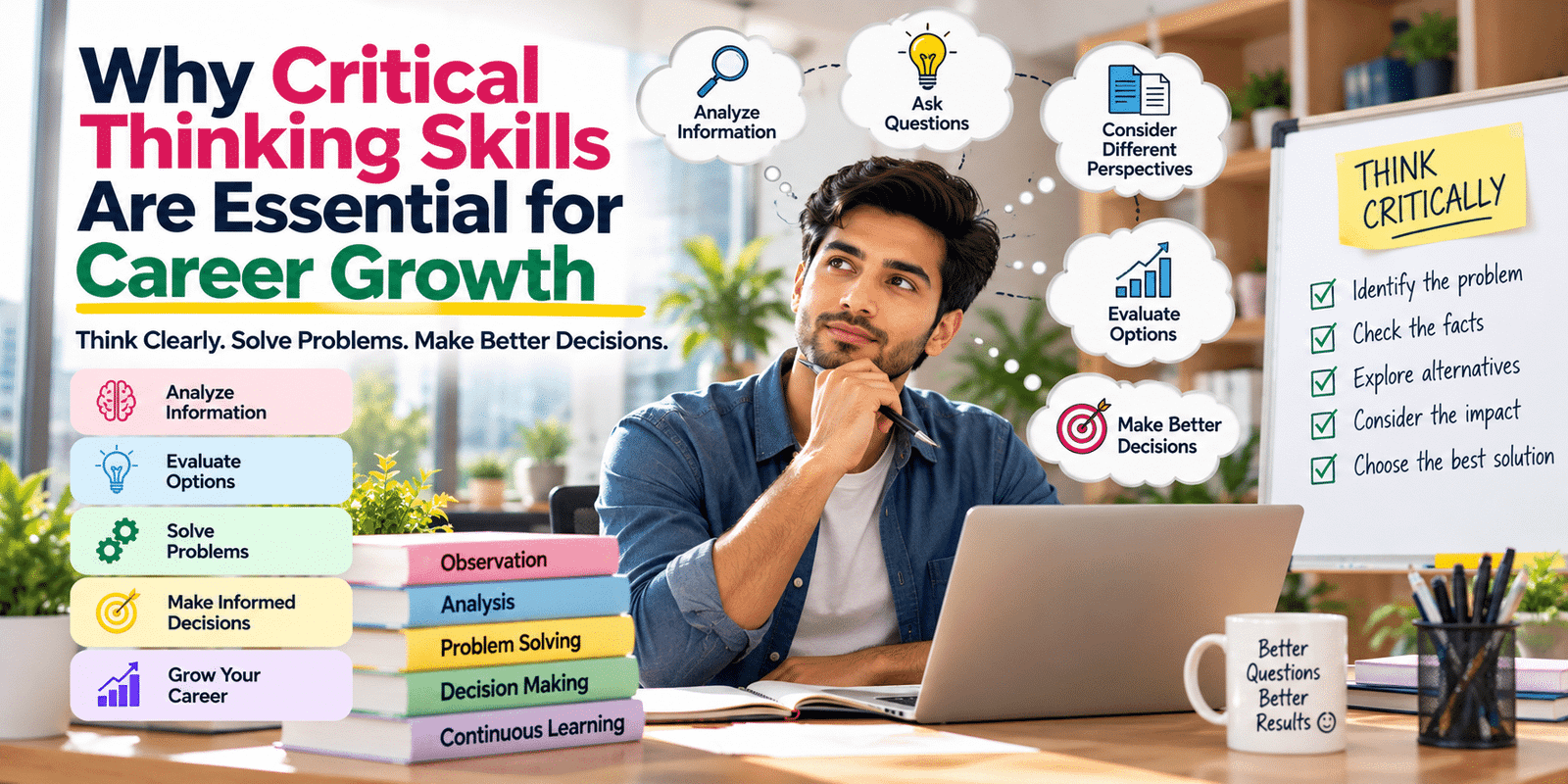
Critical thinking skills help professionals evaluate information, question assumptions, solve problems, and make informed decisions. In today’s workplace, employees regularly face new challenges, changing requirements, and large amounts of information. Simply memorizing facts or following instructions is not always enough to determine the best course of action.
Professionals need to understand problems, compare possible solutions, and consider the consequences of their decisions. Critical thinking helps them approach these situations logically rather than relying only on assumptions, habits, or first impressions.
For students and freshers, developing critical thinking skills before entering the workplace can improve problem-solving abilities, strengthen decision-making, and build confidence when facing unfamiliar situations.
1. Why Critical Thinking Skills Matter in the Workplace
Workplace decisions often involve more than one possible solution. An employee may need to identify why a project is delayed, determine whether information is reliable, or decide which task deserves immediate attention.
Without careful analysis, people may accept the first explanation they hear or choose a solution without considering its limitations.
Critical thinking encourages professionals to examine the available information, identify the actual problem, and evaluate different options before acting.
For example, if a team notices that a project is repeatedly missing deadlines, a quick response might be to ask employees to work faster. A critical thinker would investigate the reasons behind the delays. The problem could involve unclear requirements, unrealistic estimates, technical difficulties, or delayed approvals.
Understanding the actual cause makes it easier to choose an effective solution.
This approach helps professionals make better decisions, reduce avoidable mistakes, and contribute more meaningfully to their teams.
2. What Is Critical Thinking and Why Is It Important?
Critical thinking is the process of examining information carefully before accepting a claim, reaching a conclusion, or making a decision.
It involves asking relevant questions, checking evidence, identifying assumptions, comparing alternatives, and considering possible outcomes.
Critical thinking does not mean disagreeing with everyone or doubting every statement. It means understanding why something may be true, what evidence supports it, and whether another explanation is possible.
For example, when receiving a report that a new process will improve productivity, a critical thinker may ask how productivity will be measured, what evidence supports the claim, and whether the process introduces additional costs or risks.
These questions help people move beyond opinions and make decisions based on relevant information.
Critical thinking is useful in education, business, technology, research, management, and everyday professional communication because it helps people evaluate situations instead of reacting automatically.
3. The Difference Between Critical Thinking and Memorization
Memorization helps people remember information, definitions, procedures, and facts. Critical thinking helps them understand how to evaluate and apply that information in different situations.
Both are useful, but they serve different purposes.
For example, a student may memorize the steps of a programming algorithm. However, solving a new problem requires understanding which algorithm is appropriate, why it works, and what changes may be needed for different inputs.
Similarly, an employee may know a company’s standard procedure but still need to decide what to do when an unusual situation occurs.
Memorization provides a foundation. Critical thinking helps people use that foundation to make judgments, solve unfamiliar problems, and adapt when circumstances change.
Students should therefore practise explaining concepts, applying knowledge to real examples, and comparing different approaches rather than relying only on recalling information.
4. How Critical Thinking Helps Professionals Solve Problems
Problem-solving begins with understanding what is actually wrong. If people misunderstand the problem, even a well-executed solution may fail to produce the desired result.
Critical thinking helps professionals break complex situations into smaller parts, identify relevant facts, and investigate possible causes.
Consider a software application that becomes slower after an update. Immediately replacing the entire system may be unnecessary. A more careful approach would involve examining performance data, checking recent changes, identifying the affected components, and testing possible causes.
The same principle applies outside technology. If customer complaints increase, a team can examine complaint categories, response times, product issues, and customer feedback before deciding what needs to change.
A practical problem-solving process includes:
- Defining the problem clearly.
- Collecting relevant information.
- Identifying possible causes.
- Comparing potential solutions.
- Testing or implementing the most suitable option.
- Reviewing the results and learning from them.
Critical thinking makes this process more systematic and reduces the risk of acting on incomplete information.
5. Why Employers Value Critical Thinkers
Employers need people who can do more than complete assigned tasks. They also need employees who can understand requirements, recognize risks, adapt to changing circumstances, and contribute to better decisions.
Critical thinkers can be valuable because they are more likely to investigate problems before proposing solutions, ask meaningful questions, and explain the reasoning behind their recommendations.
For example, an employee reviewing a project plan may notice that an important dependency has not been considered. Raising the issue early can help the team avoid delays later.
Critical thinking also supports collaboration. Employees who evaluate ideas fairly can discuss disagreements without automatically treating different opinions as personal criticism.
However, critical thinking does not guarantee that every decision will be correct. Its value lies in improving the quality of the reasoning process and helping people recognize uncertainty before taking action.
6. How to Evaluate Information Before Making Decisions
Professionals receive information from reports, colleagues, websites, social media, customers, and AI tools. Not every source is equally accurate, complete, or relevant.
Before relying on information, examine where it came from and whether the evidence supports the conclusion.
Start by asking these questions:
Who provided the information?
Understand the source and whether it has relevant knowledge or expertise.
What evidence supports the claim?
Look for data, examples, documentation, or reliable references instead of relying only on confident statements.
Is the information current?
Older information may no longer reflect the latest requirements, policies, prices, or technology.
Could important context be missing?
A statistic or statement may be accurate in one situation but misleading when applied to another.
Are there alternative explanations?
Consider whether other factors could explain the same result.
For example, if a team believes that a new tool has improved performance, compare relevant results before and after implementation. Also consider whether workload, staffing, or other changes influenced the outcome.
Evaluating information carefully helps professionals avoid unsupported conclusions and make more informed decisions.
7. How Freshers Can Develop Critical Thinking Skills
Freshers may assume that critical thinking requires years of professional experience. In reality, they can begin developing it through everyday learning and practical exercises.
Start by asking why a particular method works instead of memorizing the steps alone. When solving a problem, try to explain your reasoning and compare at least two possible approaches.
Students can also practise analysing case studies, discussing different viewpoints, debugging code, interpreting data, and evaluating the strengths and weaknesses of proposed solutions.
During internships or projects, pay attention to how experienced professionals investigate problems. Ask how they reached a conclusion and what alternatives they considered.
Freshers should also learn to recognize the limits of their knowledge. When information is missing, asking for clarification or checking a reliable source is often better than making an unsupported assumption.
Practical experience combined with reflection can gradually improve judgment and confidence.
8. The Role of Critical Thinking in the Age of AI
AI tools can help professionals generate ideas, summarize information, draft content, and explore possible solutions. However, their outputs still need to be evaluated before being used in important decisions.
AI-generated information may contain errors, omit context, or present uncertain statements confidently. A useful-looking answer should not automatically be treated as correct.
Critical thinking helps users check important claims, verify facts against reliable sources, identify missing information, and decide whether a recommendation fits their actual situation.
For example, a student using AI to understand a technical concept can compare the explanation with trusted documentation and test the example independently.
Similarly, a professional using AI to analyse a business problem should review the assumptions, data, limitations, and potential consequences before acting on the recommendation.
The goal is not to avoid AI. It is to combine its capabilities with human judgment, domain knowledge, and responsible decision-making.
9. Common Mistakes That Weaken Critical Thinking
People can make reasoning mistakes even when they have good intentions. Recognizing these habits is an important step toward improving judgment.
Accepting the First Explanation
The first explanation may sound convincing but may not address the actual cause. Explore the evidence before reaching a conclusion.
Relying on Assumptions
Assumptions can fill gaps in understanding, but they should not be confused with verified facts. Identify what you know and what still needs confirmation.
Ignoring Different Perspectives
Listening only to people who agree with you can limit your understanding. Consider relevant alternative explanations, even when they challenge your initial opinion.
Making Decisions Based Only on Emotions
Emotions can provide useful signals, but important decisions should also consider facts, consequences, and available options.
Searching Only for Supporting Evidence
People sometimes look for information that confirms what they already believe. Actively consider evidence that could challenge your conclusion.
Refusing to Change Your Mind
Changing your position after discovering better evidence is a sign of learning, not weakness.
Avoiding these mistakes can help professionals develop more balanced and reliable reasoning habits.
10. How to Question Assumptions Without Creating Conflict
Critical thinking often involves questioning existing ideas, but the way questions are asked can influence how others respond.
A question that sounds accusatory may create defensiveness, even when the underlying concern is valid.
Instead of saying, “This plan will never work,” explain the specific issue and ask for clarification.
For example, you could say, “Could we review the timeline? I am concerned that the testing phase may need more time than we have allocated.”
This approach focuses on the decision rather than criticizing the person who proposed it.
You can also ask:
- What evidence supports this approach?
- Have we considered another option?
- What risks might we be overlooking?
- How will we measure success?
- What information would help us make this decision confidently?
These questions encourage discussion and help teams evaluate ideas more thoroughly.
Critical thinking should improve conversations, not turn every discussion into an argument.
11. Practical Ways to Improve Critical Thinking Every Day
Critical thinking develops through repeated practice. You do not need a complicated training programme to begin improving it.
Ask better questions. When you receive information, ask what it means, why it matters, and what evidence supports it.
Explain your reasoning. After making a decision, identify the facts and assumptions that influenced your choice.
Compare alternatives. Before choosing a solution, consider its benefits, limitations, costs, and risks.
Learn from mistakes. Review unsuccessful decisions to understand whether the problem involved missing information, incorrect assumptions, or poor execution.
Seek constructive feedback. Ask others to review your reasoning and point out weaknesses you may have missed.
Practise with real problems. Analyse project challenges, case studies, technical issues, or everyday decisions.
Stay open to new evidence. Be prepared to revise your conclusion when reliable information changes your understanding.
Small habits practised consistently can improve the way you evaluate information and solve problems.
12. A Simple Framework for Better Critical Thinking
Use this five-step framework whenever you need to make an important decision or solve an unfamiliar problem.
Step 1: Define
Clearly identify the question or problem. Avoid jumping into solutions before understanding what needs to be addressed.
Step 2: Investigate
Collect relevant facts, check sources, and identify missing information. Separate confirmed details from assumptions.
Step 3: Analyse
Compare possible explanations and solutions. Consider risks, benefits, limitations, and alternative perspectives.
Step 4: Decide
Choose the option that best fits the evidence, objectives, and constraints. Explain the reasoning behind your decision.
Step 5: Review
Evaluate the result after acting. If the outcome differs from expectations, identify what you learned and what should change.
This framework provides a practical structure for approaching difficult decisions without relying entirely on instinct or habit.
13. How Critical Thinking Supports Career Growth
Career growth involves more than acquiring technical knowledge or completing assigned tasks. Professionals also need to understand complex situations, make sound judgments, and respond effectively when circumstances change.
Critical thinking can help employees identify problems before they become larger, evaluate feedback, understand business requirements, and recommend improvements.
It can also support leadership development. People who explain their reasoning clearly and consider the consequences of decisions are better prepared to participate in planning and problem-solving discussions.
For students, critical thinking can improve project work, interview responses, and the ability to explain how they reached a solution.
However, critical thinking is most effective when combined with other skills, including communication, collaboration, technical knowledge, and a willingness to learn.
Developing these abilities together can help professionals contribute more confidently and take on greater responsibility over time.
Frequently Asked Questions
1. What are critical thinking skills?
Critical thinking skills are the abilities used to evaluate information, question assumptions, compare alternatives, identify problems, and make reasoned decisions.
2. Why are critical thinking skills important for career growth?
They help professionals analyse challenges, evaluate evidence, make informed decisions, solve problems, and explain their reasoning to colleagues and managers.
3. How can students improve critical thinking?
Students can practise solving unfamiliar problems, analysing case studies, asking questions, comparing different solutions, checking sources, and explaining their reasoning.
4. Is critical thinking the same as problem-solving?
They are related but different. Critical thinking helps people analyse information and evaluate possible explanations, while problem-solving focuses on finding and implementing a solution. Critical thinking often supports effective problem-solving.
5. Can critical thinking be learned?
Yes. People can develop it through practice, feedback, reflection, exposure to different perspectives, and experience evaluating real situations.
6. Why is critical thinking important when using AI?
AI-generated information can be incomplete or incorrect. Critical thinking helps users verify important claims, evaluate recommendations, and decide whether the output is appropriate for their needs.
Final Thoughts: Think Clearly, Decide Better, Grow Faster
Critical thinking skills help people move beyond memorizing information and accepting the first answer they receive. They encourage professionals to ask meaningful questions, evaluate evidence, understand different perspectives, and make thoughtful decisions.
For students and freshers, these skills provide a strong foundation for solving unfamiliar problems and adapting to workplace expectations. For experienced professionals, they support better judgment, continuous improvement, and more effective collaboration.
You can start developing critical thinking today by questioning one assumption, checking one important claim, or comparing different solutions before making a decision.
The goal is not to question everything. It is to understand enough to make better decisions and learn from the results.
Internal Links
Professional skills for freshers Suggested sentence: “Critical thinking works alongside communication and other professional skills to help employees contribute effectively.” URL: https://vyasanexus.com/skills-recruiters-look-for-in-freshers/
Project-based learning Suggested sentence: “Project-based learning gives students opportunities to analyse real problems, compare solutions, and apply what they know.” URL: https://vyasanexus.com/blog-what-is-project-based-learning/
Continuous learning and career growth Suggested sentence: “Continuous learning helps professionals update their knowledge and improve their judgment as workplace requirements change.” URL: https://vyasanexus.com/continuous-learning-career-growth/
Outbound
World Economic Forum — Future of Jobs Report 2025
https://www.weforum.org/publications/the-future-of-jobs-report-2025