
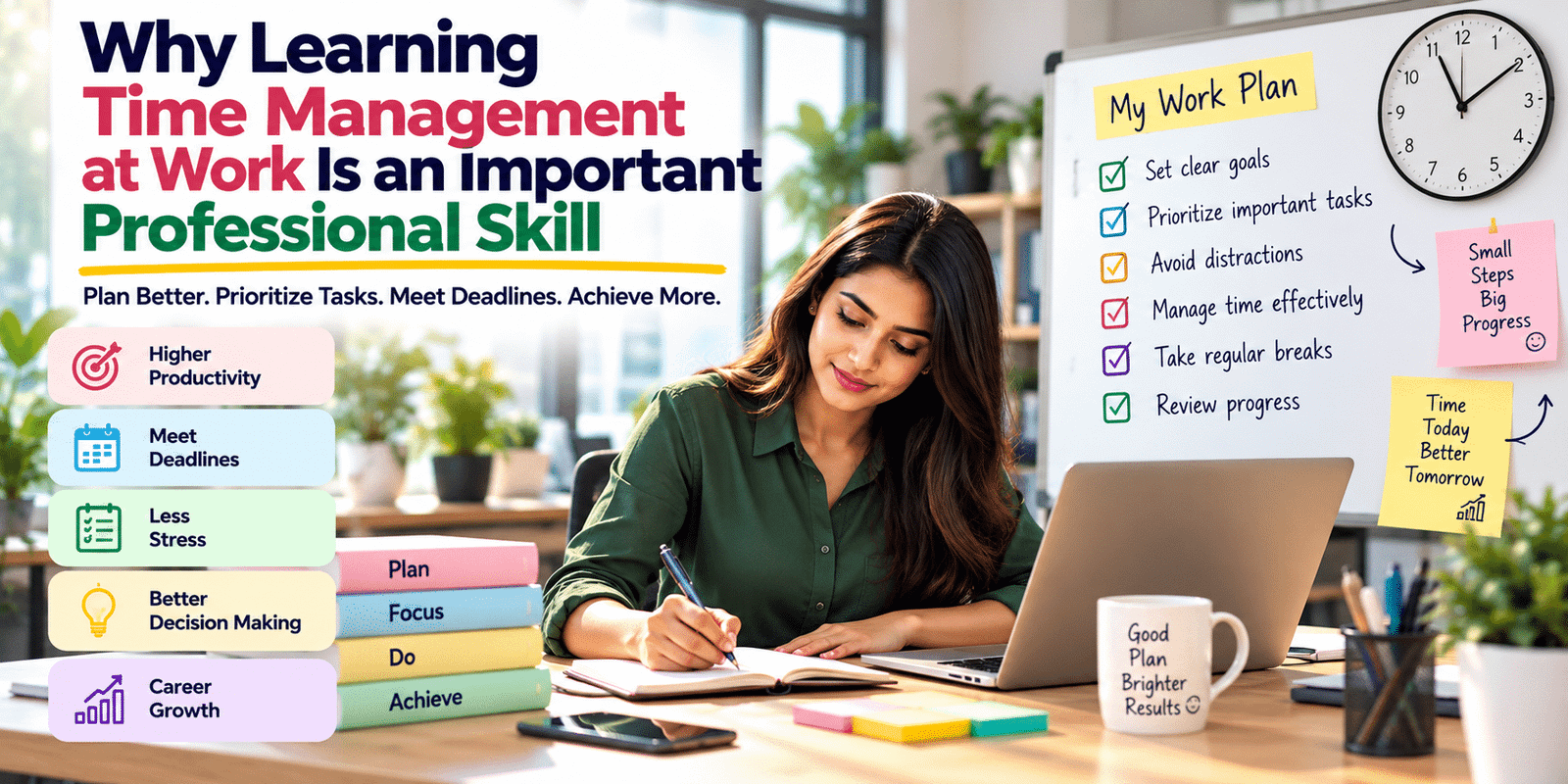
Why Learning to Manage Time Effectively Is an Important Professional Skill
Time management at work is an important professional skill that helps employees prioritize tasks, meet deadlines, and maintain the quality of their work. In a busy workplace, professionals often handle multiple assignments, attend meetings, respond to messages, and collaborate with different teams. Without a clear plan, even simple responsibilities can become difficult to manage.
Managing time effectively does not mean working continuously without breaks. It means understanding which tasks matter most, allocating time realistically, and using available resources wisely. Professionals who develop this skill can work more efficiently, reduce avoidable stress, and become more dependable team members.
For students and freshers, learning time management before entering the workplace can make the transition from academic life to professional responsibilities easier.
1. Why Time Management at Work Matters
Every workplace has deadlines, priorities, and responsibilities. Employees need to decide how to use their time so that important work is completed without unnecessary delays.
Effective time management helps professionals organize their daily activities, identify urgent responsibilities, and avoid spending too much time on low-priority tasks.
For example, an employee may have a client report due by the end of the day, an internal meeting in the afternoon, and several routine messages to answer. Without a plan, the employee might spend the morning responding to messages and leave the report until the last minute.
By identifying the most important task first and allocating time for the remaining activities, the employee can work more confidently and deliver better results.
Time management also improves coordination. When people complete their responsibilities on time, other team members can continue their work without waiting unnecessarily.
2. Why Being Busy Does Not Always Mean Being Productive
Some professionals spend the entire day answering emails, attending meetings, and switching between tasks. Despite being busy, they may struggle to complete the work that matters most.
Busyness describes how occupied a person is. Productivity describes how effectively that person uses time and effort to achieve meaningful results.
For example, checking messages every few minutes may create the feeling of constant activity, but it can interrupt concentration during an important assignment.
Similarly, attending a meeting without a clear purpose may consume time that could have been used to complete a deliverable.
To improve productivity, professionals should regularly ask themselves:
- What important result must I achieve today?
- Which task requires my full attention?
- Which activities can wait?
- Am I making progress or simply staying occupied?
Focusing on outcomes rather than activity helps employees use their time more effectively.
3. Common Time Management Challenges for Professionals
Managing time becomes difficult when several responsibilities compete for attention. Understanding common challenges helps employees identify what needs to change.
Unclear Priorities
When every task appears equally important, employees may struggle to decide where to begin. They might complete easy tasks first while delaying more important responsibilities.
Procrastination
Putting off difficult or unfamiliar work can create unnecessary pressure as deadlines approach. The longer a task is delayed, the less time remains to complete it properly.
Frequent Distractions
Notifications, unnecessary conversations, and constant message checking can interrupt concentration and increase the time needed to finish work.
Unrealistic Planning
Scheduling too many tasks without considering their complexity can make a daily plan impossible to follow.
Too Many Meetings
Meetings without clear objectives or outcomes can reduce the time available for focused work.
Unexpected Requests
Urgent tasks may appear throughout the day and require employees to adjust their plans. Without some flexibility, even a well-organized schedule can become difficult to manage.
Recognizing these challenges helps professionals create a realistic system instead of relying only on motivation.
4. How to Prioritize Tasks Based on Importance and Urgency
Prioritization is one of the most useful parts of time management. It helps employees decide which tasks deserve attention first.
A simple method is to classify work into four groups:
Urgent and important: Complete these tasks first. Examples include a critical deliverable due today or an immediate issue affecting a customer.
Important but not urgent: Schedule time for these tasks. Examples include project planning, learning new skills, and preparing for upcoming deadlines.
Urgent but less important: Determine whether these tasks can be delegated or handled efficiently without disrupting important work.
Neither urgent nor important: Reduce or postpone these activities when they do not contribute meaningfully to your goals.
This method prevents professionals from treating every notification as a priority.
However, priorities can change. If a new request affects a major deadline, confirm which task should take precedence rather than silently delaying existing commitments.
5. How to Manage Multiple Deadlines Without Feeling Overwhelmed
Multiple deadlines can become stressful when employees try to remember everything or begin tasks without understanding the effort required.
Start by listing your assignments, deadlines, and expected outcomes. Estimate how long each task may take, allowing additional time for review, unexpected problems, and collaboration.
Break larger assignments into smaller steps. For example, a report can be divided into research, drafting, review, and final submission.
Completing smaller milestones makes progress easier to track and helps identify delays before the final deadline.
When two important tasks compete for the same time, communicate with the relevant people. Explain the situation and ask for clarification about priorities or timelines.
Avoid promising that every task will be completed immediately if the schedule is unrealistic. Clear communication is better than missing deadlines without warning.
6. Why Freshers Need to Learn Time Management
Freshers may find workplace time management challenging because professional responsibilities differ from academic assignments.
At college, students may have a timetable and a defined submission date. At work, they may need to manage several tasks simultaneously, respond to changing requirements, attend meetings, and coordinate with colleagues.
New employees can develop better habits by maintaining a task list, recording deadlines, asking questions about priorities, and reviewing their progress regularly.
They should also learn how to estimate their capacity. A task that appears simple may require research, testing, feedback, or approval.
For example, if a manager assigns a new task while the fresher is completing an existing assignment, the employee should clarify which task should be completed first.
Learning to manage time helps freshers demonstrate reliability, improve their confidence, and adapt to professional expectations.
7. How Distractions Affect Workplace Productivity
Distractions can make even straightforward tasks take longer than expected. Every interruption may require employees to stop, respond, and then return their attention to the original assignment.
Common workplace distractions include frequent notifications, unnecessary meetings, social media, background conversations, and switching repeatedly between unrelated tasks.
Professionals can reduce these interruptions by turning off nonessential notifications during focused work, checking messages at planned intervals, and keeping their work environment organized.
Where possible, group similar tasks together. For example, responding to routine emails during a planned time block may be more efficient than checking the inbox after every notification.
Some interruptions are unavoidable, particularly in collaborative roles. The goal is not to eliminate all communication but to create enough uninterrupted time for important responsibilities.
8. How to Plan Your Workday Effectively
A practical daily plan should provide direction without becoming so rigid that unexpected work makes it useless.
Start your day by reviewing deadlines and identifying the two or three most important outcomes you need to achieve.
Allocate time for demanding tasks when you are most able to concentrate. Reserve specific periods for meetings, communication, and routine responsibilities.
Include short breaks and leave some flexibility in your schedule. If every minute is assigned, even a small delay can disrupt the entire day.
At the end of the day, review what you completed and identify tasks that need attention tomorrow.
A simple daily planning routine might look like this:
- Review current assignments and deadlines.
- Identify the highest-priority tasks.
- Estimate the time required for each task.
- Schedule focused work periods.
- Leave room for meetings and unexpected requests.
- Review progress and adjust the next day’s plan.
Consistency matters more than creating a perfect schedule. Choose a planning method you can maintain regularly.
9. Common Time Management Mistakes to Avoid
Even professionals who understand time management can develop habits that reduce their effectiveness.
Trying to Do Everything at Once
Multitasking between demanding activities can make it harder to concentrate and increase the risk of mistakes. Focus on one important task at a time when possible.
Underestimating Task Duration
A task may require more time than expected because of research, revisions, approvals, or technical difficulties. Include reasonable time for these activities.
Failing to Set Priorities
Starting whichever task appears first can cause important deadlines to be overlooked. Decide what matters before beginning.
Avoiding Difficult Tasks
Postponing challenging work may feel comfortable temporarily, but it can create greater pressure later. Break difficult tasks into manageable steps and begin with a clear action.
Ignoring Breaks
Working continuously without breaks can make it harder to maintain concentration. Short breaks can help people return to work with better focus.
Refusing to Adjust the Plan
A schedule should guide work, not prevent sensible decisions. When priorities change, review the plan and communicate any effects on deadlines.
Avoiding these mistakes can make daily work more manageable and predictable.
10. How to Handle Unexpected Tasks and Changing Priorities
Unexpected requests are a normal part of professional life. A customer issue, urgent meeting, or new project requirement may require immediate attention.
When an unexpected task arrives, first understand its urgency and impact. Determine whether it truly needs immediate action or can be scheduled for later.
Next, review your existing commitments. If the new task must take priority, identify which responsibility may need to be delayed or reassigned.
For example, you could tell your manager, “I can take this up today. I am currently completing the scheduled report, so could you confirm whether this request should take priority?”
This response helps everyone understand the consequences of changing plans.
Keep your task list updated when priorities change. A plan that reflects current responsibilities is more useful than one that no longer matches the work being done.
11. The Difference Between Working Faster and Working Smarter
Working faster means trying to complete tasks in less time. Working smarter means choosing effective methods, reducing unnecessary effort, and focusing on the results that matter.
Speed can be useful, but rushing through important work may cause errors that require additional time to correct.
Working smarter might involve using a reusable template, automating a repetitive task, clarifying requirements before starting, or asking a colleague for information that prevents unnecessary rework.
For example, spending ten minutes confirming a project’s requirements may prevent hours of work on the wrong solution.
Professionals should look for ways to improve both efficiency and quality. The objective is not simply to finish more tasks, but to complete the right tasks effectively.
12. A Simple Framework for Better Time Management
Use this five-step framework to organize your workday.
Step 1: Identify
List your responsibilities, deadlines, and expected outcomes.
Step 2: Prioritize
Choose tasks based on importance, urgency, dependencies, and business needs.
Step 3: Schedule
Allocate realistic time for focused work, meetings, communication, and breaks.
Step 4: Execute
Work on the selected task, reduce avoidable distractions, and track your progress.
Step 5: Review
Check what you completed, identify delays, and adjust your plan for the next day.
This framework provides a repeatable process for managing work without relying on memory alone.
Over time, reviewing your estimates and actual completion times can also help you plan more realistically.
13. How to Improve Time Management Skills Every Day
Time management improves through regular practice. Small changes to daily habits can make a meaningful difference over time.
Begin by recording how you spend your working hours for a few days. Identify activities that consume more time than expected and determine whether they can be shortened, grouped, or removed.
Set clear goals for each work session. Instead of writing “work on project,” define a specific outcome such as “complete the first draft of the project report.”
Use a calendar or task manager to track deadlines and important meetings. Choose a simple tool that fits your routine rather than maintaining several systems that create extra work.
Practise estimating task duration and compare your estimates with the actual time taken. This helps you recognize which tasks require additional planning.
Finally, review your progress without being unnecessarily critical of yourself. If a plan fails, identify the reason and make a practical adjustment.
Developing these habits can help students and professionals become more organized, reliable, and confident.
Frequently Asked Questions
1. What is time management at work?
Time management at work means organizing tasks, setting priorities, allocating time, and completing responsibilities within realistic deadlines while maintaining work quality.
2. Why is time management important for professionals?
It helps professionals prioritize important tasks, reduce avoidable delays, meet deadlines, manage distractions, and coordinate more effectively with their teams.
3. How can freshers improve time management?
Freshers can maintain task lists, record deadlines, break large assignments into smaller steps, ask managers about priorities, and review their progress each day.
4. What is the biggest time management mistake?
One common mistake is treating every task as equally important. Without prioritization, employees may spend time on less important activities while delaying critical work.
5. How can I manage multiple tasks at work?
List your tasks, assess their urgency and importance, estimate how long they will take, and schedule realistic work periods. Ask for priority clarification when deadlines conflict.
6. Does time management mean working without breaks?
No. Effective time management includes breaks and realistic planning. Rest can help maintain concentration and reduce the fatigue associated with continuous work.
Final Thoughts: Managing Time Means Managing Priorities
Time management at work is not about filling every minute with activity. It is about deciding how to use your time to achieve meaningful results.
Professionals who prioritize tasks, plan realistically, manage distractions, and communicate about competing deadlines can work more effectively without depending on last-minute effort.
For students and freshers, developing these habits early can make professional responsibilities easier to handle. Consistent practice can improve organization, reliability, and confidence.
Start with one simple change today: identify your most important task, allocate time for it, and complete it before allowing less important activities to take over your schedule.
Internal Links
Professional skills for freshers Suggested sentence: “Time management is one of the professional skills that helps freshers adapt to workplace expectations.” URL: https://vyasanexus.com/skills-recruiters-look-for-in-freshers/
Project-based learning Suggested sentence: “Project-based learning helps students practise planning, task completion, and working toward deadlines.” URL: https://vyasanexus.com/blog-what-is-project-based-learning/
Continuous learning and career growth Suggested sentence: “Continuous learning helps professionals improve their work habits and adapt to changing responsibilities.” URL: https://vyasanexus.com/continuous-learning-career-growth/
Outbound Link
World Economic Forum — Future of Jobs Report 2025
URL: https://www.weforum.org/publications/the-future-of-jobs-report-2025/