
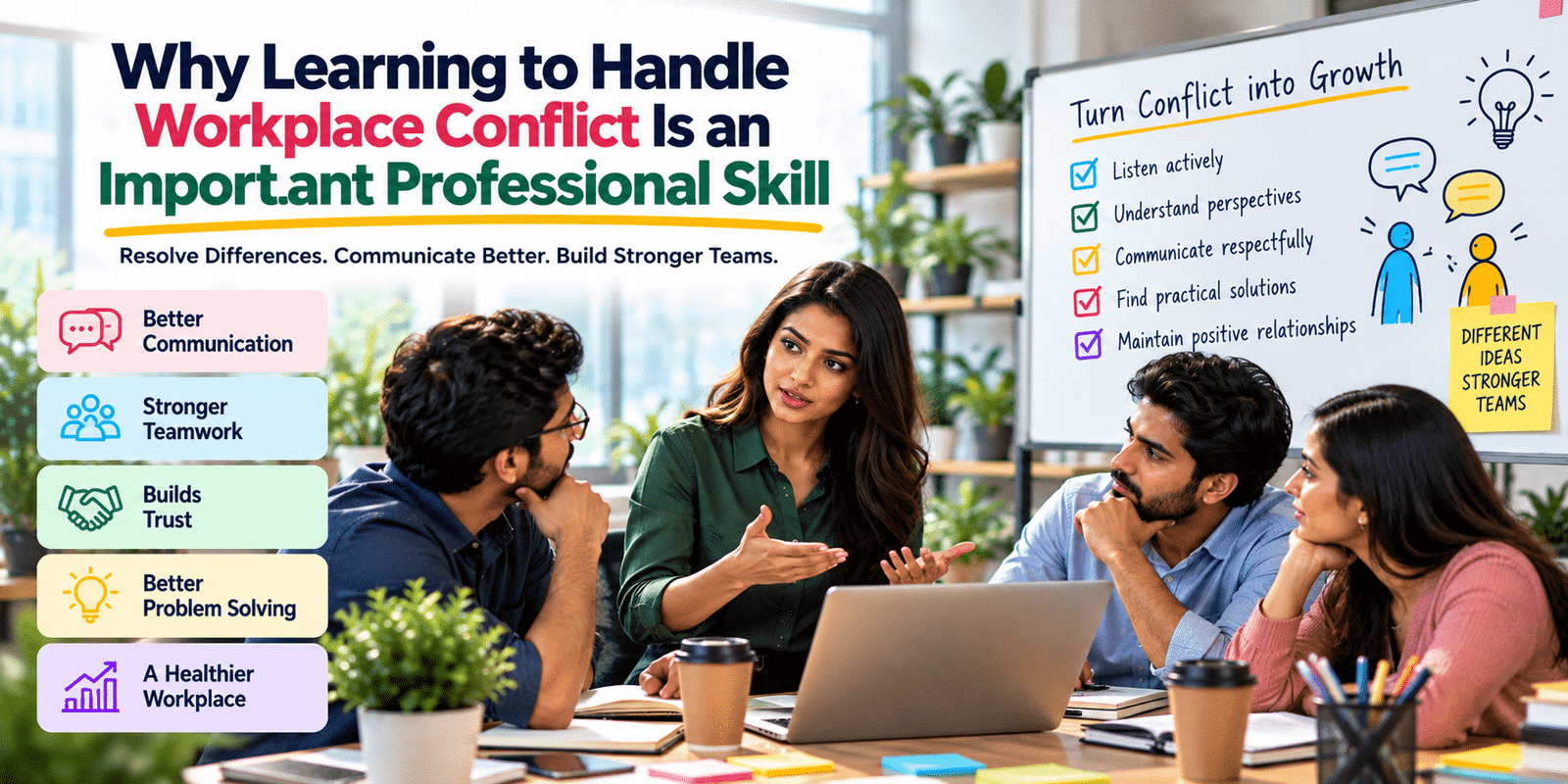
Why Learning to Handle Workplace Conflict Is an Important Professional Skill
Handling workplace conflict is an important professional skill that helps employees resolve disagreements, communicate respectfully, and maintain positive working relationships. In any workplace, people have different opinions, experiences, expectations, and ways of completing tasks. These differences can sometimes lead to misunderstandings or disagreements.
Workplace conflict is not always a sign of a bad team. When handled constructively, disagreements can help people understand different perspectives, identify problems, and make better decisions. The real challenge is learning how to address disagreements without allowing them to damage trust, teamwork, or productivity.
For students and freshers entering professional environments, learning how to manage conflict can build confidence and prepare them to work effectively with different personalities.
1. Why Handling Workplace Conflict Is an Important Professional Skill
Employees rarely work completely independently. They collaborate with managers, colleagues, clients, and other departments to achieve shared goals. Because people approach problems differently, disagreements are a natural part of professional life.
Handling workplace conflict helps employees focus on solutions instead of blaming others. It encourages open communication, reduces unnecessary misunderstandings, and helps teams continue working toward their objectives.
For example, two team members may disagree about how to complete a project. One may prefer to finish quickly, while the other may want additional testing before delivery. Instead of arguing over whose approach is correct, they can discuss the risks, deadlines, and expected results to find a practical solution.
Professionals who manage such situations calmly can contribute to a healthier working environment and stronger teamwork.
2. What Causes Conflict in the Workplace?
Workplace conflict can develop for several reasons. Understanding the cause is the first step toward resolving the problem.
Miscommunication
Incomplete instructions, unclear messages, or assumptions can cause employees to misunderstand each other. A small communication gap may become a larger issue when neither person clarifies the situation.
Different Opinions
Employees may have different ideas about priorities, strategies, or solutions. These differences are normal, but problems arise when people treat disagreement as a personal attack.
Unclear Responsibilities
When employees do not know who is responsible for a task, work may be duplicated or neglected. Team members may then blame one another for delays or mistakes.
Competing Priorities
Two employees may both have urgent responsibilities but different expectations about which task should be completed first. Without clear priorities, frustration can develop.
Different Working Styles
Some employees prefer detailed planning, while others prefer quick action. Some communicate directly, while others take more time to explain their thoughts. These differences can create tension if team members do not understand each other’s approaches.
Identifying the actual cause prevents people from responding only to the visible disagreement while ignoring the underlying issue.
3. Why Avoiding Workplace Conflict Can Make Problems Worse
Some professionals avoid disagreements because they want to maintain peace or fear negative reactions. Although avoiding unnecessary arguments is sensible, ignoring an important problem does not always resolve it.
When employees remain silent about repeated misunderstandings, missed commitments, or unfair task distribution, frustration may gradually increase. Team members may stop sharing information, lose trust, or become less willing to collaborate.
For example, if a colleague repeatedly submits incomplete work that affects your deadline, ignoring the issue may cause the same problem to happen again. A respectful conversation about expectations and responsibilities can help both employees agree on a better process.
Not every disagreement requires a formal discussion. However, problems that repeatedly affect work quality, deadlines, or relationships should be addressed before they become more difficult to manage.
4. The Difference Between Healthy Disagreement and Personal Conflict
Healthy disagreement focuses on ideas, decisions, and possible solutions. Personal conflict focuses on individuals, often involving blame, insults, or assumptions about someone’s intentions.
Consider these two responses during a project discussion.
Healthy disagreement: “I think we should test this feature before release because it may affect existing users.”
Personal conflict: “You never think about the consequences of your decisions.”
The first response explains a concern and gives the team something specific to evaluate. The second makes a personal judgment and may cause the other person to become defensive.
Professionals should learn to question ideas without attacking the people who suggest them. They can explain their reasoning, ask questions, and consider alternative perspectives while remaining respectful.
This approach makes disagreements more productive and helps teams make decisions based on evidence rather than emotions.
5. How to Handle Workplace Conflict Professionally
Handling workplace conflict requires patience, clear communication, and a willingness to understand the problem. The following practices can help.
Stay Calm Before Responding
When a disagreement becomes frustrating, pause before replying. Responding immediately while angry may lead to statements that make the situation worse.
Take a moment to understand what happened and decide what you want to achieve through the conversation.
Focus on the Specific Issue
Discuss the behaviour, decision, or work-related problem rather than making general statements about someone’s character.
Instead of saying, “You are always careless,” explain, “The report was missing two required sections, so we need to review the checklist before submission.”
Specific feedback is easier to understand and act upon.
Listen to the Other Person
Allow the other person to explain their perspective. You may discover that they lacked information, misunderstood an instruction, or were working under different expectations.
Listening does not mean you must agree. It means you are willing to understand the situation before deciding how to respond.
Look for a Practical Solution
Once the problem is clear, discuss what can change. Agree on responsibilities, timelines, communication methods, or the next steps required to prevent the issue from recurring.
The goal is to resolve the problem, not simply prove who was right.
6. How to Respond When a Colleague Disagrees With You
Disagreement can feel uncomfortable, especially when you have invested significant time in an idea or decision. However, a colleague questioning your approach does not automatically mean they are disrespecting you.
Start by understanding their concern. Ask what they think may go wrong or whether they have information you have not considered.
For example, you might say:
“That is a different approach from mine. Could you explain why you think it would work better?”
After hearing their reasoning, explain your own perspective calmly. Compare the options based on requirements, available resources, risks, and expected outcomes.
If their idea is better, be willing to accept it. If you still disagree, suggest testing both approaches or asking the appropriate decision-maker to help evaluate them.
Being open to different opinions shows maturity and a commitment to achieving the best result.
7. How Freshers Can Handle Conflict With Senior Employees
Freshers may hesitate to raise concerns with senior colleagues because they have less experience or worry about creating a negative impression.
Respecting senior employees is important, but it does not mean remaining silent when a work-related issue needs clarification.
If an instruction seems unclear or conflicts with another responsibility, ask polite, specific questions. For example:
“I want to make sure I complete this correctly. My understanding of the requirement is different. Could we review it once?”
If you receive feedback that you disagree with, listen carefully and ask for examples. Explain your perspective using facts rather than reacting defensively.
When the issue involves conflicting instructions from different senior employees, request clarification about which direction should take priority.
Freshers should also understand when a situation needs support from a manager or the appropriate workplace channel. Serious issues involving harassment, discrimination, threats, or repeated inappropriate behaviour should not be treated as ordinary disagreements.
Learning to communicate respectfully while raising genuine concerns helps new employees develop confidence and professional judgment.
8. How to Resolve Misunderstandings Before They Escalate
Many workplace conflicts begin with assumptions rather than intentional wrongdoing. A delayed reply may be interpreted as disrespect, a short message may sound rude, or an incomplete instruction may lead to an incorrect result.
Before assuming someone’s intention, verify the facts.
You can ask questions such as:
- “Could you clarify what you meant by that message?”
- “I may have misunderstood the requirement. Can we confirm it?”
- “Are we following the same deadline for this task?”
- “Can we review who is responsible for each part?”
Written communication is especially important when discussing tasks, deadlines, and decisions. Confirming agreements in a shared document or message can help prevent different interpretations later.
Addressing misunderstandings early saves time and reduces the chance that a small issue will turn into a larger conflict.
9. Why Listening Is Important During Workplace Disagreements
Listening is more than waiting for your turn to speak. It involves paying attention to what the other person says, asking relevant questions, and checking that you have understood their concern correctly.
During a disagreement, people often focus on preparing their response instead of understanding the other person’s explanation. This can cause important details to be missed.
Active listening helps professionals identify the real issue. A colleague who appears resistant to a new process may actually be concerned about the time required to learn it or the risks involved in changing the existing workflow.
You can demonstrate effective listening by summarizing the other person’s concern before responding.
For example:
“So your main concern is that changing the process now could delay the release. Is that correct?”
This simple habit reduces misunderstandings and shows that you take the other person’s perspective seriously.
10. How to Handle Conflict When Working in a Team
Teamwork requires people to share responsibilities, exchange information, and make decisions together. Differences are inevitable, particularly when deadlines are tight or tasks depend on one another.
Teams can reduce conflict by establishing clear expectations from the beginning.
Successful handling workplace conflict situations requires patience, active listening, and clear communication.
Each member should understand their responsibilities, deadlines, dependencies, and the process for raising concerns. Team members should also communicate changes early instead of allowing others to discover problems at the last moment.
When a disagreement occurs, bring the discussion back to the shared objective. Ask what outcome the team needs and which option best supports it.
For example, if two developers disagree about a technical implementation, they can compare maintainability, performance, testing requirements, and project constraints rather than debating personal preferences.
A team does not need everyone to agree on every detail. It needs a fair process for evaluating ideas and reaching decisions.
11. Common Mistakes People Make During Workplace Conflict
Even well-intentioned professionals can make disagreements more difficult by responding in unhelpful ways.
Reacting Emotionally
Raising your voice, sending angry messages, or responding sarcastically can shift attention away from the actual issue.
Making Personal Attacks
Comments about someone’s intelligence, attitude, or personality rarely help solve a work problem. Focus on specific actions and their impact.
Assuming Intentions
Do not immediately conclude that a colleague is trying to create problems. Ask questions and gather relevant information first.
Involving Others Unnecessarily
Discussing a disagreement with unrelated colleagues can spread confusion and damage trust. Start with the people directly involved when it is appropriate and safe to do so.
Trying to Win Every Argument
A professional discussion is not a competition. Sometimes the best outcome is changing your own position after considering new information.
Ignoring Repeated Problems
If the same conflict continues despite reasonable attempts to resolve it, document relevant facts and seek appropriate support.
Recognizing these mistakes helps professionals respond more thoughtfully and maintain constructive working relationships.
12. When Should You Involve a Manager?
Not every disagreement needs a manager. Many routine misunderstandings can be resolved through a direct, respectful conversation.
However, involving a manager or the appropriate workplace representative may be necessary when:
- The disagreement repeatedly affects work or deadlines.
- Responsibilities or priorities remain unclear.
- The people involved cannot reach a practical solution.
- The issue affects several employees or teams.
- There is a serious concern about workplace conduct.
- You experience harassment, discrimination, threats, or retaliation.
When raising a concern, explain what happened, when it occurred, how it affected the work, and what steps you have already taken. Keep the information factual and relevant.
For serious safety or conduct concerns, follow the organization’s formal reporting process rather than trying to resolve everything privately.
Seeking support when necessary is not a failure. It can be the responsible way to protect people, resolve persistent problems, and ensure fair treatment.
13. A Simple Framework for Resolving Workplace Conflict
Use this five-step framework to manage disagreements constructively.
Step 1: Pause
Avoid reacting immediately when emotions are high. Give yourself time to respond calmly.
Step 2: Understand
Gather the facts, listen to the other person’s perspective, and identify the actual cause of the disagreement.
Step 3: Explain
Describe your concern clearly. Focus on the issue, its impact, and the result you need.
Step 4: Collaborate
Discuss possible solutions and consider alternatives. Look for an outcome that supports the work and respects the people involved.
Step 5: Confirm
Agree on the next steps, responsibilities, and deadlines. Follow up when necessary to make sure the problem has been resolved.
This framework encourages professionals to move from emotional reactions toward clear communication and practical action.
14. What Professionals Can Start Doing Today
You do not need to wait for a major disagreement to develop better conflict-management skills. Start practising them in everyday workplace conversations.
Listen carefully when someone has a different opinion. Ask for clarification when instructions are unclear. Give feedback that focuses on specific actions instead of personal judgments.
When you make a mistake, acknowledge it and discuss how to correct it. When someone raises a concern about your work, try to understand the feedback before responding.
Practising handling workplace conflict in everyday conversations can help professionals respond calmly when disagreements arise.
You can also practise phrases such as:
- “Let’s understand the issue before deciding what to do.”
- “I see your point. Can we compare both options?”
- “Could you clarify what you expect from this task?”
- “I disagree with that approach, but I would like to understand your reasoning.”
- “What can we change to prevent this problem next time?”
These phrases help keep discussions focused on solutions.
Over time, consistent practice can improve your ability to communicate under pressure, work with different personalities, and manage professional disagreements.
Frequently Asked Questions
1. What is workplace conflict?
Workplace conflict is a disagreement between employees or teams about ideas, responsibilities, expectations, decisions, or working methods. It can be resolved constructively through communication and problem-solving.
2. Why is handling workplace conflict important?
It helps professionals address misunderstandings, maintain working relationships, improve collaboration, and prevent unresolved issues from affecting work quality or deadlines.
Effective handling workplace conflict strategies help employees address disagreements before they affect teamwork and productivity.
3. How can I handle workplace conflict without arguing?
Stay calm, listen to the other person’s perspective, explain your concern respectfully, and focus on finding a practical solution rather than proving that you are right.
4. How should freshers handle disagreements with senior employees?
Freshers should ask respectful questions, clarify expectations, explain work-related concerns using facts, and seek guidance when instructions conflict. Serious misconduct should be raised through appropriate workplace channels.
5. Should I always resolve workplace conflict directly?
No. Routine disagreements can often be discussed directly, but serious concerns involving harassment, discrimination, threats, or retaliation may require formal reporting or support from the appropriate workplace representative.
6. Can workplace conflict have positive outcomes?
Yes. When handled respectfully, disagreement can reveal overlooked risks, introduce new ideas, clarify responsibilities, and help teams make better decisions.
Final Thoughts: Disagreements Can Become Opportunities to Learn
Handling workplace conflict is an important professional skill because working with others requires more than technical knowledge. It also requires patience, listening, clear communication, and the ability to solve problems respectfully.
Disagreements are a normal part of professional life. What matters is how people respond to them. Blaming others or avoiding every difficult conversation can allow problems to continue, while thoughtful discussion can create opportunities for improvement.
For students and freshers, learning to manage conflict early can make the transition into professional life easier. By understanding different perspectives, communicating concerns clearly, and focusing on shared goals, professionals can build stronger relationships and contribute more effectively to their teams.
Internal Links
Professional skills for freshers Suggested sentence: “Clear communication and other professional skills help employees work effectively with different personalities.” URL: https://vyasanexus.com/skills-recruiters-look-for-in-freshers/
Project-based learning Suggested sentence: “Practical projects give students opportunities to collaborate, discuss different approaches, and solve problems together.” URL: https://vyasanexus.com/blog-what-is-project-based-learning/
Continuous learning and career growth Suggested sentence: “Consistent practice and continuous learning can help professionals improve their communication and problem-solving abilities.” URL: https://vyasanexus.com/continuous-learning-career-growth/
Outbound Link
World Economic Forum — Future of Jobs Report 2025
URL: https://www.weforum.org/publications/the-future-of-jobs-report-2025/