
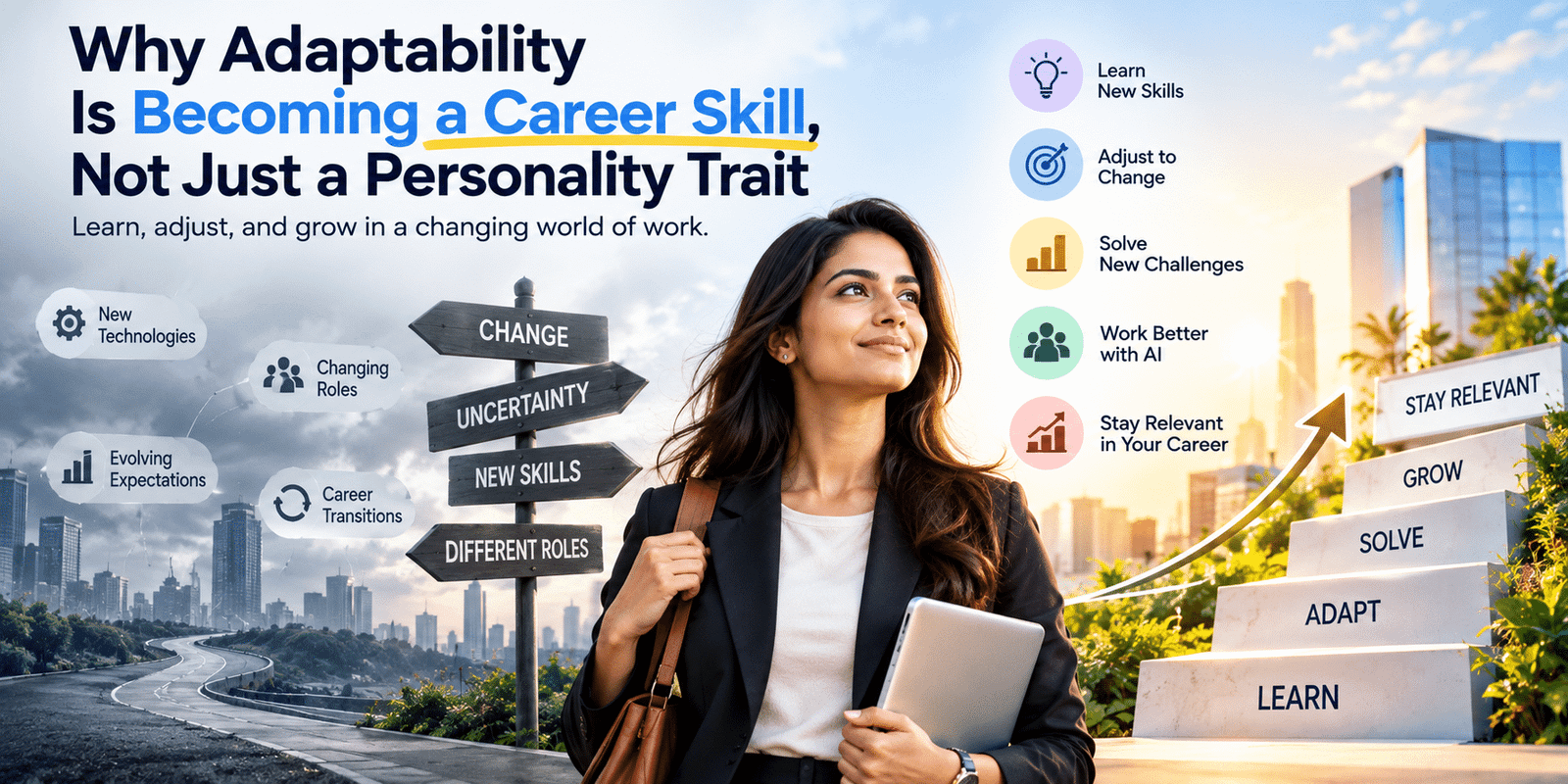
Adaptability as a career skill is becoming increasingly important as technology, job responsibilities, and workplace expectations continue to change. Professionals need to learn new skills, adjust their approach, solve unfamiliar problems, and continue developing throughout their careers.
Why Adaptability as a Career Skill Matters
Adaptability as a career skill can help professionals respond effectively when their responsibilities, tools, teams, or working environments change.
For example, a software developer may need to work with a new technology. A marketing professional may need to respond to changing customer behaviour. A manager may need to lead a team through a new business process.
In each situation, the ability to learn and adjust can be valuable.
What Does Adaptability Really Mean at Work?
Adaptability does not mean agreeing with every change or changing direction without thinking.
It means understanding what has changed, identifying what needs to be different, learning what is required, and adjusting your approach accordingly.
An adaptable professional can ask:
- What has changed?
- Why does it matter?
- What do I need to learn?
- What should I do differently?
- What can I learn from the experience?
This makes adaptability a practical professional capability rather than simply a personality characteristic.
Why Professional Roles Are Changing Faster
Technology is one of the major forces changing work. The World Economic Forum expects AI and big data, networks and cybersecurity, and technological literacy to be among the fastest-growing skill areas through 2030. At the same time, resilience, flexibility, agility, and creative thinking are also expected to increase in importance.In an AI-driven workplace, adaptability as a career skill can help professionals learn new tools and adjust their working methods.
This means professionals may need to update both their technical capabilities and their approach to work.
Adaptability vs Simply Accepting Change
As workplaces continue to evolve, adaptability as a career skill can help professionals respond to changing responsibilities and expectations.
Someone may accept that a new software system is being introduced but continue using the old process whenever possible.
An adaptable professional is more likely to understand the new system, practise using it, identify difficulties, ask questions, and gradually change their workflow.
Adaptability involves action.
How Technology Is Increasing the Need for Adaptability
Technology can change the way tasks are performed without completely changing the purpose of the job.
For example, AI may automate part of a research process while creating a greater need for professionals to review information, interpret results, and make decisions.
Deloitte’s 2026 research describes adaptability as an organisational capability that helps workers continuously learn, experiment, and evolve as work changes.
Why Learning New Skills Is Part of Adaptability
Learning is one of the foundations of adaptability.
When a role changes, professionals may need to learn a new tool, process, technology, or method. The ability to learn independently can make these transitions easier.
The World Economic Forum also identifies curiosity and lifelong learning among the skills expected to rise in importance through 2030.
How Adaptability Helps During Career Transitions
Career transitions can happen for many reasons. Someone may move into management, switch industries, take on a different role, or return to work after a career break.
These situations often involve unfamiliar responsibilities.
Adaptability can help professionals focus less on what they already know and more on what they need to learn next.
The Connection Between Adaptability and Problem-Solving
Change often creates unfamiliar problems.
A process that worked previously may no longer work after a new system or business requirement is introduced. Professionals then need to understand the new situation and find an appropriate response.
Adaptability and problem-solving therefore work closely together. One helps a person adjust to a new situation, while the other helps them determine what to do about it.
Why Adaptable Professionals Ask Better Questions
When something changes, asking questions can be more productive than making assumptions.
For example:
“What is the objective of this new process?”
“What problem is this change solving?”
“What skills do I need to develop?”
“How will my responsibilities change?”
Good questions help professionals understand change before reacting to it.
How Adaptability Works With AI
AI is creating new ways of working and changing how some tasks are performed.
Professionals do not necessarily need to become AI specialists. However, they may need to understand how AI affects their particular role and learn how to use relevant tools effectively.
Deloitte’s 2026 research describes AI as a factor that can help organisations embed learning and adaptation directly into everyday work.
Why Adaptability Matters When Expectations Change
A professional’s responsibilities can change even when their job title stays the same.
A manager may become responsible for a larger team. A developer may take ownership of architecture decisions. A marketing professional may become responsible for data-driven campaigns.
Adaptability helps people respond to these changes instead of relying only on the responsibilities they had when they started.
How Leaders Can Build More Adaptable Teams
Adaptability is not only an individual responsibility.
Leaders can support it by creating opportunities for employees to experiment, learn from mistakes, receive feedback, and work on unfamiliar challenges.
Deloitte’s 2026 research highlights approaches such as peer coaching, hands-on practice, experimentation, and learning embedded directly into work.
Common Habits That Make Adaptation Difficult
Several habits can make professional adaptation harder:
- Refusing to learn unfamiliar tools
- Depending entirely on old processes
- Avoiding feedback
- Treating mistakes as failures rather than learning opportunities
- Assuming previous experience is always sufficient
- Waiting for someone else to provide every solution
- Trying to avoid every unfamiliar situation
These habits can limit professional growth when the working environment changes.
How to Develop Adaptability Through Everyday Work
Adaptability can be developed through regular professional experiences.
Start by taking on tasks that are slightly outside your usual responsibilities. Learn a new tool. Ask for feedback. Volunteer for a project that requires a different approach.
After completing the task, consider what worked, what did not, and what you would do differently next time.
Small experiences can gradually build confidence with change.
How to Show Adaptability During Interviews
Candidates can demonstrate adaptability through specific examples rather than simply saying:
“I am adaptable.”
For example, a candidate could explain how they learned an unfamiliar technology for a project, adjusted to a new team structure, solved an unexpected problem, or changed their approach after receiving feedback.
Specific examples provide evidence of how someone responds to change.
A Practical Framework for Building Career Adaptability
A simple framework is:
Recognise → Learn → Experiment → Adjust → Reflect
Recognise: Understand what has changed.
Learn: Identify the knowledge or skill you need.
Experiment: Try a new approach in a practical situation.
Adjust: Improve your approach based on the results.
Reflect: Consider what you learned and how you can apply it again.
This turns adaptability into an ongoing professional practice.
What Professionals Can Start Doing Today
Choose one area of your work that is changing.
It could be a new software tool, a new process, a different responsibility, or an emerging technology.
Instead of waiting until the change becomes unavoidable, start learning about it now. Experiment with it, ask questions, and understand how it could affect your role.
Being prepared before change arrives can make adaptation easier.
Final Thoughts: Stay Ready to Learn, Change and Grow
Adaptability is becoming an important part of career development because professional environments do not remain static. Technologies change, responsibilities evolve, and organisations continuously adjust to new expectations.
The World Economic Forum identifies resilience, flexibility, and agility among the core skills employers consider important, while also highlighting the growing importance of technological and lifelong-learning capabilities.
The goal is not to predict every change that will happen in your career. Instead, it is to develop the ability to learn, respond, experiment, and keep growing when change arrives.
Your career may change many times. Your ability to adapt can help you keep moving forward.
Outbound Links
The World Economic Forum’s Future of Jobs Report provides further insight into the skills expected to become increasingly important as the world of work changes.
Internal Links
Strong problem-solving abilities can help professionals respond more effectively to unfamiliar situations and changing workplace demands.