
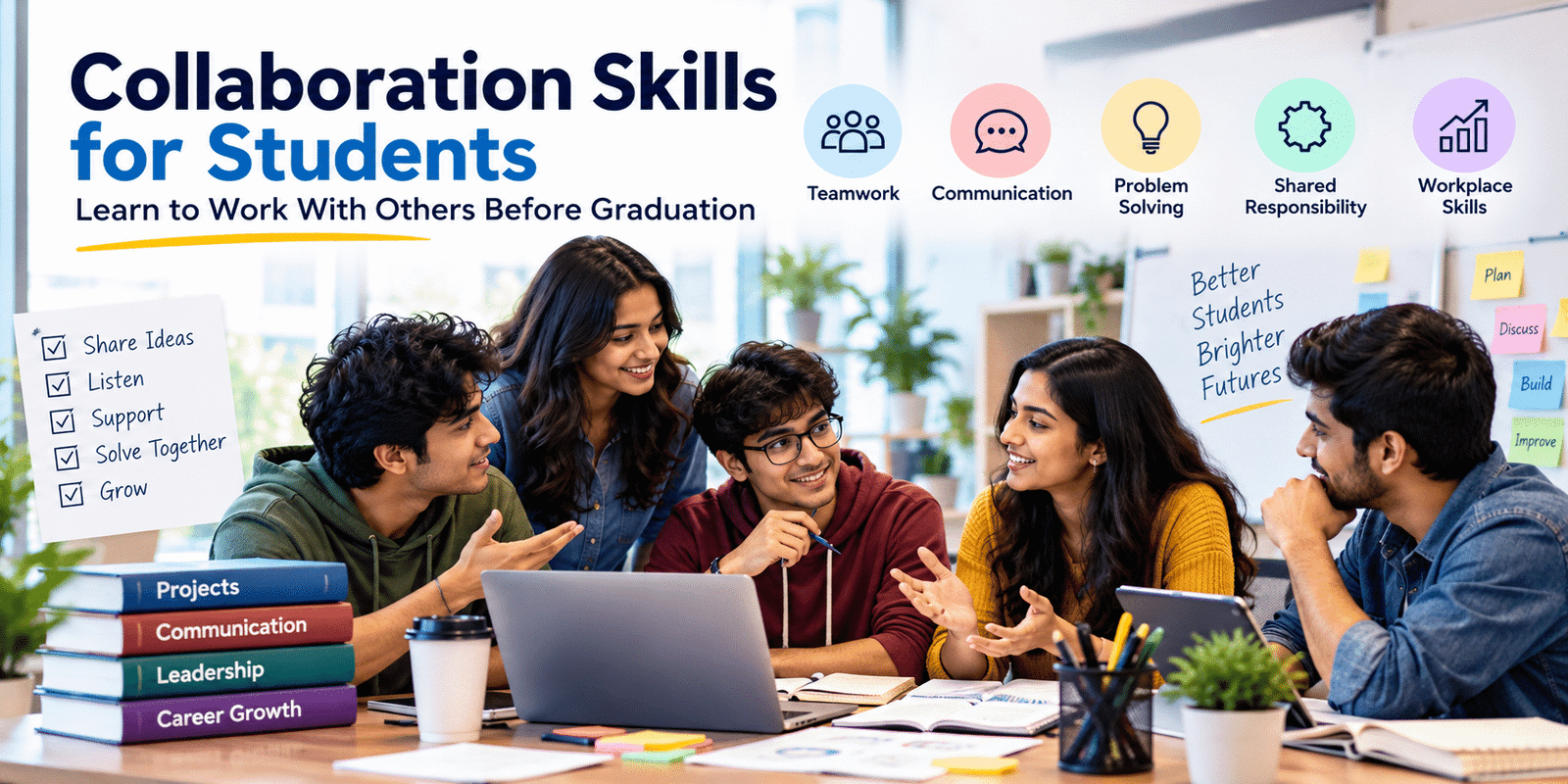
Why Students Need to Learn How to Work With Others Before Graduation
Working with other people is an important part of college, internships, and professional life. Students may have strong academic knowledge and technical skills, but real workplaces also require them to communicate, share responsibilities, handle different opinions, and contribute to a team.
Why Collaboration Skills for Students Matter
Collaboration skills for students help them work effectively with classmates, project teams, mentors, and future colleagues. These skills are useful not only for group projects but also for internships, interviews, workplace assignments, and professional growth.
Employers are increasingly considering collaboration alongside technical expertise and other workplace capabilities when evaluating early-career talent. Deloitte India’s 2026 campus workforce study identifies collaboration, adaptability, learning agility, and role-specific skills among the capabilities gaining importance in campus hiring.
What Does Good Collaboration Actually Mean?
Collaboration is more than simply working in a group. It means understanding your responsibility, communicating clearly, listening to others, sharing ideas, and helping the team move toward a common goal.
For example, imagine four engineering students building a college project. One student handles the frontend, another works on the backend, another manages the database, and the fourth prepares testing and documentation. The project can succeed only when they communicate regularly and understand how their individual work connects with the rest of the team.
Why Working in a Team Is Different From Working Alone
When students work alone, they control most of the decisions. Teamwork is different because people may have different ideas, working styles, priorities, and approaches to solving a problem.
Students therefore need to learn how to discuss differences professionally instead of treating every disagreement as a conflict.
How Group Projects Build Collaboration Skills
College projects can provide an early opportunity to practise teamwork. Students can learn how to divide responsibilities, set deadlines, review each other’s work, and solve problems together.
However, simply being part of a group does not automatically develop collaboration. Students need to actively participate, communicate, take responsibility, and contribute meaningful work.
Learning to Communicate With Different People
Students will eventually work with people who have different backgrounds, experiences, communication styles, and levels of expertise.
Good collaboration requires students to explain their ideas clearly while also listening carefully to other perspectives. This becomes especially important during internships and their first professional roles.
How Students Can Handle Different Opinions
Disagreement is a normal part of teamwork. Two students may have different approaches to a project, for example.
Instead of immediately rejecting another person’s idea, students can ask questions, understand the reasoning, compare the available options, and then decide what works best for the project.
Why Responsibility Matters in Teamwork
A team depends on each member completing their responsibilities. Missing deadlines or ignoring assigned work can affect everyone else.
Students can therefore build collaboration skills by completing their tasks on time, communicating when they face difficulties, and helping teammates when appropriate.
Learning to Give and Receive Feedback
Good teams need honest and respectful feedback. Students should learn how to explain what could be improved without unnecessarily criticising another person.
At the same time, receiving feedback without becoming defensive can help students improve both their work and their professional behaviour.
How Collaboration Helps Students Solve Problems
Some problems are easier to solve when different people bring different perspectives. One student may identify the technical issue, another may notice a user-experience problem, while someone else may suggest a simpler solution.
As a result, collaboration can help students look at problems from multiple angles.
Collaboration Skills for Students in Internships
Internships provide students with opportunities to experience professional teamwork. They may work with developers, designers, managers, analysts, customers, or other interns.
Deloitte’s 2026 campus research also reports that internships are increasingly being used as pathways to full-time employment, with behavioural competencies and learning agility identified as important predictors of pre-placement offer conversion.
Why Employers Value Teamwork and Collaboration
Most professional roles involve working with other people in some form. A software developer may work with product managers and designers. A business analyst may work with clients and technical teams. A researcher may work with other researchers and organisations.
Therefore, being able to contribute effectively to a team can complement a student’s technical or academic knowledge.
How Students Can Improve Their Collaboration Skills
Students can start with simple habits:
- Participate actively in group projects.
- Listen before responding.
- Share ideas instead of waiting for others.
- Complete assigned tasks on time.
- Ask for clarification when requirements are unclear.
- Respect different opinions.
- Give constructive feedback.
- Accept useful feedback from others.
- Help teammates when appropriate.
- Reflect on what worked and what did not after completing a project.
Common Collaboration Mistakes Students Should Avoid
Some common mistakes include taking over the entire project, depending completely on teammates, ignoring different opinions, missing deadlines, avoiding communication, and blaming others when something goes wrong.
Recognising these behaviours early can help students become more dependable team members.
A Simple Teamwork Practice Plan for Students
Students do not need to wait until they get their first job to develop collaboration skills.
Week 1: Participate actively in a group discussion or project.
Week 2: Practise explaining your ideas clearly and listening to other viewpoints.
Week 3: Take responsibility for one important part of a team project.
Week 4: Ask your teammates what you did well and what you could improve.
Over time, these small experiences can make teamwork more natural.
How Students Can Show Collaboration Skills on Their Resume
Instead of simply writing “Good team player”, students can describe what they actually did.
For example:
“Worked with a four-member team to develop a college web application, contributing to the backend API and coordinating testing with frontend team members.”
This gives recruiters more useful information because it connects the skill with actual work.
What Students Can Start Doing Today
Students can begin with their next group assignment, project, hackathon, internship, or college activity. Take responsibility for a meaningful task, communicate regularly, and learn how to work with people who may approach problems differently.
Collaboration is not something students learn from a textbook alone. It develops through repeated experience.
Final Thoughts: Learn to Work With People, Not Just With Technology
Technical knowledge can help students enter a career, but professional growth also depends on how they work with other people. Students who learn to communicate, contribute, listen, handle disagreements, and take responsibility can be better prepared for real workplace environments.
The goal is not to become perfect at teamwork before graduation. Instead, students should use college projects, internships, and practical experiences to gradually become more effective and dependable team members.
Outbound Links
Employers increasingly look at collaboration alongside other workplace capabilities when evaluating early-career talent. Deloitte’s 2026 campus workforce research provides recent insights into the skills employers are considering in campus hiring.
Internal Links
Under “How Group Projects Build Collaboration Skills”, add:
Students can also learn how practical projects support learning and skill development through project-based learning.
Under “Collaboration Skills for Students in Internships”, add:
Students can also explore how internships can provide practical workplace experience through internships for college students.