
Every student knows the feeling. The clock says two hours have passed, but the page in front of you looks exactly the same as when you started. Your mind wanders — to lunch, to a message you haven’t answered, to anything except the chapter you’re meant to be reading.
Staying motivated during long study sessions is one of the hardest parts of academic life, and it has very little to do with intelligence or willpower alone. It has more to do with how you set up your study environment, your habits, and your expectations of yourself.
This guide walks through methods that have stood the test of time, long before productivity apps and study influencers came along. Students used these techniques decades ago, and they still hold up today because they’re built on how the human mind actually works, not on trends.
Why Motivation Fades During Long Study Sessions
Before fixing the problem, it helps to understand it.
The brain isn’t built for hours of unbroken focus. Attention naturally rises and falls in waves, and after roughly 45 to 60 minutes, concentration begins to dip whether you like it or not. Add hunger, poor sleep, a cluttered desk, or an unclear goal for the session, and motivation drops even faster.
Most students blame themselves for “lacking discipline” when the real issue is a poorly designed study session.
Once you treat motivation as something you can build with structure, rather than something you either have or don’t, everything becomes easier to manage.
12 Techniques to Stay Motivated
1. Set a Clear Goal Before You Begin
Sitting down to “study biology” is vague and unmotivating. Sitting down to “finish the diagram labelling and answer the five practice questions on cell division” is specific — and specific goals are far easier to start and finish.
Try this: Write the goal on a sticky note or at the top of your notebook page before you open a single book.
2. Break the Session Into Smaller Blocks
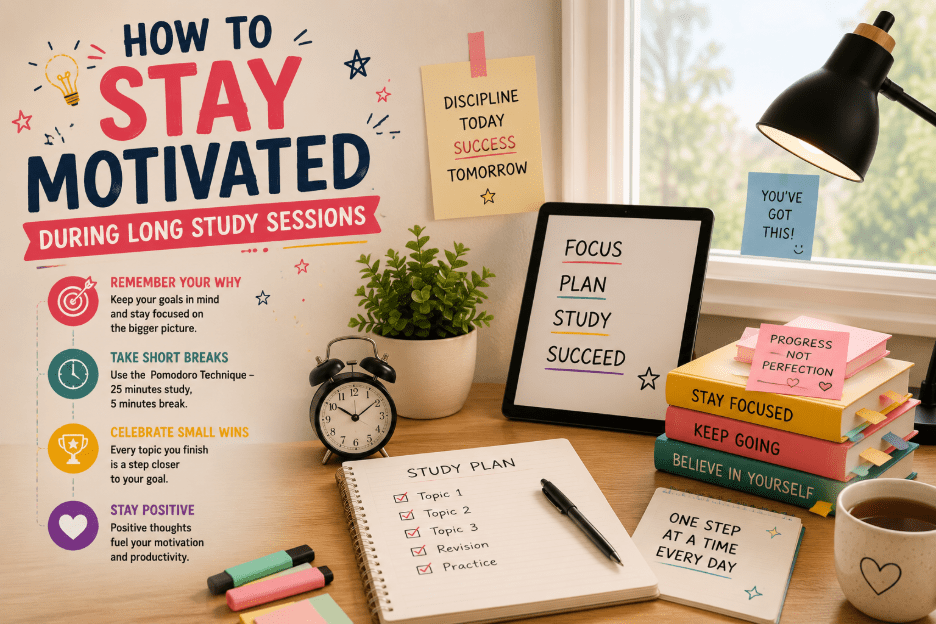
Long study sessions feel unbearable when viewed as one giant, shapeless task. Break the time into blocks of 25 to 50 minutes, each with its own small target — an approach sometimes called the Pomodoro technique.
This works because the brain finds short deadlines far easier to commit to than open-ended ones. A five-minute break between blocks lets your mind reset before fatigue sets in.
3. Study in the Same Place Every Day
Old-fashioned advice, but it holds up: a fixed study spot trains your brain to associate that chair, that desk, and that lighting with focused work. Over time, simply sitting down in that spot signals to your mind that it’s time to concentrate — cutting down the mental warm-up period.
4. Remove Every Small Distraction Before You Start
Phones, notifications, and half-finished browser tabs are the biggest silent killers of motivation.
Try this: Keep your phone in another room, or at the very least, out of arm’s reach and on silent. Every time attention breaks to check a message, it can take several minutes to return to the same depth of focus.
5. Use the Two-Minute Rule to Beat Procrastination
If starting feels impossible, tell yourself you’ll study for just two minutes. Almost always, once you begin, the resistance fades and you keep going far past the two-minute mark.
The hardest part of any long study session is never the middle — it’s the very first minute.
6. Reward Yourself After Each Milestone
Small rewards work as well now as they ever did. Finish a chapter, and allow yourself a short walk, a snack, or five minutes of music. This turns a long slog into a series of small wins rather than one overwhelming climb.
7. Study With a Purpose, Not Just a Deadline
Cramming for a test the night before rarely brings real motivation — only stress. Students who connect their study material to a longer goal (a career, a scholarship, a skill they want to master) tend to stay motivated far longer than those studying purely to avoid failing.
8. Keep Your Body in the Equation
A tired, hungry, or dehydrated body can’t support a focused mind, no matter how strong the intention.
Try this: Drink water through the session, eat something light beforehand, and sit with good posture. Fatigue is often mistaken for laziness when it’s really just the body asking for basic care.
9. Alternate Between Subjects
Studying the same subject for four hours straight leads to diminishing returns. Switching between two or three subjects during a long session keeps the mind engaged, since each subject uses slightly different mental muscles — and it prevents the dull, flat feeling that comes from staring at the same material for too long.
10. Track Your Progress Visually
Crossing off completed topics on a checklist, or watching a chart fill in as chapters get finished, gives a visible sense of achievement. Progress you can see is far more motivating than progress you can only feel, because the eye believes what the mind sometimes doubts.
11. Study With Others When It Helps
Group study sessions, when kept disciplined, can push motivation upward through simple accountability. Explaining a concept to a classmate is also one of the fastest ways to discover what you don’t yet understand — and this alone can renew interest in a subject that felt stale minutes earlier.
12. Accept That Motivation Comes and Goes
The biggest myth about long study sessions is that motivated students feel like studying the whole time. They don’t. What separates them is a routine that carries them through the low points, rather than waiting for inspiration to strike again.
Build the habit, and motivation will often follow the action rather than come before it.
Quick Reference
| # | Technique | Core Idea |
|---|---|---|
| 1 | Set a clear goal | Specific beats vague |
| 2 | Break into blocks | 25–50 min sprints |
| 3 | Fixed study spot | Trains focus by association |
| 4 | Remove distractions | Phone out of reach |
| 5 | Two-minute rule | Starting beats resistance |
| 6 | Reward milestones | Small wins add up |
| 7 | Study with purpose | Connect to a bigger goal |
| 8 | Care for your body | Water, food, posture |
| 9 | Alternate subjects | Avoids diminishing returns |
| 10 | Track progress visually | Seeing beats feeling |
| 11 | Study with others | Accountability + teaching |
| 12 | Accept the ebb and flow | Routine over inspiration |
Final Thoughts
Staying motivated during long study sessions is less about finding some rare burst of willpower and more about building a routine that makes willpower unnecessary. Clear goals, short blocks, a distraction-free space, and basic care for your body and mind will carry you through hours of study far better than any last-minute pep talk.
Start small, stay consistent, and the long sessions will begin to feel far shorter than they once did.