
Artificial Intelligence (AI) is no longer a futuristic concept—it’s already transforming industries, redefining work, and creating entirely new career paths. As automation handles repetitive tasks, humans are shifting toward roles that require creativity, strategy, and emotional intelligence.
So, what does the future of jobs with AI really look like? Let’s explore.
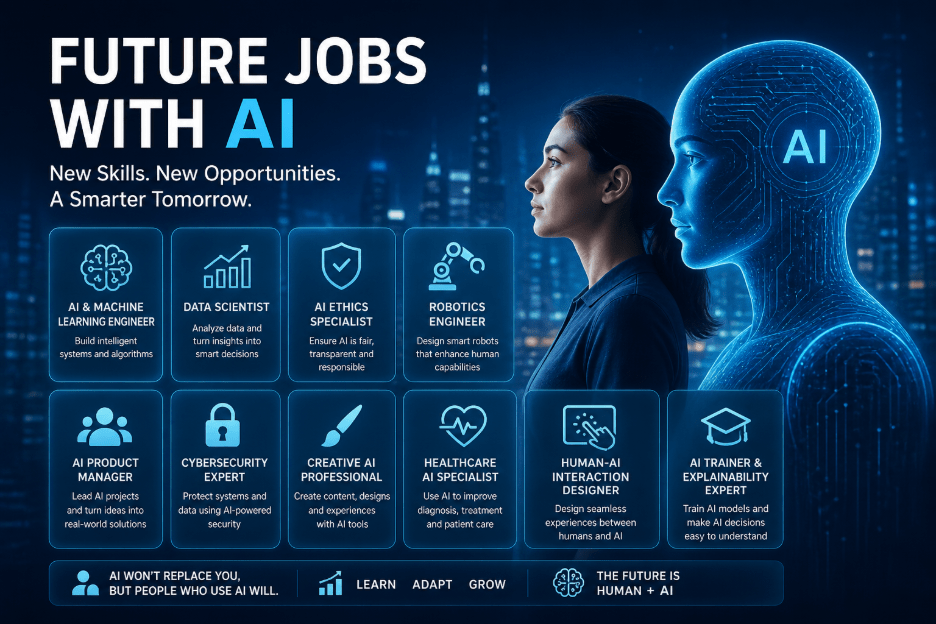
1. AI & Machine Learning Specialists
AI engineers and machine learning experts are among the most in-demand professionals today—and this demand will only grow.
What they do:
- Build AI models and algorithms
- Train systems to learn from data
- Improve automation processes
Skills needed:
- Python, R, TensorFlow
- Data science and statistics
- Problem-solving mindset
2. Data Analysts & Data Scientists
Data is the fuel behind AI. Without data, AI cannot function.
What they do:
- Analyze large datasets
- Extract insights for business decisions
- Build predictive models
Why it matters:
Companies rely on data-driven decisions, making this role critical across industries like healthcare, finance, and e-commerce.
3. AI Ethics Specialists
As AI becomes more powerful, ethical concerns are rising.
What they do:
- Ensure AI systems are fair and unbiased
- Develop ethical AI policies
- Monitor privacy and security issues
Future importance:
This role will be essential to maintain trust in AI systems.
4. Robotics Engineers
Robots powered by AI are transforming manufacturing, healthcare, and even agriculture.
What they do:
- Design intelligent robots
- Integrate AI into physical machines
- Automate complex tasks
5. AI Product Managers
Not all AI jobs are technical. AI product managers bridge the gap between business and technology.
What they do:
- Define AI product strategies
- Coordinate teams of engineers and designers
- Ensure products meet user needs
6. Cybersecurity Experts (AI-driven)
AI is both a tool and a target in cybersecurity.
What they do:
- Use AI to detect threats
- Prevent cyberattacks
- Secure sensitive data
7. Creative AI Professionals
AI is entering creative fields like content writing, design, and music.
Examples:
- AI content creators
- Prompt engineers
- AI-assisted designers
Key insight:
AI won’t replace creativity—it will enhance it.
8. Healthcare AI Specialists
AI is revolutionizing healthcare through faster diagnosis and personalized treatments.
Roles include:
- AI-assisted doctors
- Medical data analysts
- Health tech developers
9. Human-AI Interaction Designers
As humans work more closely with AI, user experience becomes crucial.
What they do:
- Design intuitive AI interfaces
- Improve human-AI collaboration
- Enhance usability and trust
10. AI Trainers & Explainability Experts
AI systems need training and interpretation.
What they do:
- Teach AI systems using labeled data
- Explain AI decisions in simple terms
- Improve transparency
Will AI Replace Jobs?
AI will replace some repetitive jobs, but it will also create new opportunities. The key is adaptation.
Jobs most at risk:
- Data entry
- Routine customer support
- Manual repetitive tasks
Jobs that will grow:
- Tech-driven roles
- Creative and strategic jobs
- Human-centric professions
How to Prepare for AI Careers
To stay relevant in the AI-driven future:
- Learn digital and AI-related skills
- Focus on problem-solving and creativity
- Stay updated with technology trends
- Build adaptability and continuous learning habits
Conclusion
The future of jobs with AI is not about humans vs machines—it’s about collaboration. Those who learn how to work alongside AI will have a significant advantage in the job market.
AI is not taking away the future—it’s creating a new one.