
Artificial Intelligence (AI) is transforming the way we live and work. From virtual assistants to self-driving cars, AI is everywhere. But along with its rapid growth comes a wave of misconceptions.
Let’s break down some of the most common AI myths vs facts so you can better understand what AI really is—and what it isn’t.
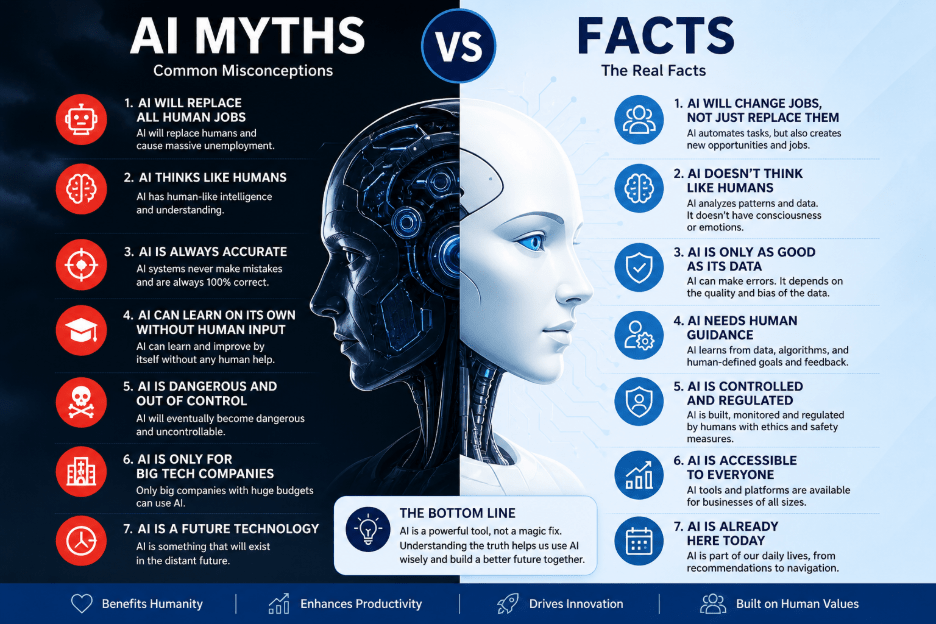
🔍 Myth 1: AI Will Replace All Human Jobs
Fact:
AI will change jobs more than it replaces them.
While automation can handle repetitive tasks, AI also creates new opportunities in areas like data science, AI ethics, machine learning engineering, and more. Human skills such as creativity, emotional intelligence, and decision-making are still irreplaceable.
Reality: AI is a tool that enhances human productivity—not a total replacement.
Myth 2: AI Thinks Like Humans
Fact:
AI doesn’t “think” or “understand” like humans.
AI systems analyze patterns and make predictions based on data. They don’t have consciousness, emotions, or real understanding. Even advanced models are simply executing complex mathematical operations.
Reality: AI simulates intelligence—it doesn’t possess it.
Myth 3: AI Is Always Accurate
Fact:
AI is only as good as the data it’s trained on.
Biases in data can lead to biased outcomes. Errors can occur if the system encounters unfamiliar situations or poor-quality inputs.
Reality: AI requires continuous monitoring, training, and validation.
Myth 4: AI Can Learn on Its Own Without Human Input
Fact:
AI needs human guidance to learn effectively.
Machine learning models rely on training data, algorithms, and human-defined objectives. Even in advanced systems, humans play a key role in development, supervision, and improvement.
Reality: AI is a human-assisted technology.
Myth 5: AI Is Dangerous and Out of Control
Fact:
AI is controlled and regulated by humans.
While there are valid concerns about misuse, AI itself doesn’t have intentions. Governments, organizations, and researchers are actively working on ethical AI frameworks and safety measures.
Reality: The risk lies in how AI is used—not the technology itself.
Myth 6: AI Is Only for Big Tech Companies
Fact:
AI is accessible to businesses of all sizes.
Today, AI tools and platforms are available for startups, small businesses, and even individuals. From chatbots to analytics tools, AI is becoming more democratized.
Reality: AI is for everyone, not just tech giants.
Myth 7: AI Is a Future Technology
Fact:
AI is already part of our daily lives.
You use AI when:
- You get recommendations on streaming platforms
- You use voice assistants
- You receive spam-filtered emails
- You navigate using maps
Reality: AI is not the future—it’s the present.
Conclusion
AI is powerful, but it’s often misunderstood. By separating myths from facts, we can better appreciate its potential and use it responsibly.
Instead of fearing AI, the smarter approach is to learn, adapt, and leverage it to improve our lives and careers.