
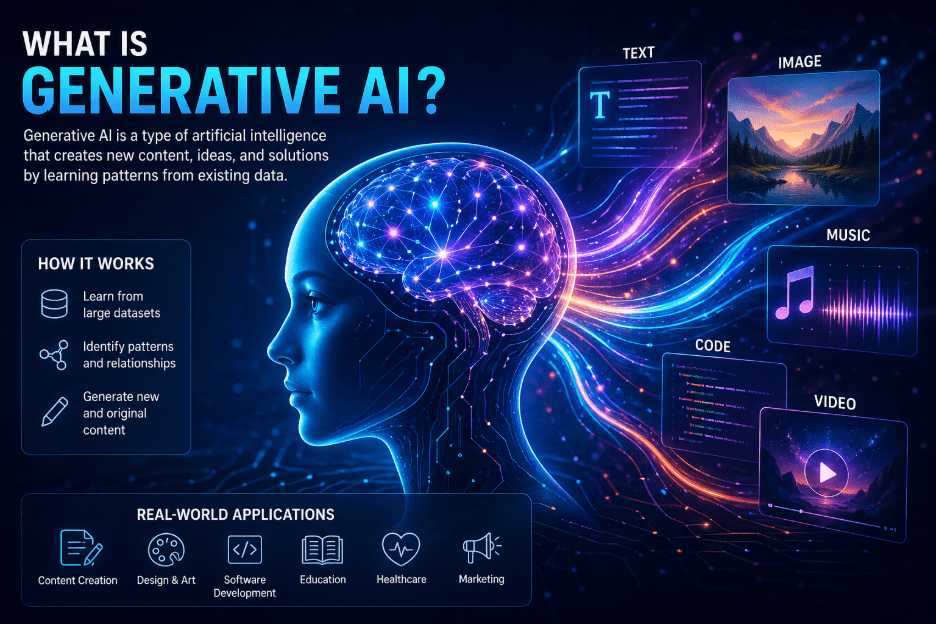
Generative AI is a branch of artificial intelligence focused on creating new content rather than simply analyzing or classifying existing data. Unlike traditional AI systems that follow predefined rules or patterns, generative AI learns from vast datasets and uses that knowledge to produce original outputs—such as text, images, music, code, and even videos.
How Generative AI Works
At its core, generative AI relies on advanced machine learning techniques, especially deep learning models. These models are trained on large datasets and learn patterns, structures, and relationships within the data.
Some of the most common technologies behind generative AI include:
- Neural Networks – Mimic how the human brain processes information
- Transformers – Power modern language models for text generation
- Generative Adversarial Networks (GANs) – Use two models competing to create realistic outputs
- Diffusion Models – Generate high-quality images by gradually refining noise
Once trained, these models can generate new content that resembles the data they learned from—but isn’t a direct copy.
Examples of Generative AI
Generative AI is already part of everyday technology. Some common examples include:
- Text Generation – Writing articles, emails, or chat responses
- Image Creation – Generating artwork or realistic photos from prompts
- Code Generation – Assisting developers with programming tasks
- Music & Video Creation – Producing original compositions or clips
- Chatbots & Virtual Assistants – Providing human-like conversations
Real-World Applications
Generative AI is transforming multiple industries:
1. Content Creation
Marketers, bloggers, and businesses use it to generate articles, social media posts, and advertisements quickly.
2. Healthcare
It helps in drug discovery, medical imaging, and generating synthetic data for research.
3. Software Development
Developers use AI tools to write, debug, and optimize code.
4. Education
Students and teachers use generative AI for personalized learning, summaries, and study materials.
5. Design & Creativity
Designers use it to create logos, graphics, and product prototypes.
Benefits of Generative AI
- Boosts productivity by automating repetitive tasks
- Enhances creativity by generating new ideas
- Saves time and cost in content production
- Personalizes user experiences at scale
Challenges and Concerns
Despite its advantages, generative AI also raises important concerns:
- Accuracy Issues – Outputs may sometimes be incorrect or misleading
- Bias in Data – Models can reflect biases present in training data
- Copyright & Ownership – Questions about who owns AI-generated content
- Misuse Risks – Deepfakes and fake information
The Future of Generative AI
Generative AI is evolving rapidly. In the future, we can expect:
- More realistic and human-like AI interactions
- Integration into everyday tools and workflows
- Advanced personalization across industries
- Stronger regulations and ethical frameworks
Conclusion
Generative AI represents a major shift in how machines interact with humans—not just understanding information, but creating it. As the technology continues to grow, it will reshape industries, redefine creativity, and open up new possibilities for innovation.