
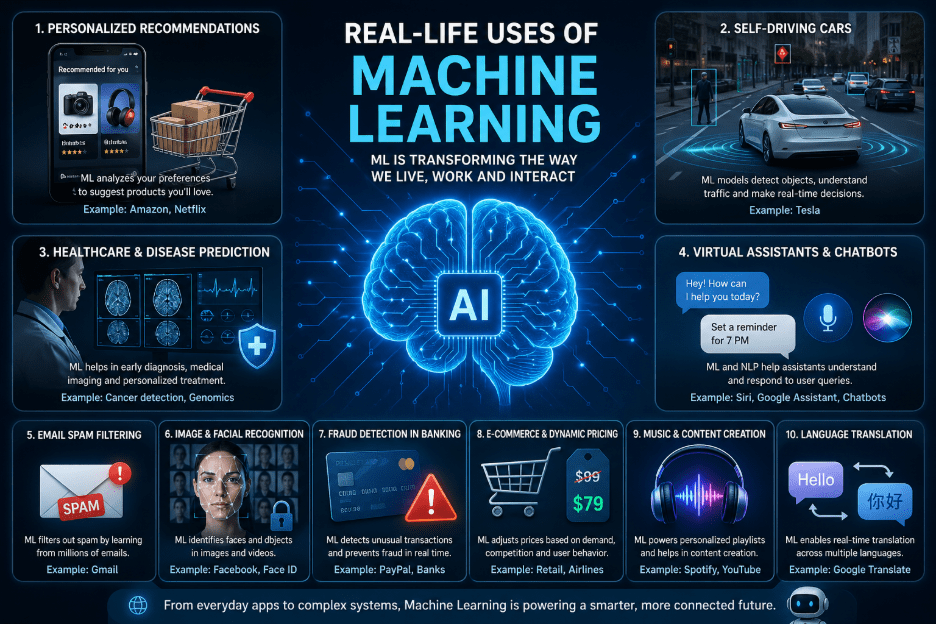
Machine Learning (ML), a core part of Artificial Intelligence, is no longer a futuristic concept—it’s deeply embedded in our daily lives. From the apps on your phone to the systems powering global industries, ML is quietly transforming how we live, work, and interact.
Let’s explore some of the most impactful real-life applications of machine learning.
1. Personalized Recommendations
Have you ever noticed how Amazon suggests products you might like, or how Netflix recommends movies based on your watch history?
That’s machine learning at work. These platforms analyze your behavior, preferences, and interactions to predict what you’re most likely to enjoy or purchase next—enhancing user experience and boosting engagement.
2. Self-Driving Cars
Companies like Tesla are leading the way in autonomous driving technology. ML models process data from cameras, sensors, and radar to:
- Detect objects and pedestrians
- Understand traffic signals
- Make real-time driving decisions
This technology aims to reduce accidents and revolutionize transportation.
3. Healthcare and Disease Prediction
Machine learning is making healthcare smarter and faster. Systems can analyze medical data to:
- Predict diseases like Cancer at early stages
- Assist in medical imaging diagnostics
- Personalize treatment plans
Hospitals and research institutions use ML to improve patient outcomes and reduce costs.
4. Virtual Assistants and Chatbots
Virtual assistants like Google Assistant and Siri rely on ML and natural language processing to understand and respond to user queries.
They can:
- Answer questions
- Set reminders
- Control smart home devices
Businesses also use chatbots to provide 24/7 customer support.
5. Email Spam Filtering
Ever wondered how your inbox stays clean? Services like Gmail use ML algorithms to detect and filter spam emails.
These systems learn from millions of examples to identify suspicious patterns and keep unwanted messages out of your inbox.
6. Image and Facial Recognition
Machine learning powers image recognition in platforms like Facebook, where it can automatically tag people in photos.
It’s also used in:
- Security systems
- Smartphone face unlock features
- Surveillance and identity verification
7. Fraud Detection in Banking
Banks use ML to monitor transactions and detect unusual activity in real time.
For example, PayPal uses ML to identify fraudulent transactions by analyzing spending patterns, location, and device data—helping protect users from financial loss.
8. E-Commerce and Dynamic Pricing
Online retailers use ML to adjust prices based on demand, competition, and user behavior. This is called dynamic pricing.
It helps businesses stay competitive while offering personalized deals to customers.
9. Music and Content Creation
Streaming platforms like Spotify use ML to create personalized playlists like “Discover Weekly.”
ML is also used in:
- Generating music and art
- Enhancing video editing
- Automating content creation
10. Language Translation
Tools like Google Translate use ML to provide accurate translations across languages in real time.
This helps break communication barriers and enables global connectivity.
Final Thoughts
Machine learning is not just a technological trend—it’s a powerful force reshaping industries and everyday experiences. From healthcare to entertainment, its applications are vast and growing rapidly.
As ML continues to evolve, we can expect even more innovative solutions that will make our lives smarter, safer, and more efficient.