
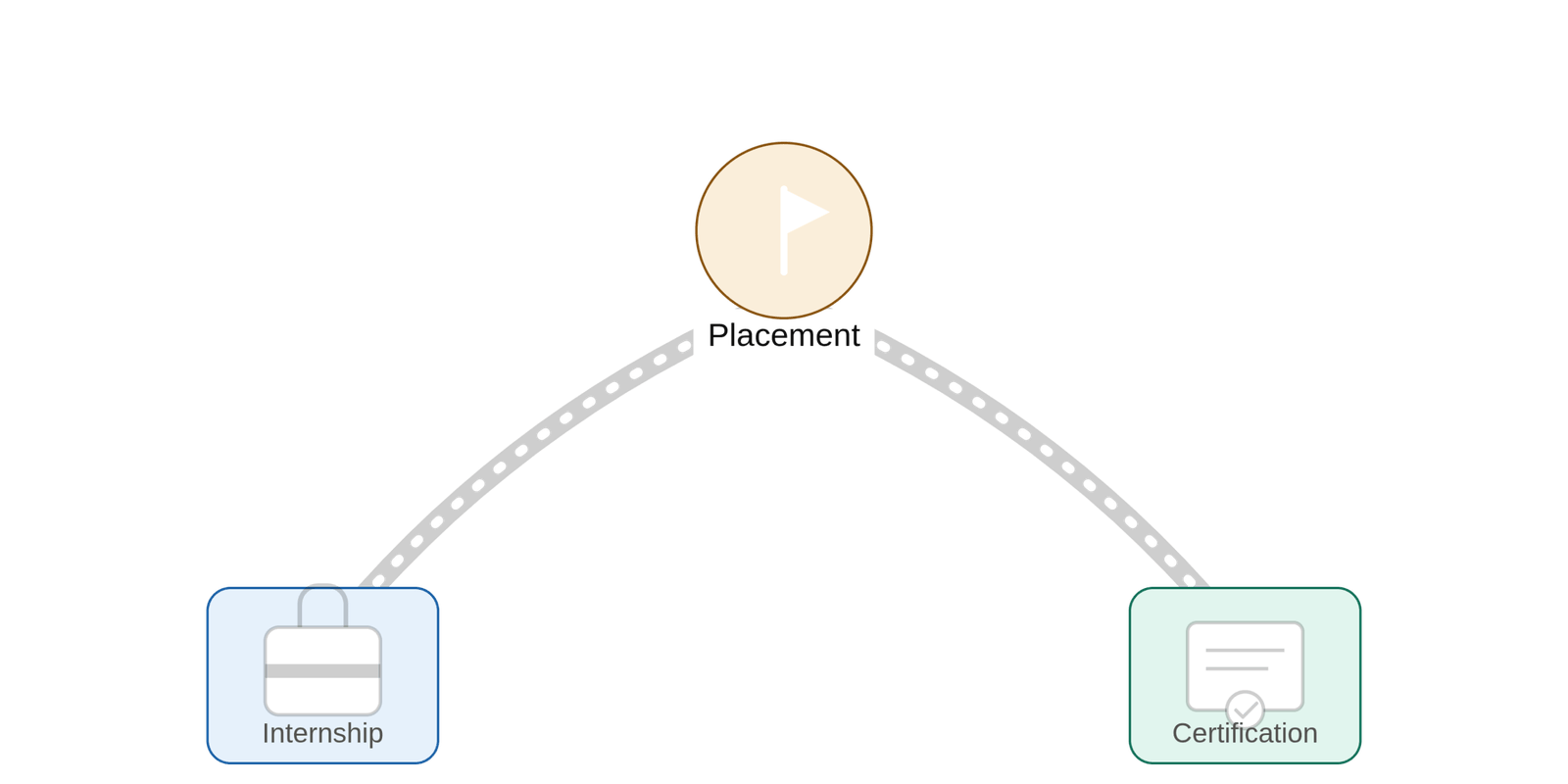
You’ve got limited time, limited budget, and a placement season closing in. Do you spend the next two months doing an internship, or do you knock out a certification instead? It’s one of the most common questions freshers ask — and most of the answers online are vague. Here’s a direct, practical breakdown of what actually helps you get placed, based on what recruiters are really evaluating.
The Short Answer
Neither an internship nor a certification alone guarantees placement. What moves the needle is demonstrable, applied skill — and internships and certifications each provide a different piece of that proof. Understanding what each one actually signals to a recruiter is the key to choosing correctly.
What a Certification Actually Signals to Recruiters
A certification tells a recruiter that you’ve studied a defined curriculum and passed an assessment. That’s useful — but limited.
What it proves:
- You understand core concepts in a structured way
- You have baseline knowledge of a specific tool, language, or framework
- You’re motivated enough to complete a structured program
What it doesn’t prove:
- Whether you can apply that knowledge to a messy, real-world problem
- Whether you can work in a team, handle ambiguity, or debug something that isn’t in the course material
- Whether you can communicate technical decisions
Recruiters increasingly see certifications as a filter, not a differentiator — especially generic ones from platforms with no real assessment rigor. A certification from a recognized, project-backed program (rather than a passive video course) carries meaningfully more weight.
What an Internship Actually Signals to Recruiters
An internship, even a short one, tells a recruiter something a certification structurally cannot: that you’ve operated in something resembling a real work environment.
What it proves:
- You can work with deadlines, feedback, and ambiguity
- You’ve likely collaborated with others or used real tools (Git workflows, ticketing systems, code reviews)
- You have at least one concrete project or contribution you can discuss in depth in an interview
What it doesn’t prove:
- Depth of technical knowledge (internships vary wildly in rigor)
- That you understand why something works, not just that you did it
This is why interviewers frequently probe internship experience harder than certifications — they’re checking whether the internship was substantive or just an entry on a resume.
Head-to-Head Comparison
| Factor | Certification | Internship |
|---|---|---|
| Time investment | Typically 4–12 weeks | Typically 4–12 weeks (similar) |
| Cost | Usually paid, moderate cost | Often unpaid or stipend-based; some structured programs charge a fee |
| Recruiter perception | Signals baseline knowledge | Signals applied, real-world capability |
| Interview talking points | Limited — concepts, not stories | Strong — specific challenges, decisions, outcomes |
| Best for | Filling a knowledge gap fast | Building interview-ready experience and references |
| Weakest when | Generic, video-only, no assessment | Unstructured, no mentorship, “coffee-fetching” role |
Why This Shouldn’t Be an Either/Or Decision
The strongest fresher resumes don’t choose one — they combine both, in the right order:
- Certification first — to build the foundational knowledge and vocabulary you need to actually contribute in a real setting
- Internship second — to apply that knowledge to real problems, build a portfolio-worthy project, and get a reference or work sample
Doing an internship with zero foundational knowledge often means spending most of it playing catch-up. Doing only a certification with no applied work leaves you unable to answer the interview question every recruiter asks: “Can you walk me through a real project you’ve worked on?”
This is exactly why outcome-focused programs increasingly bundle the two together. For example, Vyasa Nexus’s Career Acceleration Kits combine structured certification with a linked internship at Enigma Metaverse — so you graduate with both the knowledge and the applied proof to back it up, rather than choosing one and hoping it’s enough.
How to Choose If You Can Only Do One Right Now
If time or budget genuinely forces a choice, use this quick decision guide:
- Choose a certification if: you have a clear skill gap (e.g., you don’t know a required framework at all), and your resume already has some project or academic work to show applied ability.
- Choose an internship if: you already have foundational knowledge from coursework or self-study, but your resume has no real-world project or work sample to point to in interviews.
- Choose neither, temporarily, if: you haven’t built any personal projects yet — in that case, spend a few weeks building 1–2 solid portfolio projects first, so whichever option you pick afterward is more effective.
What Recruiters Told Us (In Short)
Across mock interviews and hiring conversations we’ve run at Vyasa Nexus, one pattern is consistent: recruiters spend far more interview time probing experience-based answers (from internships or real projects) than knowledge-based answers (from certifications). A certification gets you past an ATS keyword filter. An internship — or a strong project that simulates one — gets you through the actual conversation.
Final Thoughts
Certifications and internships aren’t competing options — they solve two different problems. Certifications close knowledge gaps quickly; internships convert that knowledge into interview-ready experience. If you can only afford the time or money for one right now, use the decision guide above. If you can do both, do the certification first and let it feed directly into a real, applied internship.
Explore Vyasa Nexus’s certification and internship-linked programs to see how a structured path combining both can get you placement-ready faster than either one alone.
Frequently Asked Questions
Q: Do certifications actually help freshers get hired? A: Certifications help freshers pass initial resume/ATS filters and demonstrate baseline knowledge, but they rarely carry an interview on their own. Recruiters weigh certifications more heavily when they come from project-based, assessed programs rather than passive video courses.
Q: Is an unpaid internship still worth it for placements? A: Yes, if it involves real, substantive work you can discuss in detail during interviews. An unpaid internship with genuine mentorship and project ownership is generally more valuable than a paid one with minimal real responsibility.
Q: Should I do a certification before or after an internship? A: Generally, certification first is more effective — it builds the foundational knowledge needed to contribute meaningfully during an internship, rather than spending the internship catching up on basics.