
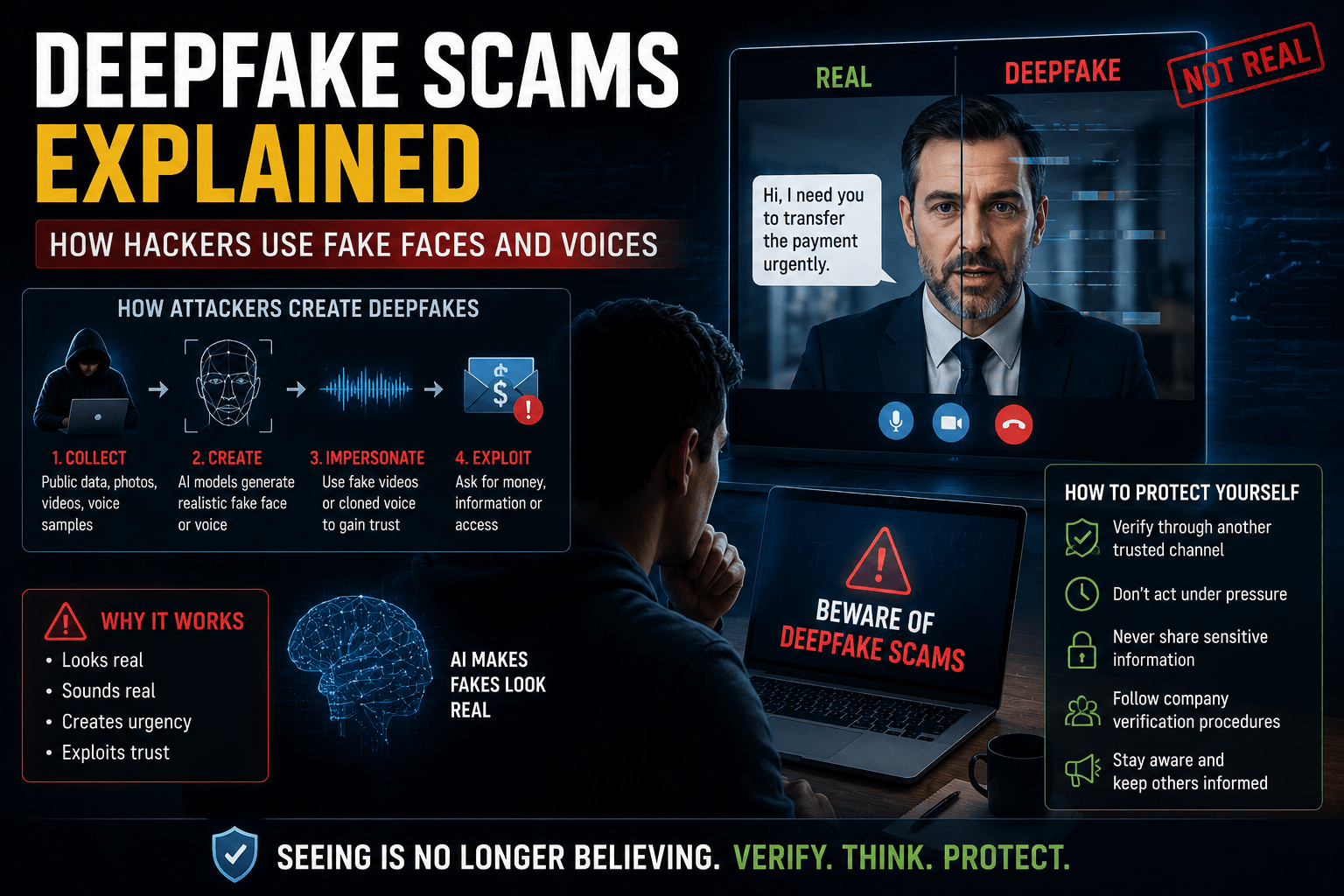
Imagine receiving a video call from your manager.
You see their face. You hear their voice. They ask you to transfer money or share confidential information.
Everything looks real.
However, the person on the screen may not be real at all.
This is the danger of deepfake scams. Attackers can use artificial intelligence to create convincing fake images, videos, and voices. As a result, traditional methods of verifying someone’s identity are becoming less reliable.
What Is a Deepfake?
A deepfake is digitally created or modified media that makes a person appear to say or do something they never actually said or did.
AI can generate or manipulate:
- Faces
- Voices
- Videos
- Images
- Audio recordings
For example, an attacker could create a fake video that appears to show a company executive giving an instruction.
The technology itself has legitimate uses. However, criminals can also use it for fraud, impersonation, and social engineering.
What Is a Deepfake Scam?
A deepfake scam uses manipulated or AI-generated media to trick someone into believing that they are communicating with a real person.
Attackers may impersonate:
- Company executives
- Family members
- Friends
- Government officials
- Bank employees
- Celebrities
- Business partners
The goal is usually to make the victim trust the attacker.
Once trust is established, the attacker may request money, passwords, confidential information, or access to an account.
How Do Deepfake Scams Work?
A typical attack can follow a simple pattern.
Collect information → Create fake media → Contact the victim → Build trust → Request an action
First, attackers collect information about their target.
They may find photos, videos, voice recordings, or professional information online.
Next, they create convincing fake content.
Then, the attacker contacts the victim through email, messaging apps, or a video call.
Because the fake media looks familiar, the victim may believe the person is genuine.
Finally, the attacker makes a request.
That request could involve money, sensitive information, or access to an account.
Voice Cloning Scams
Voice cloning is one of the most concerning uses of deepfake technology.
An attacker can create an artificial voice that sounds similar to a real person.
For example, someone may receive a phone call that appears to come from a family member.
The caller claims to have an emergency and asks for money.
The voice sounds familiar, so the victim may react quickly without verifying the situation.
However, the voice alone does not prove the caller’s identity.
Fake Video Calls
Deepfake technology can also manipulate video.
An attacker may attempt to create a fake face during a video interaction.
This can make an online meeting appear legitimate.
For example, imagine an employee receives a video call from someone who looks like a senior executive. The person asks the employee to share confidential files.
The employee sees the familiar face and follows the request.
Therefore, even video communication should not automatically be treated as proof of identity.
Why Deepfake Scams Are Dangerous
Deepfake scams combine technology with social engineering.
Instead of attacking a computer directly, criminals can manipulate human trust.
A convincing face or voice can create a strong emotional reaction.
For example, an attacker may create a sense of:
- Urgency
- Fear
- Authority
- Trust
- Excitement
As a result, people may make decisions before checking whether the request is genuine.
Common Warning Signs
Deepfakes can look convincing. However, suspicious behavior can still reveal a scam.
Watch for:
Unusual Requests
Be careful when someone suddenly asks for money, passwords, or confidential files.
Urgent Instructions
Scammers often create pressure.
They may say that you must act immediately.
Unexpected Video Calls
A surprise call involving sensitive information deserves extra verification.
Strange Speech or Movements
Some deepfakes may contain unnatural facial movements, unusual expressions, or strange audio.
However, these signs are not always obvious.
Requests to Avoid Verification
A major warning sign appears when someone discourages you from confirming their identity through another channel.
Why Seeing and Hearing Someone Is Not Enough
People naturally trust familiar faces and voices.
Unfortunately, AI-generated media can exploit that trust.
Therefore, identity verification should not depend on appearance or voice alone.
Instead, use another trusted method.
For example, if someone requests a sensitive action during a video call, contact them through a separate communication channel.
This simple step can stop many impersonation attempts.
How to Protect Yourself From Deepfake Scams
Fortunately, you can take several practical steps.
1. Verify Important Requests
Always verify unusual requests independently.
For example, call the person using a phone number you already trust.
Do not use contact information provided by the suspicious message.
2. Do Not Act Under Pressure
Take a moment before responding.
Scammers often use urgency to prevent victims from thinking carefully.
A short delay can give you enough time to verify the request.
3. Use Multi-Step Verification
For sensitive actions, use more than one verification method.
For example, a financial transfer could require approval from another employee.
This creates an additional security layer.
4. Limit Personal Information Online
Attackers need information to create convincing impersonations.
Therefore, avoid sharing unnecessary personal details publicly.
Review the information available on your social media profiles.
5. Create Verification Procedures
Businesses should create clear procedures for sensitive requests.
For example, employees could require a second approval for large financial transactions.
This approach reduces reliance on a single person’s judgment.
6. Educate Employees
Employees should understand that a familiar face or voice does not guarantee authenticity.
Regular security training can help people recognize social engineering attempts.
Deepfake Scams in Businesses
Businesses can face significant risks from deepfake impersonation.
An attacker might pretend to be:
- A CEO
- A finance manager
- An employee
- A customer
- A supplier
The attacker could then request a payment or confidential information.
For this reason, businesses should create verification procedures for sensitive actions.
For example, financial requests should require independent confirmation.
That way, even a convincing deepfake becomes much harder to use successfully.
Can AI Detection Tools Stop Deepfakes?
AI detection tools can help identify manipulated content.
However, organizations should not depend on one detection tool.
Deepfake technology continues to evolve. Detection systems can also produce false positives or miss sophisticated manipulation.
Therefore, a stronger approach combines:
- Identity verification
- Security awareness
- Access controls
- Transaction approvals
- Monitoring
- Technical detection tools
In other words, technology should support verification rather than replace it.
Deepfake vs Traditional Phishing
Both attacks try to manipulate people. However, they use different methods.
| Traditional Phishing | Deepfake Scam |
|---|---|
| Often uses fake emails or websites | Uses fake audio, images, or video |
| May impersonate a company | Can impersonate a specific person |
| Relies heavily on written messages | Can exploit face and voice recognition |
| Often uses suspicious links | May use calls or video meetings |
| Targets human trust | Targets human trust and familiarity |
The techniques can also work together.
For example, an attacker could send a phishing message and follow it with a fake voice call.
A Simple Deepfake Safety Checklist
Before trusting an unexpected request, ask:
- Did I expect this message or call?
- Is the request unusual?
- Is someone creating urgency?
- Can I verify the person another way?
- Does the request involve money or sensitive information?
- Am I being asked to bypass normal procedures?
- Can another person confirm the request?
If something feels unusual, stop and verify it.
What Should Businesses Do?
Organizations can reduce deepfake risks with clear security procedures.
For example, businesses should:
- Require independent verification for sensitive requests.
- Use approval processes for financial transactions.
- Train employees about AI impersonation.
- Protect sensitive employee information.
- Monitor unusual account activity.
- Establish reporting procedures for suspicious calls.
- Avoid relying on voice or video alone for authentication.
These measures can reduce the impact of deepfake-based social engineering.
Final Thoughts
Deepfake scams use AI-generated or manipulated media to make impersonation more convincing.
Attackers can use fake faces, cloned voices, and manipulated videos to build trust and pressure victims into taking risky actions.
However, technology is not the only defense.
The most effective protection starts with a simple habit:
Verify before you trust.
When a request involves money, passwords, confidential information, or important business actions, use an independent verification method.
A familiar face can be fake. A familiar voice can be fake.
Therefore, identity should be verified through trusted channels, not appearance or sound alone.