
Every few months, someone predicts that machines are about to take over the workplace for good.
And every few months, those same machines turn out to need a human sitting next to them — asking better questions, catching mistakes, or explaining the output to someone who actually has to make a decision.
That gap, between what a machine can calculate and what a person can judge, is where the real opportunity sits right now.
AI has gotten remarkably good at pattern recognition, drafting, summarizing, and number-crunching. What it hasn’t gotten good at is the messier stuff: reading a room, holding two conflicting truths at once, taking responsibility for a call that didn’t work out.
Those are human skills, and they’re becoming more valuable, not less, as automation spreads.
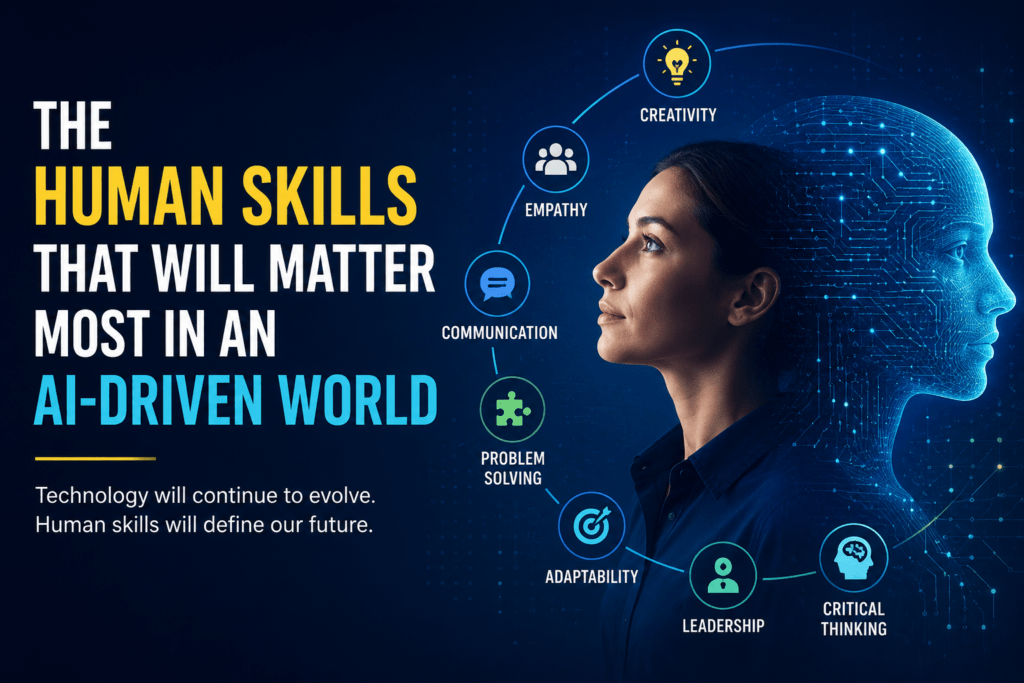
Below are the seven worth building deliberately over the next few years — and why they’ll hold up even as the tools around us keep changing.
Quick Summary: 7 Human Skills for the AI Era
- Critical thinking
- Emotional intelligence
- Creative problem-solving
- Adaptability and continuous learning
- Clear communication
- Ethical judgment and accountability
- Cross-disciplinary collaboration
1. Critical Thinking Is Not Optional Anymore
AI tools produce answers quickly. Quick isn’t the same as correct.
A chatbot can hand you a confident, well-formatted paragraph that’s subtly wrong — and unless you know enough to question it, you’ll never catch the error.
Critical thinking in the AI age means asking:
- Where did this information come from?
- Does it hold up against what I already know?
- What might be missing from the picture?
This isn’t a new skill invented for the AI era. Good editors, doctors, and engineers have always needed it. What’s changed is the sheer volume of information moving past us every day, and the confidence with which flawed information now gets presented.
People who slow down, question a source, and spot a gap in logic will always have an edge over people who take output at face value.
2. Emotional Intelligence Still Belongs to Us
Emotional intelligence was already a hot workplace topic before generative AI showed up, and it hasn’t lost any relevance.
- Reading a colleague’s frustration before it turns into a resignation letter
- Sensing when a client needs reassurance rather than more data
- Knowing when to push a team and when to let it breathe
None of this shows up in a training dataset.
Companies are learning, sometimes the hard way, that automating a task doesn’t automate the relationship around it. Customers still want to feel heard. Employees still want a manager who notices when something’s off. As routine tasks get handed to software, the human interactions left behind carry more weight, not less.
3. Creative Problem-Solving Beyond the Template
AI is excellent at producing variations on things that already exist. It struggles with the genuinely new — the idea that doesn’t have a thousand examples to draw from.
Creative problem-solving — combining unrelated ideas, or challenging an assumption nobody thought to question — remains a distinctly human strength.
This matters especially in business strategy, design, and product development, where the winning idea is often the one nobody expected. Teams that treat AI as a starting point rather than a final answer, then push their own thinking further, tend to outperform teams that stop at the first draft a machine hands them.
4. Adaptability and the Willingness to Keep Learning
If there’s one certainty about the next decade of work, it’s that the tools will keep changing. The specific software or model in use today may be gone within a year or two.
What won’t go out of date is the ability to:
- Learn something new quickly
- Unlearn an old habit
- Adjust to a workflow that didn’t exist last quarter
Adaptability isn’t a personality trait some people are born with. It’s a habit, built through practice: trying new tools before you have to, asking for feedback instead of avoiding it, treating a mistake as information rather than a verdict on your worth.
Workers and organizations that build this habit into their culture will weather change far better than those waiting for things to settle down.
5. Communication That Actually Lands
AI can write a passable email. It cannot read the specific tension in a room during a difficult negotiation, or know exactly which words will land with a particular person on a particular day.
Communication skills that matter now include:
- Explaining something complicated in plain language
- Listening without immediately formulating a rebuttal
- Disagreeing without burning a bridge
As more first drafts get generated by software, human value shifts toward editing for tone, judgment, and context. Knowing what to say — and just as importantly, what to leave out — improves with deliberate practice. It can’t be outsourced.
6. Ethical Judgment and Accountability
Someone has to decide what an AI system should and shouldn’t do. Someone has to answer for it when things go wrong. That responsibility can’t be handed to the software itself.
Ethical judgment means weighing fairness, consequences, and long-term trust against short-term convenience.
This shows up in obvious places, like deciding how customer data gets used, and in quieter ones, like whether a shortcut that saves time this week creates a bigger problem next year. Organizations that build strong ethical judgment into their teams tend to avoid reputational damage that no amount of automation can fix afterward.
7. Collaboration Across Disciplines
The most useful AI applications tend to come from teams that mix technical skill with domain expertise — a data scientist working alongside a nurse, a developer working alongside a teacher.
Collaboration skills — translating between specialties and finding common ground with people who think differently than you do — make that mixing work.
This kind of cross-disciplinary collaboration is hard to fake and hard to automate. It requires patience, curiosity about someone else’s field, and enough humility to admit when you don’t understand something yet.
Building These Skills on Purpose
None of these seven areas develop by accident. They come from deliberate practice, honest feedback, and often, structured learning that pairs real-world experience with guided instruction.
That’s the gap that focused upskilling programs are meant to close — not by teaching people to compete with AI, but by strengthening the exact abilities that make people irreplaceable next to it.
The workplace of the next decade won’t reward people simply for knowing how to use a tool. It will reward the people who bring judgment, empathy, creativity, and accountability to whatever the tool produces.
Those are old-fashioned strengths, in a sense — the kind good mentors have always tried to instill. They just happen to be exactly what the moment calls for now.
FAQ
What are the most important human skills in an AI-driven workplace? Critical thinking, emotional intelligence, creative problem-solving, adaptability, communication, ethical judgment, and cross-disciplinary collaboration.
Can AI replace soft skills? No. AI can draft, summarize, and calculate, but it can’t read a room, take responsibility for a decision, or build trust the way a person can.
How do I build these skills on purpose? Through deliberate practice, honest feedback, and structured learning that pairs real-world experience with guided instruction.