
For as long as people have worked together in groups, leadership has changed shape to fit the tools of the day. The foreman who once walked the factory floor with a clipboard has given way to a manager reading a dashboard on a laptop. The office memo has given way to the Slack message. And now, as artificial intelligence, automation, and data analytics settle into nearly every corner of business, leadership is being asked to change shape once again. The question worth asking is not whether technology will affect how we lead — that much is already settled — but what kind of leader will be needed once the dust from this shift finally clears.
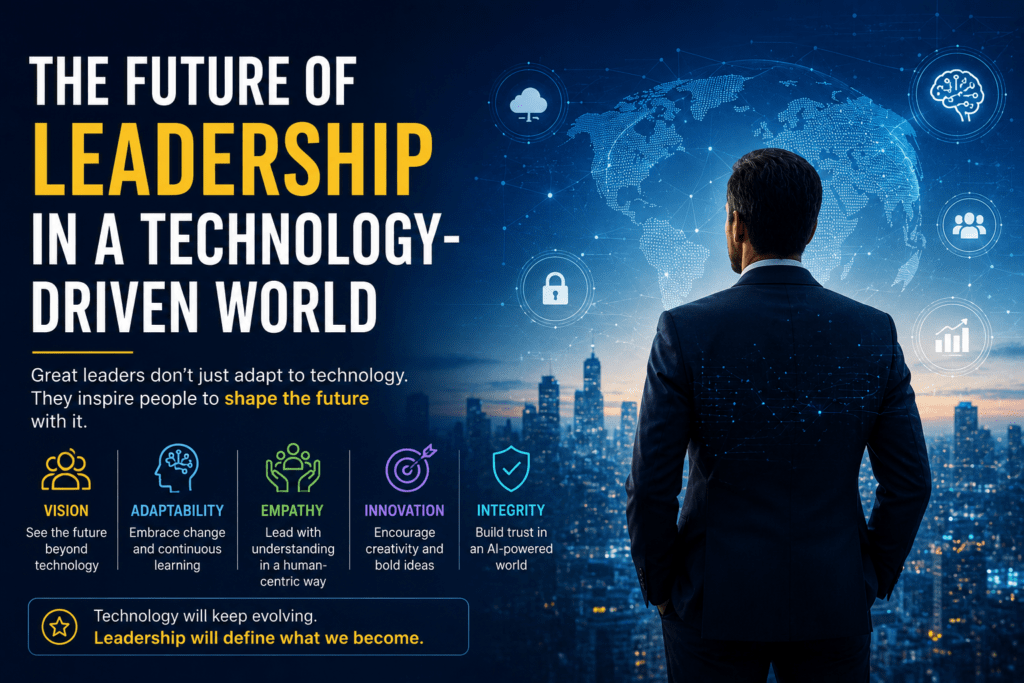
Why Technology Is Reshaping Leadership
Leading in a technology-driven world isn’t just about learning new software. In fact, technology is reshaping how organizations operate. As a result, it’s changing what leadership itself has to look like.
Deloitte’s 2026 Global Technology Leadership Study describes a workforce that now blends employees, gig workers, and AI agents. Each group needs a different kind of management. Each also needs its own approach to coordination and trust. Because work now sits between people and machines, the old model is losing its grip. That model put one person at the top, directing everyone below.
Digital transformation is flattening organizations too. Economic pressure and the push for efficiency are moving decisions away from headquarters. Instead, decisions are landing closer to the teams doing the work. Consequently, influence, collaboration, and expertise now matter more than job titles. In short, leadership is becoming horizontal.
The Human Skills Machines Can’t Replace
Many data-savvy leaders assume that better information will eventually erase uncertainty. Often, though, the opposite happens.
AI is absorbing routine analysis and repetitive decisions. So what’s left are the things machines still struggle with:
- Reading a team’s mood
- Recognizing when people are under pressure
- Having hard conversations with empathy
- Making sound judgment calls when the data is incomplete
Leadership consultancy DDI has identified five qualities that set apart leaders who thrive in AI-enabled workplaces: connection, conscience, creativity, clarity, and curiosity. No software can learn these. Instead, they come from experience, reflection, mistakes, and honest feedback.
Emotional intelligence, once written off as a “soft skill,” is now a core leadership capability. Leaders who explain why change is happening tend to build real trust. That’s especially true when they also listen to the concerns change raises. No automated message can do that. As the World Economic Forum has put it: the future belongs not to the fastest-moving organizations, but to the ones that bring the most people with them.
Building Tech Fluency Without Losing the Human Touch
Valuing human skills doesn’t mean leaders should ignore technology.
Leaders who don’t understand what AI can and can’t do put their organizations at risk. So do leaders who trust AI blindly. That’s why the best leaders now treat AI literacy the way earlier generations treated financial literacy. It’s not a technical specialty. It’s a basic leadership skill.
Still, no executive needs to learn to code. Instead, they need to ask the right questions:
- What assumptions is this model making?
- Where could it be wrong?
- Who’s accountable when it fails?
Leaders who can talk confidently with engineers and data scientists earn real credibility. That’s because they can challenge assumptions and make informed calls. This kind of credibility often extends well beyond their formal title.
Of course, this fluency doesn’t appear overnight. That’s why leading organizations invest in ongoing workshops and hands-on AI training. As a result, managers build confidence before they have to lead through disruption under pressure.
From Hierarchy to Influence
Traditional leadership was built for a slower, more predictable world. Information moved up the chain. Then decisions came back down, following rank.
Today, that model is under strain.
Employees now expect to contribute ideas, not just take instructions. So they can easily tell the difference between organizations that welcome feedback and ones that only claim to.
As a result, leadership is becoming more collaborative. Trust, communication, and shared responsibility increasingly outweigh formal authority. For example, a project manager close to the work can end up with more real influence than a senior VP several steps removed from it.
Because of this shift, successful leaders invest in cross-functional collaboration. They also welcome diverse perspectives and build environments where anyone can speak up, regardless of rank.
Ethics, Trust, and Responsible Leadership
As technology automates more decisions, leaders’ ethical responsibilities grow rather than shrink.
Hiring algorithms, pricing models, and customer service systems can reinforce bias without anyone intending it. When that happens, human leaders bear the responsibility to catch and fix it.
Meanwhile, many employees worry about what automation means for their jobs. Surveys consistently show widespread concern about displacement. Yet those same surveys show that leadership rarely offers guidance about it.
Closing that gap may be one of the decade’s defining leadership challenges. It requires three things: transparency about what’s changing, honesty about what leaders don’t yet know, and a willingness to explain decisions rather than simply announce them.
In other words, purpose-driven leadership isn’t a branding exercise anymore. It’s now central to earning and keeping employee trust.
Preparing the Next Generation of Leaders
None of this happens by accident.
Future leaders need chances to build judgment long before they take on formal roles. Universities, corporate programs, and professional development providers all play a part. The strongest programs pair academic knowledge with real practice. That combination lets emerging leaders navigate uncertainty, solve real problems, and learn from experienced mentors.
Leadership education is changing too. Case studies from stable, predictable markets no longer cut it. Instead, programs need to prepare people for ambiguity and incomplete information. They also need to prepare people for technology that keeps evolving even as organizations adopt it.
So which programs produce the most capable graduates? Usually, the ones that combine certification, hands-on experience, current research, and mentorship.
Where This Leaves Us
The future of leadership won’t hinge on who adopts the flashiest technology. Instead, it will depend on leaders who can hold two things at once: they must embrace new tools while staying deeply committed to the people those tools serve.
Technology can strengthen leadership. However, it can’t replace judgment, empathy, or trust.
Ultimately, organizations that invest in both technological capability and human leadership will earn lasting confidence. That confidence will come from employees, customers, and the communities they serve.