
Introduction
Artificial Intelligence has evolved rapidly—from rule-based systems to machine learning and now to advanced generative models. But a new paradigm is emerging that goes beyond passive intelligence: Agentic AI. This next generation of AI systems is designed not just to respond, but to act, decide, and adapt autonomously toward achieving goals.
Agentic AI represents a shift from “tools” to “digital agents”—systems capable of reasoning, planning, and executing tasks with minimal human intervention.
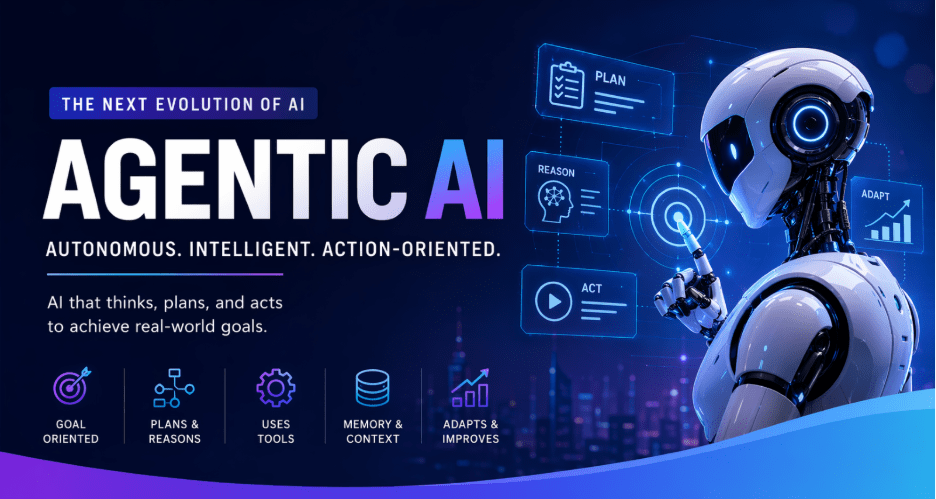
What is Agentic AI?
Agentic AI refers to AI systems that behave like autonomous agents. Unlike traditional AI models that require constant human prompts, agentic systems can:
- Understand objectives
- Break them into actionable steps
- Execute tasks independently
- Learn and adapt from outcomes
In simple terms, Agentic AI = AI with initiative and decision-making ability.
Key Characteristics of Agentic AI
1. Autonomy
Agentic AI can operate independently without needing step-by-step instructions.
2. Goal-Oriented Behavior
It focuses on achieving defined goals rather than just generating outputs.
3. Planning & Reasoning
These systems can create multi-step plans and adjust strategies dynamically.
4. Memory & Context Awareness
Agentic AI retains context over time, improving decision-making.
5. Tool Usage
It can interact with APIs, databases, and software tools to complete tasks.
How Agentic AI Works
Agentic AI systems typically combine multiple components:
- Large Language Models (LLMs) for reasoning and communication
- Planning Engines to break down tasks
- Memory Systems for storing context
- Execution Modules to perform actions (e.g., calling APIs, running code)
Example Workflow:
- User sets a goal: “Plan a marketing campaign”
- AI breaks it into steps: research, audience analysis, content creation
- Executes tasks using tools
- Refines strategy based on results
Real-World Use Cases
1. Business Process Automation
Agentic AI can manage workflows, approvals, and decision-making in BPM systems like Pega.
2. Software Development
AI agents can write code, debug, test, and deploy applications autonomously.
3. Customer Support
Intelligent agents can handle end-to-end customer queries without escalation.
4. Personal Productivity
AI assistants can schedule meetings, manage emails, and optimize daily tasks.
5. Healthcare & Research
Agentic systems can analyze data, suggest treatments, and assist in drug discovery.
Benefits of Agentic AI
- Increased Productivity – Automates complex workflows
- Reduced Human Effort – Minimizes manual intervention
- Faster Decision-Making – Real-time analysis and action
- Scalability – Handles large-scale operations efficiently
Challenges & Risks
While powerful, Agentic AI comes with concerns:
- Control & Oversight – Autonomous decisions may need governance
- Bias & Errors – Poor data can lead to flawed actions
- Security Risks – Autonomous systems interacting with tools can be exploited
- Ethical Concerns – Decision accountability becomes complex
Agentic AI vs Traditional AI
| Feature | Traditional AI | Agentic AI |
| Interaction | Reactive | Proactive |
| Control | Human-driven | Semi/fully autonomous |
| Task Execution | Single-step | Multi-step workflows |
| Adaptability | Limited | Dynamic |
The Future of Agentic AI
Agentic AI is expected to redefine industries by enabling:
- Fully autonomous enterprises
- AI-driven decision ecosystems
- Human-AI collaboration at scale
In the coming years, we will likely see AI agents working alongside humans, acting as co-workers rather than just tools.
Conclusion
Agentic AI marks a significant leap in artificial intelligence—from passive systems to intelligent, action-oriented agents. As organizations embrace this technology, the focus will shift from using AI to collaborating with AI.
The question is no longer “What can AI do?”
But rather, “What can AI achieve on its own?”
Call to Action
Are you ready to explore Agentic AI in your applications? Start experimenting with AI agents today and be part of the next digital revolution.