
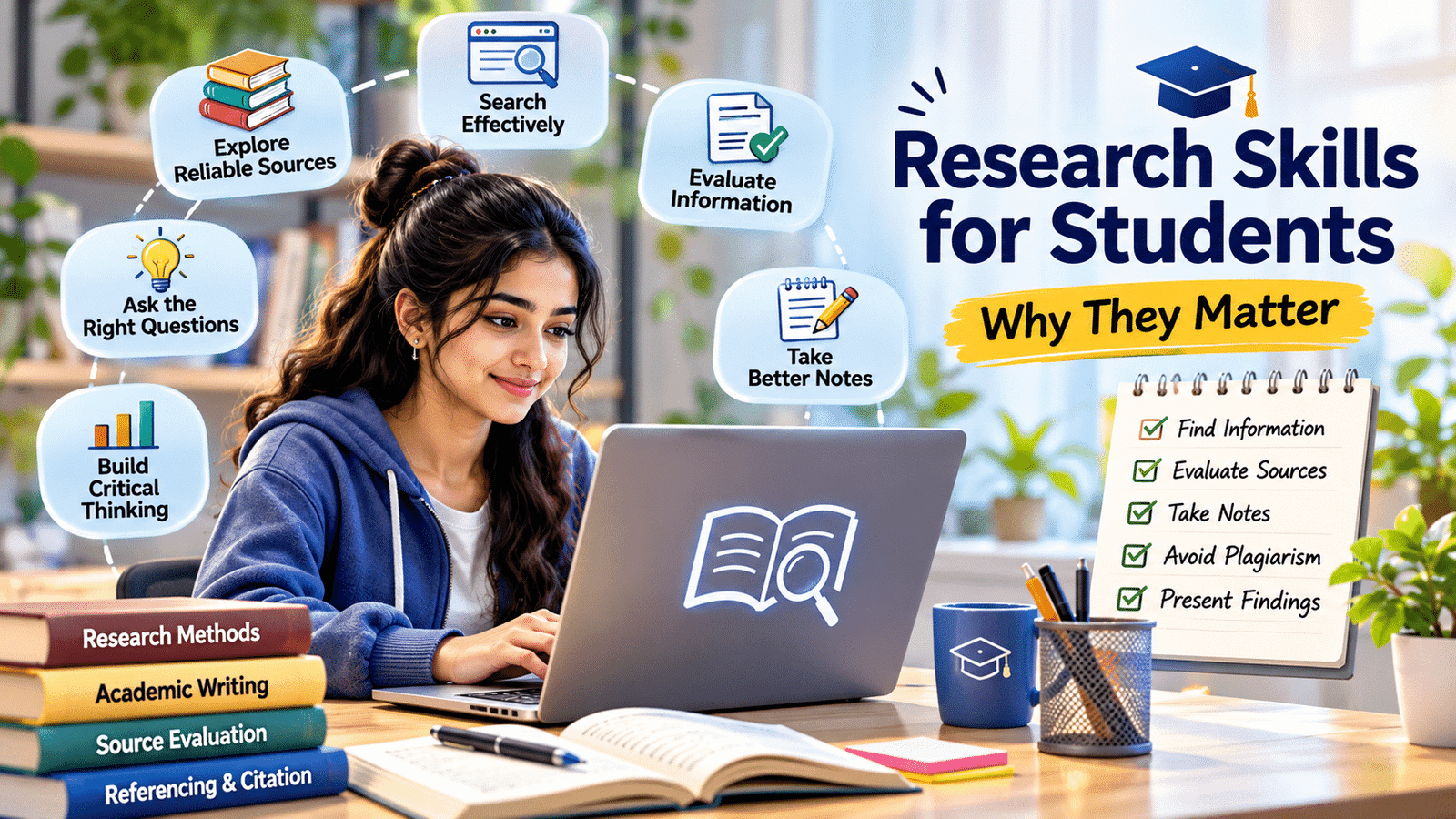
Research Skills for Students: Why They Matter
Research skills for students are essential for academic success and future career growth. They help learners find reliable information, evaluate different sources, understand complex topics, and develop well-supported conclusions. These skills also encourage independent learning, critical thinking, and better decision-making.
Research skills for students are essential because they help learners collect relevant information, evaluate sources, understand complex topics, and develop well-supported conclusions.
Whether students are preparing a college assignment, working on a group project, or exploring a future career, research skills help them become independent and informed learners.
Research is not simply about searching on Google or collecting information from websites. It involves asking meaningful questions, checking facts, understanding different perspectives, and presenting findings clearly.
In this article, we will explore why research skills matter, how students can find reliable information, avoid plagiarism, and improve their research abilities through practical activities.
1. Why Research Skills for Students Matter
Research skills for students are important because they help learners understand subjects beyond textbooks and classroom explanations.
When students research a topic, they learn how to explore different sources, identify useful information, and develop their own understanding.
For example, a student preparing a project about environmental pollution may collect information from educational websites, research articles, government reports, and books. By comparing these sources, the student can understand different causes, effects, and possible solutions.
Research skills also help students:
- Understand difficult subjects more effectively.
- Complete assignments with accurate information.
- Develop independent learning habits.
- Identify trustworthy information.
- Improve critical thinking and problem-solving.
- Present ideas with supporting evidence.
- Prepare for higher education and professional responsibilities.
These abilities are useful beyond academic life. Many professional roles require employees to investigate problems, understand information, compare options, and make informed decisions.
2. What Are Research Skills?
Research skills are the abilities required to find, collect, evaluate, organize, and communicate information about a particular subject.
They help students move from simply collecting information to understanding and using it effectively.
Some important research skills include:
Information searching: Knowing how to find relevant information through search engines, books, journals, and other resources.
Source evaluation: Checking whether information comes from a reliable and trustworthy source.
Question formation: Creating clear questions that guide the research process.
Note-taking: Recording important points in an organized way.
Critical thinking: Comparing information, identifying differences, and examining evidence.
Referencing: Giving proper credit to the original authors and sources.
Communication: Presenting research findings in a clear and understandable manner.
Students can gradually develop these abilities through assignments, presentations, academic projects, and independent learning activities.
3. How Research Skills Improve Learning
Research encourages students to become active participants in their learning process.
Instead of depending entirely on classroom explanations, students can explore additional information, investigate unfamiliar concepts, and understand how different ideas are connected.
For example, when studying artificial intelligence, a student may begin with basic definitions and then explore practical applications, advantages, limitations, and real-world examples.
This process makes learning more meaningful because students understand not only what a concept means but also how it works in different situations.
Research also improves memory and understanding. When students actively search for information, compare explanations, and organize their findings, they engage more deeply with the subject.
Another benefit is curiosity. Research encourages students to ask additional questions and explore topics beyond their regular syllabus.
These habits can support academic improvement and prepare students for continuous learning throughout their careers.
4. How to Find Reliable Information Online
The internet provides access to a large amount of information. However, not every website or online article contains accurate or trustworthy content.
Students should learn how to search carefully and identify useful sources.
Use Specific Search Terms
Instead of searching for a broad topic, use specific phrases related to the information you need.
For example, instead of searching only for “climate change,” search for “effects of climate change on agriculture.”
Specific searches can help students find more relevant results.
Explore Educational Resources
Look for information from universities, educational institutions, research organizations, government websites, and recognized publications.
These sources may provide more reliable information than unknown websites.
Compare Multiple Sources
Do not depend entirely on one website. Compare information from different sources to understand whether the findings are consistent.
Check Publication Dates
Some information may become outdated over time. Check when an article or report was published, especially when researching technology, science, policies, or current developments.
Look for Supporting Evidence
Reliable information often includes references, research findings, examples, or links to original sources.
Students should check whether important claims are supported by evidence.
Learning to search carefully helps students avoid misinformation and develop stronger research habits.
5. The Importance of Evaluating Sources
Finding information is only one part of research. Students must also understand whether the information is accurate, relevant, and suitable for their work.
A source may contain incorrect details, outdated information, personal opinions, or unsupported claims.
Before using information, students should consider the following questions:
- Who created or published this information?
- Is the author qualified to discuss the subject?
- When was the information published?
- Does the source provide evidence?
- Are references or supporting materials available?
- Does another reliable source confirm the information?
- Is the content relevant to the research question?
For example, if two websites provide different statistics about the same topic, students should investigate where the numbers came from and which source provides stronger evidence.
Evaluating sources helps students avoid repeating inaccurate information and improves the quality of academic assignments.
It also teaches them to think independently instead of accepting every statement they read online.
6. How to Take Effective Research Notes
Note-taking is an important part of the research process. It helps students organize information, remember important concepts, and prepare assignments more efficiently.
Instead of copying entire paragraphs from websites or books, students should identify the main ideas and write them in their own words.
Here are some practical note-taking methods:
Write Down Important Points
Focus on the information directly related to your research question. Avoid collecting unnecessary details.
Use Headings and Subheadings
Divide notes into smaller sections. This makes it easier to locate information when preparing an assignment.
Record Source Details
Keep the author, title, publication date, and website or book details so that sources can be referenced later.
Use Bullet Points
Short bullet points can help students organize important facts and supporting examples.
Summarize in Your Own Words
Read the information, understand its meaning, and then write a short explanation without copying the original sentences.
For example, instead of copying a long paragraph about renewable energy, a student can summarize the main idea as follows:
“Renewable energy comes from naturally replenished sources such as sunlight, wind, and water.”
Effective note-taking saves time and makes it easier to create clear and original academic work.
7. How to Avoid Plagiarism and Use Sources Properly
Plagiarism happens when someone presents another person’s words, ideas, or work as their own without giving proper credit.
Students may accidentally commit plagiarism by copying information directly from websites, books, or other assignments without acknowledging the original source.
To avoid plagiarism, students should follow responsible research practices.
Write in your own words: Understand the information before explaining it in your own writing.
Use quotation marks: When using exact words from another source, clearly identify the quoted content.
Give proper credit: Mention the original author or source when using their ideas, findings, or information.
Maintain source records: Save links and publication details while conducting research.
Avoid copying assignments: Do not submit another student’s work as your own.
Check institutional guidelines: Follow the citation and referencing format required by your school or college.
Students should also understand that changing a few words in a copied paragraph does not automatically make it original. Proper attribution is important whenever they use another person’s work.
Responsible research helps students build academic integrity and professional credibility.
8. How Research Develops Critical Thinking
Research and critical thinking are closely connected. Research gives students information to examine, while critical thinking helps them understand and evaluate that information.
For example, a student researching online education may find different opinions about its advantages and disadvantages.
Instead of accepting one opinion immediately, the student can compare evidence, identify possible limitations, and understand why different people may have different experiences.
Research helps students:
- Ask meaningful questions.
- Identify assumptions.
- Compare different viewpoints.
- Recognize unsupported claims.
- Understand cause-and-effect relationships.
- Develop conclusions based on evidence.
These abilities are valuable in academic learning and professional environments.
Students can also explore our guide on critical thinking skills to understand how evaluating information supports better decisions.
9. Common Research Mistakes Students Should Avoid
Students may face difficulties during research because they are unfamiliar with reliable research methods.
Understanding common mistakes can help improve the quality of their work.
Depending on Only One Source
Using information from only one website may provide an incomplete understanding of a topic. Compare multiple reliable sources.
Copying Information Directly
Copying paragraphs without proper attribution can lead to plagiarism. Understand the information and write your own explanation.
Using Outdated Information
Old information may no longer be accurate, especially in fast-changing subjects. Check publication dates and updated sources.
Ignoring the Research Question
Collecting unrelated information can make assignments confusing. Keep your research focused on the original question.
Trusting Every Online Source
Not all online content is accurate. Evaluate the author, evidence, and credibility before using information.
Poor Note Organization
Unorganized notes can make it difficult to prepare assignments and remember where information came from. Use headings and record source details.
Leaving Referencing Until the End
Forgetting where information came from can make proper citation difficult. Record source details while researching.
Avoiding these mistakes can make research more organized, accurate, and effective.
10. How Students Can Improve Their Research Skills
Research skills improve through regular practice. Students do not need to begin with complicated academic studies. Simple learning activities can help them develop stronger research habits.
Here are some practical ways to improve:
Choose a topic every week: Select a subject that interests you and explore it using reliable sources.
Prepare research questions: Write down what you want to understand before beginning your search.
Compare information: Read multiple sources and identify similarities and differences.
Practise summarizing: Explain what you have learned in a short paragraph using your own words.
Work on academic projects: Participate in assignments and presentations that require information gathering and analysis.
Learn basic referencing: Understand how to acknowledge books, articles, reports, and websites.
Discuss findings: Share your research with classmates or teachers and listen to their feedback.
Review your work: Check whether your conclusions are supported by reliable evidence.
Students can also improve their learning habits through regular practice and continuous learning.
Over time, these activities can help them become more confident, independent, and organized researchers.
11. How Research Skills Prepare Students for Future Careers
Research skills are useful in many professional fields because employees regularly need to collect information, understand problems, and identify suitable solutions.
For example, a marketing professional may research customer preferences before planning a campaign. A software developer may investigate a technical issue before choosing a solution. A business analyst may compare reports and data before preparing recommendations.
Research abilities can support students in different career paths, including:
- Technology and software development.
- Business and management.
- Education and academic research.
- Marketing and communication.
- Science and healthcare.
- Finance and data analysis.
- Entrepreneurship.
Employers value people who can understand information, evaluate evidence, and communicate their findings clearly.
Students who practise research during their education can build abilities that are useful when entering professional environments.
12. Frequently Asked Questions
Why are research skills important for students?
Research skills help students find reliable information, understand subjects, evaluate evidence, complete assignments, and develop independent learning abilities.
What are the basic research skills every student should learn?
Students should learn information searching, source evaluation, question formation, note-taking, critical thinking, referencing, and communication.
How can students improve their research skills?
Students can practise researching interesting topics, comparing multiple sources, preparing notes, summarizing information, and completing academic projects.
How do research skills help in academic performance?
Research skills help students understand topics more deeply, prepare better assignments, support their arguments with evidence, and improve the quality of their academic work.
What is the difference between research and searching online?
Searching online is the process of finding information. Research involves identifying questions, collecting relevant information, evaluating sources, analyzing evidence, and developing conclusions.
How can students avoid plagiarism?
Students should write in their own words, acknowledge original sources, use quotation marks for direct quotations, and follow the required referencing guidelines.
Are research skills useful for professional careers?
Yes. Many professions require employees to investigate problems, analyze information, compare options, and communicate evidence-based findings.
Final Thoughts
Research skills for students are essential for effective learning, informed decision-making, and future professional growth.
Learning how to find reliable information, evaluate sources, organize notes, avoid plagiarism, and develop evidence-based conclusions can improve both academic and practical abilities.
Students do not need to become expert researchers immediately. They can begin by choosing an interesting topic, asking meaningful questions, comparing trustworthy sources, and summarizing what they learn.
Consistent practice can gradually turn research into a valuable lifelong learning skill.
Internal Links
Digital Footprint for Students
Skills Recruiters Look for in Freshers
Outbound Link
Students can explore Google Scholar to discover academic articles, research papers, and scholarly publications related to their topics.