
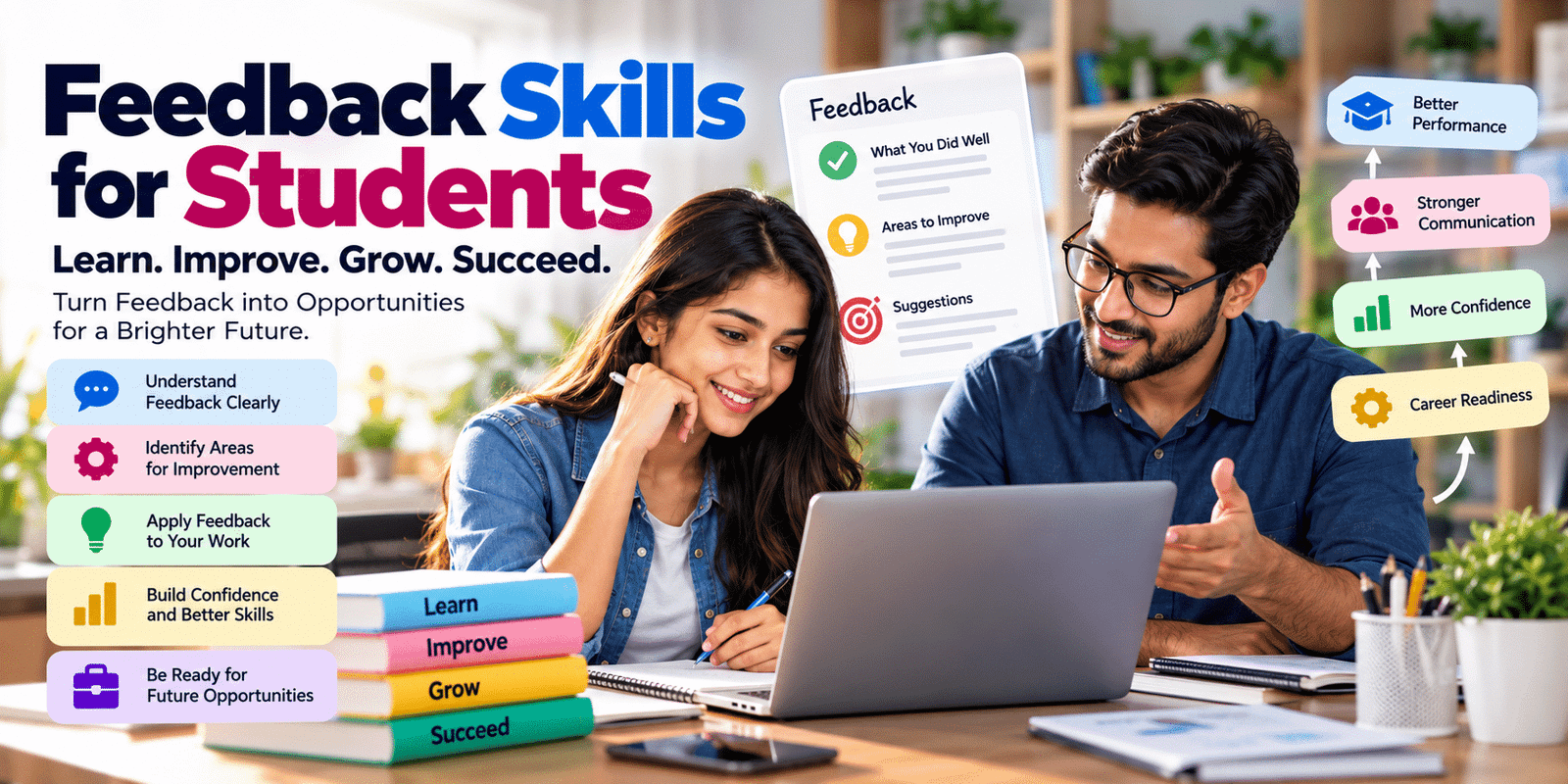
Feedback Skills for Students: Why They Matter Before Work
Feedback skills for students are essential for learning, personal development, and career growth. Students receive feedback from teachers, classmates, mentors, and project guides throughout their education. Learning how to accept feedback, understand it, and use it to improve is just as important as gaining knowledge.
Feedback skills for students help them recognize their strengths, identify areas for improvement, and develop the confidence to handle challenges. These skills also prepare students for professional environments where learning from mistakes and improving performance are essential.
In this article, we will explore why feedback matters, how students can respond to it effectively, and how they can develop this important skill before starting their careers.
1. Why Feedback Skills for Students Matter
Students often focus on completing assignments, earning good grades, and gaining technical knowledge. While these goals are important, personal improvement also depends on understanding what can be done better.
Feedback provides valuable information about a student’s performance. It can highlight mistakes, suggest better approaches, and reveal strengths that students may not recognize themselves.
Developing feedback skills for students encourages them to treat suggestions as opportunities to learn instead of viewing them as personal criticism. This mindset helps students become more confident, responsible, and prepared for future challenges.
2. What Is Feedback and Why Is It Important?
Feedback is information about someone’s work, behavior, performance, or progress. It may include appreciation for something done well, suggestions for improvement, or guidance on correcting mistakes.
For example, a teacher may explain how a student can improve an assignment, while a project mentor may recommend a clearer way to present an idea.
Feedback is important because it helps students understand the difference between their current performance and their desired results. Instead of repeating the same mistakes, they can make specific changes and track their progress.
Constructive feedback also helps students develop self-awareness, improve communication, and understand different perspectives.
3. Why Students Sometimes Struggle to Accept Feedback
Receiving feedback is not always comfortable. Students may feel disappointed when their work is criticized, especially when they have invested considerable time and effort into it.
Some students may interpret suggestions as a sign that they are not capable enough. Others may become defensive because they believe their original approach was correct.
These reactions are common, but they can prevent meaningful improvement.
Students should remember that feedback usually focuses on a particular task, decision, or behavior rather than their entire ability as a person. A mistake in an assignment does not mean someone cannot succeed. It simply identifies something that can be improved.
Learning to pause, listen, and understand the message before responding helps students handle feedback more productively.
4. The Difference Between Criticism and Constructive Feedback
Not every comment provides useful guidance. Understanding the difference between criticism and constructive feedback helps students decide how to respond.
Constructive feedback identifies a specific issue and provides suggestions for improvement. For example, a mentor might explain that a project presentation contains useful information but needs a clearer structure.
Unhelpful criticism may be vague, overly personal, or fail to explain what should change.
When receiving feedback, students can look for three things:
- Specific information: What exactly needs improvement?
- Useful guidance: What can be done differently?
- A clear objective: What outcome should the improvement achieve?
If feedback is unclear, students can politely ask for examples or suggestions. They should also use their judgment when evaluating comments and seek clarification when necessary.
5. How Feedback Helps Students Improve Their Skills
Feedback can help students improve both academic performance and practical abilities. It makes learning more focused by showing them which areas need attention.
For example, a student learning programming may receive feedback about code readability, problem-solving logic, or testing. Applying those suggestions can help the student write more maintainable code and understand programming concepts more deeply.
Similarly, students working on presentations can improve their organization, speaking pace, and ability to explain complex ideas.
Feedback is especially valuable when students apply it consistently. Instead of making a correction once and forgetting it, they can use the lesson in future assignments, projects, and collaborative activities.
6. How to Respond to Feedback Without Becoming Defensive
A thoughtful response to feedback begins with listening. Students do not need to agree with every suggestion immediately, but they should first understand what the other person is communicating.
Here are some practical steps:
Listen carefully. Avoid interrupting while the other person explains their observations.
Ask questions. If a suggestion is unclear, request a specific example or explanation.
Avoid reacting immediately. Take a moment to think before responding emotionally.
Identify the useful points. Consider which suggestions can help improve the result.
Thank the person. Acknowledge the time they spent reviewing your work, even when you need to evaluate their suggestions further.
For example, instead of saying, “I already did it correctly,” a student could respond, “Thank you for explaining that. Could you show me which part I should improve?”
This approach encourages productive conversations and demonstrates a willingness to learn.
7. How Students Can Apply Feedback to Projects and Assignments
Understanding feedback is only the first step. Students must also turn suggestions into practical actions.
After receiving feedback on an assignment or project, write down the main points. Separate them into areas such as content, technical accuracy, presentation, communication, and time management.
Next, decide which changes are most important and create a simple action plan.
For example, if a project mentor suggests improving the user interface, a student can identify the confusing screens, revise the layout, and ask for another review.
Students should also compare their revised work with the original feedback. This helps them determine whether the changes addressed the problem.
Keeping a record of feedback and improvements creates a useful learning history. It can also provide examples of personal growth during interviews or portfolio reviews.
8. Why Employers Value People Who Accept Feedback
In professional environments, employees regularly receive feedback from managers, teammates, clients, and mentors. They may need to revise reports, improve code, adjust communication, or change their approach to a task.
Employers value people who can listen to suggestions, learn quickly, and make meaningful improvements. These qualities support teamwork, adaptability, and continuous learning.
For freshers, demonstrating that they can respond positively to feedback can be particularly valuable. They may not have extensive professional experience, but they can show curiosity, accountability, and a willingness to develop their skills.
Students can explore our guide on skills recruiters look for in freshers to understand how learning ability and other professional qualities contribute to career readiness.
9. Common Mistakes Students Should Avoid When Receiving Feedback
Students can make better use of feedback by avoiding a few common mistakes.
Taking every suggestion personally: Focus on the work or behavior being discussed rather than treating feedback as a judgment of your worth.
Ignoring repeated advice: If different people identify the same problem, consider whether it needs more attention.
Accepting feedback without understanding it: Ask questions instead of making changes based on assumptions.
Making corrections without learning the reason: Understanding why a change is necessary helps prevent similar mistakes in the future.
Forgetting to follow up: After making improvements, ask whether the revised work meets the expected standard.
Rejecting every disagreement: Evaluate feedback fairly, even when it challenges your original ideas.
Avoiding these mistakes helps students become more independent learners and better collaborators.
10. Practical Ways to Develop Feedback Skills Before Graduation
Students do not need to wait until they start working to develop feedback skills. They can practice throughout their education.
- Request feedback regularly: Ask teachers, mentors, and classmates to review your work.
- Participate in group projects: Learn how to give and receive suggestions respectfully.
- Review mistakes: Identify what went wrong and what you can change next time.
- Practice self-evaluation: Compare your work against clear requirements before submitting it.
- Keep an improvement journal: Record feedback, actions taken, and lessons learned.
- Apply suggestions to future tasks: Demonstrate that you can use previous feedback to improve later results.
- Ask for clarification when necessary: Make sure you understand the expected outcome before changing your approach.
Students can also create a professional portfolio to document their projects, improvements, and achievements. Our guide on building a professional portfolio before graduation explains how students can present their work and demonstrate their development.
11. How Feedback Builds Confidence and Self-Awareness
Confidence does not come only from receiving praise. It also grows when students understand their weaknesses and learn how to address them.
Constructive feedback helps students recognize what they already do well and where they need more practice. Over time, they can see evidence of their improvement rather than relying only on grades or external validation.
Feedback also encourages self-awareness. Students begin to recognize patterns in their work, such as struggling with time management, overlooking details, or explaining ideas unclearly.
When students use this information to set realistic goals, they can approach new challenges with greater confidence and a clearer plan for improvement.
12. Frequently Asked Questions
What are feedback skills for students?
Feedback skills for students are the abilities needed to receive, understand, evaluate, and apply suggestions to improve academic performance, practical skills, communication, and personal development.
Why is feedback important for students?
Feedback helps students identify mistakes, understand their strengths, improve their work, and develop skills that support academic success and future employment.
How can students accept feedback positively?
Students can listen without interrupting, ask questions for clarification, avoid reacting emotionally, and focus on suggestions that can improve their performance.
How do feedback skills help students get jobs?
Employers value candidates who can learn from mistakes, adapt to suggestions, collaborate with teammates, and improve their work. These abilities help freshers adjust to professional expectations.
What should students do if they disagree with feedback?
Students should listen carefully, ask questions, and evaluate the reasoning behind the suggestion. They can respectfully explain their perspective and seek clarification before deciding how to proceed.
How often should students ask for feedback?
Students can request feedback after important assignments, presentations, group projects, and practical tasks. Regular feedback gives them more opportunities to identify and correct problems.
Final Thoughts
Feedback is not simply a way to identify mistakes. It is a practical tool for learning, improving performance, and preparing for professional responsibilities.
By developing feedback skills for students, learners can become more open to new ideas, more aware of their strengths and weaknesses, and better prepared to handle challenges.
The most important step is to put feedback into action. Listen carefully, ask questions, make improvements, and apply what you learn to future tasks. These habits can help students build confidence and develop the mindset needed for long-term career growth.
Start practicing today by asking someone you trust to review your work and identify one area you can improve.
Outbound links
National Careers Service ane text ki ee URL hyperlink ga add cheyyi: