
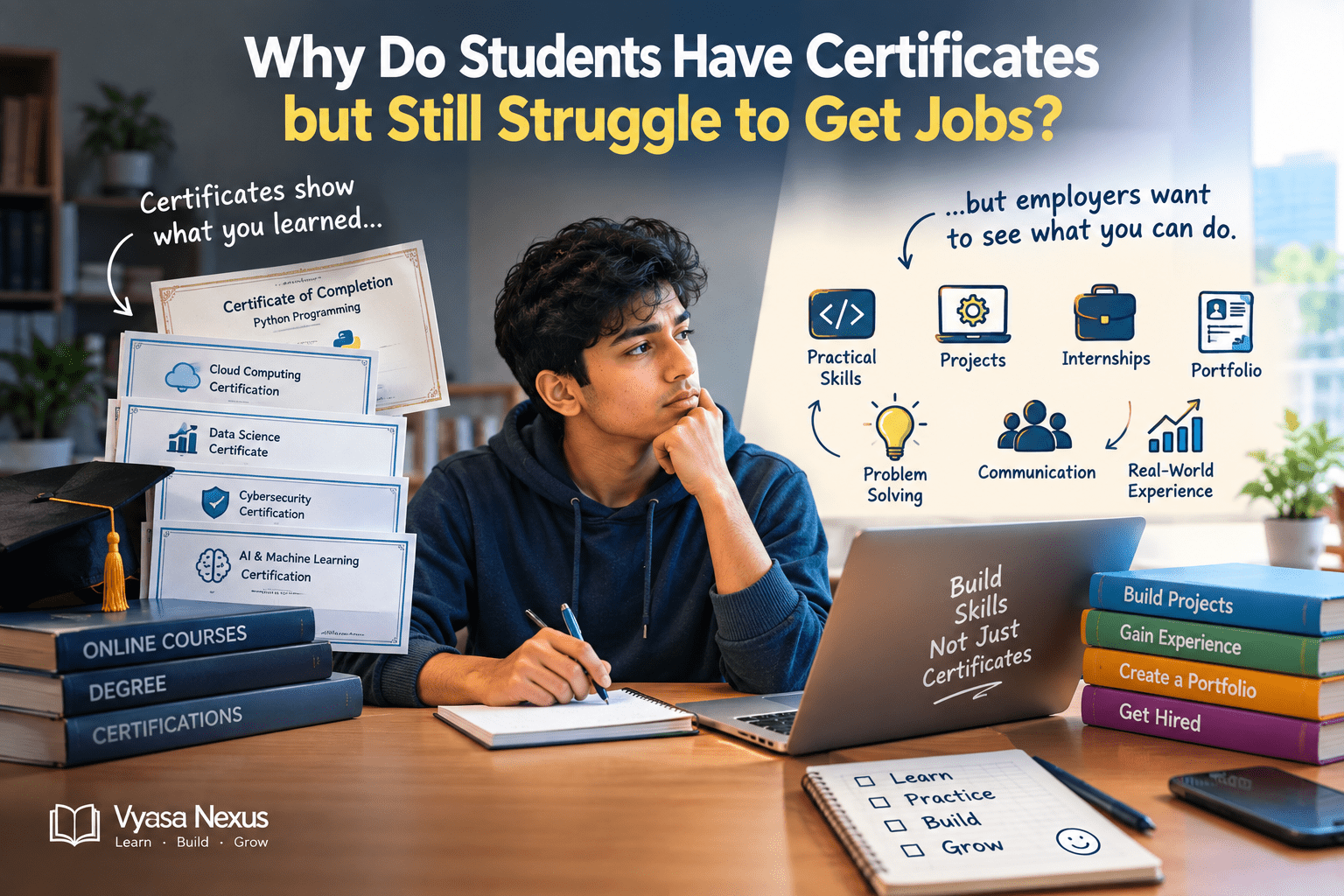
Students struggle to get jobs when their education does not clearly demonstrate practical ability. A degree or certificate can show that a student completed a course, but employers may also want evidence of skills, projects, experience, and problem-solving ability.
This is one of the biggest challenges facing students and fresh graduates today.
When students struggle to get jobs, collecting another certificate is not always the best next step. Building a real project, gaining practical experience, and documenting completed work can provide stronger evidence of job-ready skills.
“What have you actually built or worked on?”
That question explains the growing importance of skills, projects, internships, portfolios, and proof of work.
Certificates Are Useful, But They Are Not the Whole Story
Certificates are not worthless.
A good certification can demonstrate that a student has studied a subject, completed structured training, or passed an assessment. Some professional certifications are also important or required for particular careers.
The problem begins when students collect certificates without developing the ability to apply what they learned.
For example, a student might complete a Python course and receive a certificate. That is a useful starting point.
But another student might complete the same course and then build a simple expense tracker, contribute to an open-source project, automate a repetitive task, or create a small data analysis project.
The second student has something concrete to discuss.
The certificate shows learning.
The project shows application.
Both can matter.
The transition from education to employment is becoming more focused on what candidates can demonstrate.
The OECD’s recent analysis of skills-first hiring notes that work experience and university degrees remain important signals, but employers are also increasingly using practical assessments and other ways to evaluate skills. The World Economic Forum’s employer data cited by the OECD indicates that around 80% of surveyed employers expected to prioritize work experience when assessing skills for hiring between 2025 and 2030.
This does not mean degrees or certificates have disappeared.
Instead, it means students increasingly need to connect their qualifications with evidence of capability.
There are several common reasons students struggle.
1. They Collect Certificates Instead of Building Skills
Some students treat certificates as the final goal.
They complete one course after another but spend very little time practicing.
Learning a programming language, for example, requires more than watching lessons and passing quizzes. Students need to write code, debug errors, build projects, and understand why their solution works.
The same applies to cybersecurity, cloud computing, AI, data science, design, and other technical fields.
A certificate can confirm course completion.
Practice develops competence.
2. Their Resume Lists Skills Without Evidence
A resume might say:
- Python
- Java
- SQL
- AWS
- Machine Learning
- Cybersecurity
- Communication
- Leadership
But recruiters may want to know where those skills were actually used.
A stronger resume connects skills to evidence.
Instead of simply writing “Python”, a student could describe a Python project, explain the problem it solved, mention the technologies used, and describe the result.
Instead of saying “Machine Learning”, a student could show a project using a dataset, explain the model selected, and discuss what they learned from the results.
The difference is simple:
A skill is a claim. Evidence makes the claim more credible.
Indeed’s research on skills-first hiring similarly emphasizes the importance of being able to provide examples when claiming a skill.
3. They Do Not Have Enough Real-World Experience
Many students face a frustrating cycle:
When students struggle to get jobs, the solution is not always another qualification. Developing practical skills, gaining experience, creating a portfolio, and demonstrating proof of work can make a student’s capabilities much clearer.
Employers want experience → students need a job to gain experience → students cannot get the first job without experience.
Internships, freelance work, volunteering, open-source contributions, college projects, hackathons, research work, and personal projects can help break this cycle.
Not every project needs to come from a company.
A student who identifies a real problem and builds a useful solution can demonstrate initiative and practical ability.
The World Economic Forum reported in April 2026 that employers increasingly prioritize experience when assessing skills and that universities are responding by strengthening work-integrated learning.
4. Their Projects Are Too Generic
Having projects on a resume is helpful, but the quality and explanation of those projects matter.
A resume containing:
“Created a weather app.”
does not tell an employer very much.
A stronger project description explains:
- What problem did you solve?
- Which technologies did you use?
- What was your role?
- What challenges did you face?
- How did you test the solution?
- What did you improve?
- What did you learn?
Students should also be prepared to explain their projects without reading directly from their resumes.
If a recruiter asks, “Why did you choose this technology?”, the student should be able to answer.
That is where projects become useful during interviews.
5. They Depend Too Much on Academic Knowledge
Academic knowledge provides an important foundation.
But companies also need people who can apply knowledge in situations that may not look exactly like textbook problems.
A student may know the definition of an API, database, network protocol, or machine learning algorithm.
During an interview, however, they may be asked to troubleshoot a problem, design a solution, explain a trade-off, or work through an unfamiliar scenario.
This is why problem-solving matters.
Students need to move from:
“I know this concept.”
to:
“I can use this concept to solve a problem.”
6. They Underestimate Communication Skills
Technical ability is important, but technical candidates still need to communicate.
A student may build an excellent project but struggle to explain:
- What the project does
- Why it was created
- What their contribution was
- What went wrong
- How they solved problems
- What they would improve
Communication becomes particularly important during technical interviews and teamwork.
Skills-first hiring is not limited to technical abilities. Indeed’s research also highlights skills such as communication, adaptability, critical thinking, and project management as important workplace capabilities.
7. They Have Certificates but No Portfolio
A portfolio can bring together the evidence that a resume cannot fully communicate.
For a technology student, a portfolio might include:
- GitHub repositories
- Software projects
- AI experiments
- Cybersecurity labs
- Data analysis projects
- Technical articles
- Open-source contributions
- Hackathon projects
- Research work
For a design student, it might include visual projects.
For a marketing student, it could include campaigns, research, content, or analytics work.
The goal is not to create a portfolio filled with dozens of unfinished projects.
A few meaningful projects that a student can confidently explain can be more useful than a long list of certificates.
What Should Students Do Instead?
Students do not need to stop earning certificates.
They need to combine certificates with demonstrated skills.
A practical approach looks like this:
Learn
Take courses and develop foundational knowledge.
Practice
Use that knowledge regularly instead of stopping after completing a course.
Build
Create projects that solve real or realistic problems.
Document
Write down what you built, the tools you used, the problems you faced, and the results.
Share
Create a professional portfolio, GitHub profile, or other suitable platform where your work can be seen.
Explain
Prepare to discuss your decisions, challenges, mistakes, and results during interviews.
Improve
Use feedback to make your projects and skills stronger.
This creates a much clearer connection between learning and employability.
What Does Skills-First Hiring Mean for Students?
Skills-first hiring focuses more directly on whether a candidate has the capabilities needed for a role rather than relying only on traditional qualifications.
The OECD describes skills-first approaches as a way to broaden how employers assess talent, while noting that degrees and work experience still remain important signals in many hiring processes.
For students, this creates an important lesson:
Many students struggle to get jobs because their resumes list skills without showing where those skills were used. Building projects and documenting the work gives employers something concrete to evaluate.
Do not hide your skills inside a certificate list. Show them.
If you claim that you know Python, show a Python project.
If you claim that you understand cybersecurity, demonstrate your learning through safe labs, projects, or research.
If you claim that you understand AI, build something useful with AI and explain how it works.
If you claim that you have communication skills, demonstrate them through presentations, articles, teamwork, or other experiences.
The Future of Student Employability
The traditional path of:
Degree → Certificate → Job
is becoming less straightforward.
A stronger approach is:
Education → Skills → Practice → Projects → Experience → Proof of Work → Job Opportunities
This does not mean every student needs years of professional experience before graduation.
It means students should start creating evidence of their abilities before they need to convince an employer.
The job market is also moving toward more skills-based approaches. Indeed’s 2025 research in India found that 42% of surveyed jobseekers were unsure how to showcase their skills, highlighting a gap between having skills and communicating them effectively to employers.
That distinction matters.
Having a skill is one challenge.
Showing that skill is another.
Final Takeaway
Students do not necessarily struggle to get jobs because they have too few certificates.
Sometimes, the bigger problem is that their certificates do not clearly demonstrate what they can do.
Certificates can show that you learned something.
Projects can show that you applied it.
Internships can show that you worked in a professional environment.
Portfolios can show your body of work.
And strong interview answers can show that you understand what you built.
Students should therefore think beyond collecting qualifications.
The better question is not:
“How many certificates do I have?”
It is:
“What can I show an employer that proves what I can do?”
That shift—from collecting credentials to building and demonstrating capability—can help students prepare more effectively for a skills-focused job market.
Frequently Asked Questions
Yes. Certificates can demonstrate learning and may be valuable for certain roles. However, their impact depends on the field, employer, certification, and how well the student can demonstrate practical skills alongside the qualification.
Completing courses does not automatically create practical experience. Students may still need projects, internships, problem-solving practice, communication skills, and evidence of their abilities.
Are projects more important than certificates?
They serve different purposes. Certificates can demonstrate structured learning, while projects can demonstrate application. For many roles, having both can provide a stronger picture of a candidate’s capabilities.
What should students put on a resume besides certificates?
Students can include relevant projects, internships, work experience, open-source contributions, achievements, technical skills, research, competitions, and measurable results.
How can freshers gain experience without having a job?
Students can build personal projects, participate in internships, contribute to open source, work on college projects, join hackathons, volunteer for relevant work, freelance where appropriate, or create solutions to real-world problems.
What is proof of work?
Proof of work is tangible evidence that demonstrates what someone can actually create, solve, or accomplish. For students, this can include projects, portfolios, GitHub repositories, research, writing, or other relevant work samples.
Outbound links
According to the OECD’s research on skills-first hiring, employers can use skills information and practical assessment alongside traditional qualifications when evaluating candidates
The World Economic Forum’s research on entry-level employment also highlights the importance of connecting education with workplace experience.
Internal links
When discussing portfolios:
Professional Portfolio for Students
When discussing proof of ability:
When discussing experience:
When discussing internships:
Internships for College Students
When discussing interviews: