
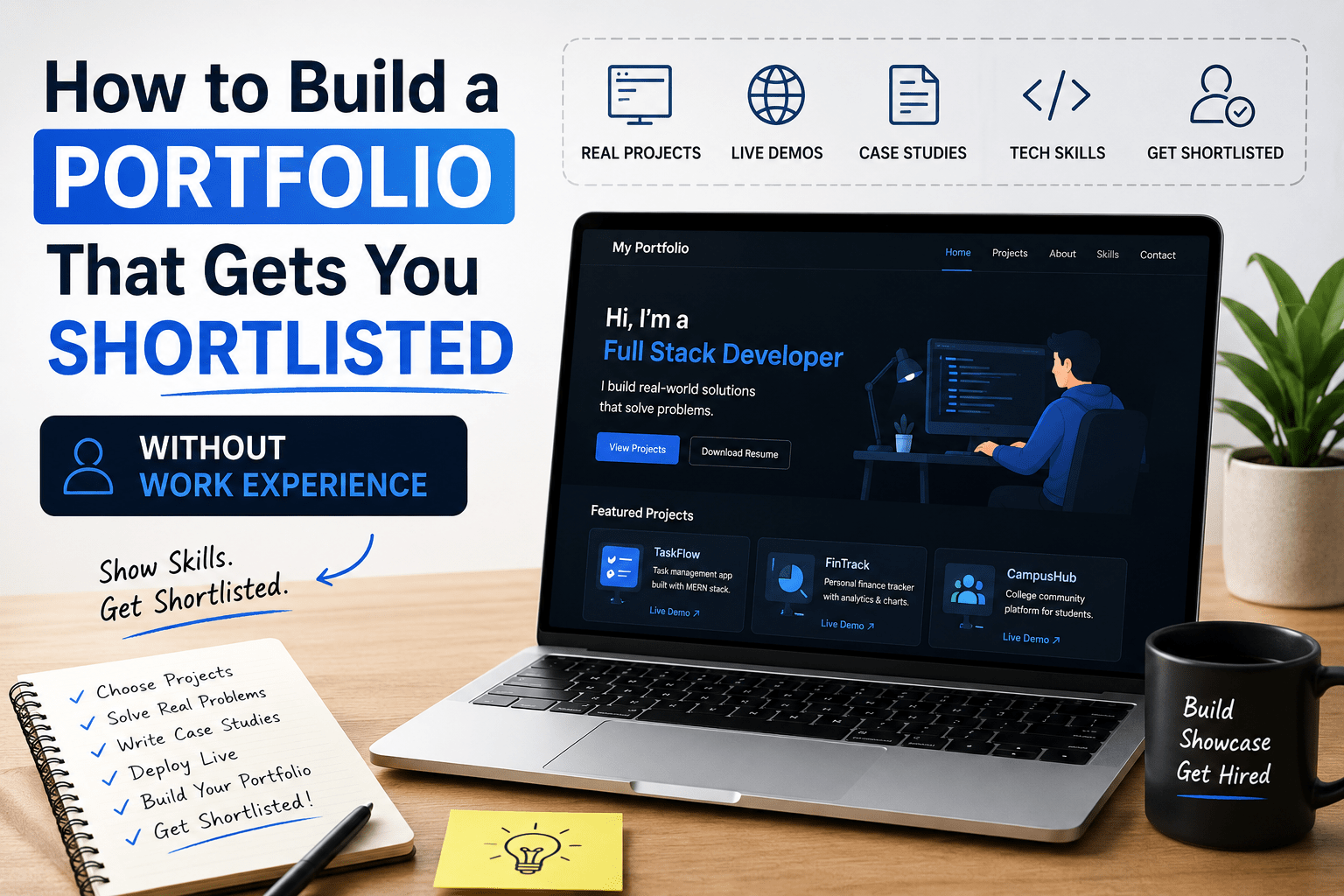
“Minimum 1 year experience required” — if you’ve applied to entry-level jobs, you’ve seen this line and wondered how you’re supposed to get experience before you’re even hired. The answer is a strong portfolio. Recruiters don’t just hire based on resumes anymore; they hire based on proof of ability. A well-built portfolio is that proof, even if you’ve never had a job.
Here’s exactly how to build one that gets you shortlisted, step by step.
Why a Portfolio Matters More Than a Resume for Freshers
A resume tells a recruiter what you claim to know. A portfolio shows it. For freshers with no professional experience, a portfolio is often the single biggest differentiator between getting shortlisted and getting filtered out by an ATS (Applicant Tracking System) or a bored recruiter skimming 200 resumes.
Step 1: Pick 3 Strong Projects Over 10 Weak Ones
Quality beats quantity every time. A portfolio with 10 tutorial-clone projects (“Netflix clone,” “Todo app”) signals that you followed instructions. A portfolio with 3 well-thought-out projects signals that you can solve real problems.
What makes a project “strong”:
- It solves an actual problem (yours, your college’s, or a real-world use case)
- It has a working, deployed link — not just code sitting in a repo
- You can explain every technical decision you made in it
Step 2: Choose Projects That Demonstrate Range
Instead of building three versions of the same type of app, aim for range across your portfolio:
- One full-stack project — shows you can handle frontend, backend, and a database end-to-end
- One project solving a niche/real problem — e.g., an attendance tracker for your college club, a budgeting tool, a local business finder
- One project showing depth in a specific skill — e.g., a project with authentication, real-time features (WebSockets), or a well-designed REST API
Step 3: Write Case-Study Style Descriptions, Not Just a README
Most freshers write a one-line project description. Recruiters skim past this. Instead, structure each project like a mini case study:
- The problem — what gap or need this project addresses
- Your approach — the tech stack and why you chose it
- A specific challenge — one real technical obstacle you hit and how you solved it
- The outcome — what the project does, with a link and screenshots/GIFs
This structure does the recruiter’s thinking for them and makes you memorable.
Step 4: Make It Easy to Verify — Deploy Everything
A GitHub repo with no live link asks the recruiter to do extra work (clone it, install dependencies, run it) — and most won’t bother. Always deploy your projects using free platforms like Vercel, Netlify, or Render, and link the live version prominently.
Step 5: Build a Simple, Clean Portfolio Website
You don’t need a fancy design — you need clarity. A good fresher portfolio website includes:
- A short intro (who you are, what you’re learning/building)
- 3 featured projects with case-study descriptions and live links
- A skills section (be honest — don’t list technologies you can’t explain)
- A resume download link
- Contact info and links to GitHub/LinkedIn
Keep the design simple and fast-loading. Recruiters spend an average of under a minute on a portfolio — clarity beats decoration.
Step 6: Fill the “No Experience” Gap with Real-World Simulation
If you genuinely have zero project experience, the fastest way to close that gap isn’t more tutorials — it’s working on problems modeled after real industry scenarios. This is exactly why structured programs exist: to give you project experience that mirrors what companies actually build, rather than isolated coding exercises.
Vyasa Nexus’s Industry Project Packs and internship-linked certification tracks are designed specifically for this — giving you portfolio-ready, real-world projects plus a certification and a 1-month internship at Enigma Metaverse to back it up.
Step 7: Keep It Updated and Linked Everywhere
A portfolio only works if recruiters see it. Add the link to:
- Your resume header
- Your LinkedIn “Featured” section
- Your GitHub profile README
- Every job application you submit
Update it every time you complete a meaningful project — a portfolio that hasn’t changed in six months signals stagnation.
Common Portfolio Mistakes to Avoid
- Too many low-effort clone projects instead of a few original ones
- No live/deployed links — code-only repos get skipped
- No explanation of your role or challenges — just a tech stack list
- Cluttered or slow-loading design that distracts from the work
- Never updating it after the first version
Final Thoughts
You don’t need work experience to build a portfolio that gets you shortlisted — you need evidence of real, well-explained problem-solving. Three strong, well-documented, deployed projects will consistently outperform a resume full of claims with nothing to back them up.
If you want guided, real-world projects and mentorship to build that portfolio faster, explore Vyasa Nexus’s Career Acceleration Kits to go from student to shortlist-ready.
Frequently Asked Questions
Q: How many projects should a fresher have in their portfolio? A: 3 strong, well-documented, and deployed projects are generally more effective than 10 shallow ones. Focus on quality and clear explanations over quantity.
Q: Do portfolio projects need to be original ideas? A: Not necessarily, but they should solve a real or specific problem and go beyond a basic tutorial clone. Adding your own twist, feature, or real-world use case makes a huge difference.
Q: What should I include in a portfolio if I have no internship experience? A: Include personal or academic projects with detailed case-study style write-ups, live deployed links, and clear explanations of your role and challenges. Structured project-based programs can also help fill this gap credibly.